

Italy Aviation Strike to Disrupt Flights Feb 16, 2026
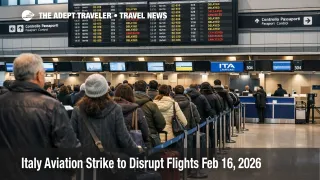
A nationwide air transport strike is set to affect flights to, from, and within Italy on Monday, February 16, 2026, with airport operators and strike calendars warning that scheduled services may be delayed or cancelled. Travelers are most exposed when the disruption hits both airline operations and airport ground handling on the same day, because even flights that operate can suffer slow check in, delayed baggage delivery, and longer aircraft turnaround times. The practical move is to treat February 16 as a high risk day, add buffer on both ends of your trip, and avoid tight same day connections or positioning plans that cannot survive a roll to the next day.
The Italy aviation strike Feb 16 disruption matters because a 24 hour stoppage can remove flight options across multiple banks, which forces rebooking into fewer seats and increases misconnect risk across long haul networks.
Who Is Affected
The most affected travelers are those flying through Italy's major hubs, including Leonardo da Vinci International Airport (FCO), Milan Malpensa Airport (MXP), Milan Linate Airport (LIN), Venice Marco Polo Airport (VCE), Naples International Airport (NAP), and Bologna Guglielmo Marconi Airport (BLQ). After the first wave of cancellations, the next problem is operational drag, long queues at the remaining open counters, slower security feed, and late arriving aircraft that disrupt the rest of the day's schedule even outside the original strike footprint.
Travelers connecting onward to long haul routes, or connecting from long haul arrivals into domestic and Schengen flights, carry higher misconnect risk because a single delay can break the legal and practical timing of minimum connection windows. Separate ticket itineraries are especially vulnerable, because a missed connection can become a new purchase at walk up fares if the original carriers do not treat the itinerary as a protected connection.
Cruise passengers and tour travelers should treat the strike as a positioning risk, not just an airport day problem. Civitavecchia sailings are sensitive to late arrivals into Rome area airports, and Venice area cruise departures are sensitive to delays into Venice Marco Polo, plus ground handling and baggage backlogs that slow the last mile transfer. Timed entry sightseeing plans, rail connections, and pre booked transfers can also collapse when arrival times shift late in the day.
What Travelers Should Do
If you are traveling on February 16, build immediate operational buffer. Arrive earlier than normal, keep carry on essentials for a forced overnight, and assume baggage delivery could be delayed even if your flight operates. Check your airline app, the airport departure board, and any email or SMS notices in parallel, because updates can post unevenly during disruption days.
Use a clear decision threshold for rebooking versus waiting. If a cancellation would cause you to miss a cruise embarkation, a protected connection, a major event, or a prepaid plan you cannot move, rebook now to February 15 or February 17, even if the routing is less direct. If you can tolerate arriving a day late, waiting can be rational, but only if you have identified realistic alternatives that still have seats and do not rely on a tight same day chain.
Over the next 24 to 72 hours, monitor three signals. First, whether your flight is scheduled inside the protected flight windows, which are generally designed to keep limited service operating during a strike day. Second, whether your specific airport is showing signs of handling constraints, including check in counter consolidation and baggage belt delays, because those create second order effects well after a flight is declared "on time." Third, whether your airline has posted a waiver for no fee changes, which can be the fastest way to move off the riskiest day without paying a fare jump.
For related Italy network disruption context during the Olympics demand peak, see Italy Rail Sabotage Hits Bologna Trains Olympics Week.
How It Works
Italy's strike framework for air transport typically includes protected time bands, published by the civil aviation authority, that require certain flights to operate during specific hours even when industrial action is active. For travelers, that often means early morning and early evening departures have a better chance of operating than mid day banks, but it is not a guarantee of smooth service, because ground staffing, gate operations, and baggage systems can still be constrained.
This is how the disruption propagates through the travel system. The first order effect is fewer operating flights and slower airport processing at the source, which creates longer lines, slower aircraft turns, and delayed baggage delivery. The second order ripples spread into at least two other layers. Connections break across alliance networks when inbound flights arrive late and outbound flights do not wait, and crews and aircraft get displaced when rotations cannot be completed on schedule. That can reduce capacity on the following day as well, because aircraft and crews may be out of position, and rebooked passengers concentrate demand into the same limited inventory. The onward impacts show up in hotels near airports, cruise embarkation timing failures, and a spike in last minute ground transfers as travelers scramble for alternate routes.