

ORD Admirals Club Expansion Planned for Concourse L
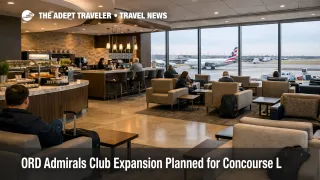
American Airlines says it is replacing its current Admirals Club in Concourse L at Chicago O'Hare International Airport (ORD) with a larger, upgraded lounge in the same concourse. The carrier announced the plan on February 10, 2026, and said construction is already underway, while the existing Concourse L club stays open during the build. For travelers, the practical change is that American is signaling more space and a more modern lounge layout at one of the Midwest's biggest connection points, but with the near term reality that peak time crowding can still happen until the new space opens.
American's newsroom release says the new lounge will be more than 10,000 square feet and will incorporate "neighborhoods," meaning distinct zones designed for different needs, rather than one uniform seating room. American has used that concept in other newer clubs, typically separating quieter seating, food and beverage, work oriented areas, and refresh amenities. At ORD, American also says to expect local Chicago design elements plus airside views through floor to ceiling windows overlooking the runway, which matters because daylight, sightlines, and separation from gate noise are often what determine whether a lounge feels usable during a tight connection.
Who Is Affected
The highest value group is travelers flying American through Chicago O'Hare who regularly connect in Terminal 3 and use Concourse L gates, especially those trying to turn a short layover into reliable time for a meal, a call, or quiet work. Lounge upgrades are not just cosmetic for frequent flyers, they are capacity decisions, because a larger room can absorb more eligible guests and reduce the spillover effect where travelers give up and crowd gate areas instead.
This also affects travelers deciding whether to pay for access, including those weighing an Admirals Club membership, eligible oneworld status benefits, a qualifying credit card, or a day pass. American's press release reiterated common access paths and pricing, which is a useful reminder that lounge entry is often the most constrained precisely when irregular operations spike and more passengers seek shelter at once. If you are traveling as a family, note that neighborhood style lounges sometimes add more family friendly seating patterns, but until American confirms the exact amenity mix for ORD, you should assume the experience remains oriented to mixed business and leisure travelers and plan accordingly.
Finally, this announcement lands in a moment when many travelers are already scrutinizing American's reliability and premium promises across its network. If you want related context on why operational resilience still matters more than any single amenity during winter and shoulder season travel, see American Airlines Pilot Union Talks Raise Delay Risk and American Airlines No Confidence Vote Raises Flight Risk.
What Travelers Should Do
If you expect to use the Concourse L lounge on an upcoming trip, treat the current club as the operational baseline until American publishes an opening timeframe for the new space. Build a buffer so you are not depending on last minute lounge entry for essentials, for example eating a full meal, taking a work call that cannot move, or resetting a child before boarding. In practice, that means arriving at the lounge earlier than you think you need to, and keeping a Terminal 3 food fallback in mind if the lounge hits capacity.
Use a clear decision threshold for whether lounge time is worth it on a connection day. If your layover is short enough that a single line, a crowded elevator, or a slow boarding process would put you at risk of missing the flight, prioritize getting to the gate area first and only returning to the lounge if your boarding time window is comfortable. Rebooking and same day standby dynamics can also compress boarding timelines, so the days when you want the lounge most are often the days when you should not drift too far from the gate.
Over the next 24 to 72 hours before you travel, monitor three practical signals: gate assignment patterns for your flight in Terminal 3, any American customer alerts about construction wayfinding near Concourse L, and whether your itinerary has tight connections that could be stressed by routine terminal congestion. If you are choosing flights for spring travel, consider building in a bit more layover time through ORD than you usually would, because the value of an upgraded lounge is highest when you actually have time to use it.
Background
An airport lounge expansion sounds simple, but it propagates through the travel system in predictable ways. The first order layer is capacity and flow, a larger lounge can pull more eligible travelers out of gate holdrooms, which reduces perceived crowding and can make boarding zones feel less chaotic during banked departures. During disruption, lounges also become pressure valves, because travelers who are rebooking, waiting for crew legality resets, or dealing with rolling delays tend to cluster anywhere with power, seating, food, and staff, and that clustering otherwise lands at gates and customer service queues.
The second order ripple shows up across connections and the premium product race at hubs. If American can better absorb premium eligible travelers at Chicago O'Hare, that supports its attempt to sell higher fare products and keep frequent flyers from defecting to competing hubs, which then influences schedule planning and aircraft allocation over time. It also intersects with broader capacity constraints across the industry, where seat supply and aircraft delivery timelines can change how crowded peak day flying becomes, even when demand is steady. For a deeper evergreen explainer on why constrained aircraft supply can tighten peak travel conditions across carriers and hubs, see FAA Delays on Boeing 737 MAX 10 Hit Airline Capacity.
American positioned the ORD lounge project as part of a broader Chicago investment narrative, citing more than 500 daily flights and spring break peak departures, plus recent network growth. The traveler takeaway is not that a lounge fixes connection pain, but that at a hub this large, small improvements to space, seating, and amenities can meaningfully improve the odds that a layover feels controlled rather than cramped, especially when multiple banks of flights overlap.