

OUIGO Madrid to Seville Trains Canceled Through Feb 13
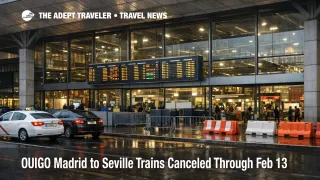
OUIGO passengers headed to Andalusia are dealing with a separate, operator level disruption that can still break trips even as Spain's broader strike pressure eases. The South high speed corridor linking Madrid with Seville and Málaga has remained constrained while infrastructure repairs continue after the Adamuz crash, and reopening timing has been sensitive to weather and ongoing works. If you are traveling February 12 or February 13, you should plan as if your original rail plan may not operate, and you should set early decision cutoffs for swapping to another operator, switching to a flight, or adding an overnight buffer.
One hard limitation: OUIGO has not provided a single, publicly accessible consolidated list of South corridor train numbers for February 9 through February 13 that can be independently verified in a static web posting the way some strike day notices are posted. In practice, travelers are learning their exact impact through booking specific notifications, station boards, and operator customer service channels. That matters because it means you should treat any secondhand train list as potentially incomplete, and instead confirm status directly against your booking reference before you travel.
Who Is Affected
The highest risk group is anyone booked on OUIGO itineraries that depend on the Madrid to Seville and Madrid to Málaga high speed spine, including travelers chaining connections through Córdoba. Even when another operator has seats, the forced swap problem is that same day inventory can be thin, and the remaining seats can be more expensive than typical, especially close to departure.
The next risk layer is travelers using rail as a timed connector into the broader travel system. When South corridor trains are canceled or pushed later, the failures ripple into airport check in windows, same day long distance rail connections, and cruise and tour cutoffs. Rail disruption also compresses arrivals into fewer trains, which increases station crowding and makes last mile transport less predictable in Seville and Málaga.
A third group is travelers trying to treat the wider strike story as "over" and rebook back into rail at the last minute. Even if labor action is de escalating, the corridor outage and repair cycle can remain the binding constraint, which is why this OUIGO specific risk can persist independently of strike headlines. For broader context on the recovery day dynamics, see Spain Rail Strike Recovery Leaves Trains Uneven Feb 10.
What Travelers Should Do
If you are traveling within 24 hours, prioritize certainty over convenience. Check your OUIGO booking status in the OUIGO app or site using your reservation reference, then cross check with station departure boards when you arrive, because corridor level statements do not guarantee your individual train is running. If your booking is canceled, initiate the refund or exchange flow immediately, because the best alternate inventory tends to disappear first in disrupted corridors.
Use consequence based decision thresholds instead of hoping for a same day fix. If arriving late would cause a missed flight on a separate ticket, a missed cruise embarkation, or a non refundable tour pickup, do not wait for the corridor to stabilize, switch to an earlier departure on another operator, switch to a flight, or add an overnight in Madrid, Seville, or Málaga so you protect the downstream commitment. If your only consequence is arriving later to a flexible hotel check in, waiting for a reissued rail option can be rational, but only if you are not chaining additional timed legs.
Over the next 24 to 72 hours, watch three signals that actually change outcomes. First, Adif repair and reopening guidance reported by authoritative outlets, because corridor reopening assumptions have shifted with weather. Second, operator specific notices tied to your booking, because they tend to reflect dispatch reality faster than general news. Third, mode substitution pressure, if flights and rental cars are selling fast, it is a warning that rail capacity is not absorbing displaced demand, and you should lock a plan early rather than later. If your Andalusia plan also touches southern road corridors affected by severe weather, review Storm Marta Strait Ferries, Andalusia Roads Still Shut before committing to a long drive.
Background
This disruption is rooted in a corridor level infrastructure outage that has kept high speed rail between Madrid and Andalusia constrained since the Adamuz crash, with repairs and restoration work affected by conditions on the ground. Reporting has described operators anticipating a reopening around February 14, 2026, while Adif has cautioned that weather and remaining tasks can shift the exact timing. That uncertainty is what makes February 12 and February 13 particularly fragile for travelers who need a guaranteed arrival time.
The travel system effects propagate in layers. First order, fewer trains actually run on the South corridor, so passengers are stranded on fixed departure times, and they are forced into swaps that may not exist at the same hour or price. Second order, the displaced demand spills into other layers, including AVE, Avlo, and iryo availability, short haul air capacity, and hotel demand near the largest nodes when travelers choose to overnight rather than risk a failed same day transfer. Even when rail resumes, restart surges can keep stations crowded, and keep rebooking lines long, which is how a corridor repair story becomes a multi day traveler reliability problem.
Sources
- Servicios mínimos huelga del sector ferroviario
- Lío en el corredor Madrid-Andalucía: Ouigo, Iryo y Renfe ya venden billetes pero Adif no confirma fecha de reapertura
- Adif trabaja para abrir el sábado el corredor Madrid-Andalucía, según evolución de lluvias
- Spanish train drivers call three-day strike after deadly derailments
- Renfe establece un plan alternativo de transporte por la suspensión del servicio de alta velocidad entre Madrid y Andalucía