

Spain Rail Strike Recovery Leaves Trains Uneven Feb 10
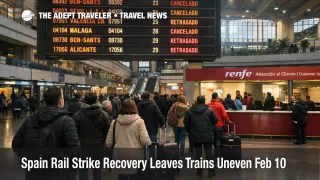
Spain's national rail strike threat eased after the main unions suspended the remaining February 10 and February 11, 2026 stoppages, but February 10 is still shaping up as a recovery day rather than a clean return to normal. The practical issue for travelers is that smaller unions outside the agreement said they would continue action, and rail operations do not instantly snap back once timetables, crews, and trainsets have already been reshuffled. If you are traveling today, the next step is simple, verify your exact train number in the official operator channel, then decide whether you can tolerate a late arrival, or whether you need to switch modes.
The Spain rail strike recovery matters because the travel system already absorbed disruption on February 9, 2026, and that creates lag. Some trains were removed from sale, crews were re assigned to meet staffing constraints, and stations operated under strike procedures. Even when most services resume, specific corridors can stay exposed to short notice cancellations, slower turnarounds, and crowding as stranded demand compresses into fewer departures.
For background on what changed when the deal was first reported, see Spain Rail Strike Called Off, Feb 9 to 11 Train Plans.
Who Is Affected
Long distance passengers are the first group to feel uneven recovery because reserved seat services tend to run in tightly choreographed sequences across the day. When a strike is threatened, operators pre cancel selected departures, publish amended schedules, and reposition trainsets to protect the minimum service pattern and avoid stranded equipment. When the strike is partially called off, the railway then has to rebuild the planned diagram while some crews and trains are still out of position, and while customer service channels are overloaded with exchanges and refunds.
Private operator travelers should be especially cautious on February 10 and February 11, 2026. Reporting in Spain indicates minority unions continuing action can concentrate disruption on specific operators and specific high speed paths, which creates a simple failure mode for travelers, a corridor can look normal in general coverage while your individual departure is not. If you are booked on Madrid to Barcelona, Madrid to Valencia, Madrid to Seville, Madrid to Malaga, or other high demand routes, the risk is less about total shutdown and more about one or two missing trains that force a same day replan.
Commuter and regional riders are the second risk layer, and they often cause the most expensive misses. You can hold a confirmed long distance ticket and still fail the day if the feeder network runs with wider headways, or if crowding slows station entry and boarding. This is particularly relevant around Barcelona, where Rodalies updates can lag real world conditions when a disruption day transitions into a recovery day.
High stakes connection travelers are the third group, rail to air, rail to cruise, and rail to timed tours. A partial normalization day is notorious for breaking tight plans because the whole system is more variable. Station queues, platform changes, and customer service lines do not look like a normal Tuesday, and that is what turns a modest delay into a missed flight, a missed embarkation cutoff, or a forfeited ticketed attraction.
What Travelers Should Do
Treat February 10, 2026 as a verification and buffer day. Confirm your exact train number and departure time in the operator app or website, and then cross check against station boards when you arrive. Build extra time for station entry, boarding, and last mile transfers, especially at Madrid Puerta de Atocha and Barcelona Sants, where crowding and rebooking flows can spike even when trains are running.
Use consequence based decision thresholds. If arriving late would cause a missed flight on a separate ticket, a missed cruise embarkation, or a lost timed tour pickup, do not wait for the situation to stabilize in real time. Move to an earlier departure, switch to a flight, or shift to long distance bus, or a same day car hire, as soon as you see your train marked canceled, significantly delayed, or repeatedly re timed. If your only consequence is arriving later to a flexible hotel check in, it can be rational to wait for the operator reissue flow, but only if you are not chaining multiple legs where one break collapses the day.
Over the next 24 to 72 hours, watch for three signals that change outcomes. First, operator notices that explicitly say service has returned to normal by corridor, which is more meaningful than a general statement that the strike is called off. Second, push notifications tied to your booking, because they usually reflect real dispatch decisions faster than news coverage. Third, station operations signals, staffing at gates, platform churn, and visible crowding, because these are the early indicators that a recovery day is behaving like a disruption day.
Background
Rail strikes and strike stand downs propagate through the travel system in layers. The first order effect is at the source, rosters, dispatch, and minimum service compliance alter the timetable, removing capacity and forcing passengers into fewer trains. When the main strike is called off after timetables were already amended, the system still has to rebuild the original pattern while crews and trainsets are out of position and while customer service channels are congested with changes.
The second order ripple hits connections and lodging. When long distance departures are thinned out, passengers arrive in pulses, platforms change more often, and missed connections climb. Those misses then create unplanned hotel nights in the biggest hubs, and they also push demand into flights, buses, and road transfers, raising prices and reducing same day inventory. On the rebound, travelers who pivoted away from rail often try to pivot back once the headline risk appears lower, which can tighten seat availability and keep stations crowded precisely when travelers expect relief.
Sources
- Rail workers' unions end strike after Spain agrees to new safety measures
- La huelga del ferrocarril sigue con coletazos por la protesta de los tres sindicatos minoritarios
- Huelga de maquinistas de febrero: fechas, trenes afectados y servicios mínimos
- Spanish unions call off strike after achieving all demands
- Afectaciones programadas, Rodalies de Catalunya