

Tirana Protest Roadblocks Disrupt City Transfers
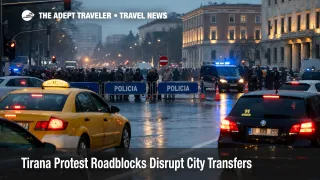
Large anti government protests in Tirana, Albania, escalated into violent clashes on February 10, 2026, shifting the situation from routine demonstrations into a practical mobility and safety constraint for travelers moving through the city center. Visitors are most affected if they need to cross central boulevards to reach hotels, museums, meeting points, or night departures from Tirana International Airport Nënë Tereza (TIA). The high level move is to avoid the central demonstration corridor, shift taxi and rideshare pickups to the edge of the center, and add meaningful buffer time for any time sensitive transfer.
The Tirana protest roadblocks transfers risk is higher than a typical march because clashes and crowd control can trigger stop start closures that do not show clearly in navigation apps until after traffic has already stalled.
Who Is Affected
Travelers staying in or transiting through the city core are the most exposed, particularly those whose hotel is near government buildings, major squares, or the main boulevard that often hosts marches and police perimeters. U.S. Embassy guidance for the February 10 demonstration flagged Dëshmorët e Kombit Boulevard between Skanderbeg Square and Mother Teresa Square, with the Prime Minister's building identified as a focal point, and warned that protesters might block intersections across the city center.
Departing flyers are the next highest risk group. Even if the airport road itself is open, the failure point is frequently the urban approach, where detours compress traffic onto fewer usable arterials, and where drivers may refuse pickups inside the closure ring or cancel when they cannot reach the pin. That is how a city center protest becomes an airport problem, it shortens the margin for bag drop cutoffs, security time, and boarding. The same dynamic can also break day tours and timed entries, because tour operators cannot reliably reposition vehicles through controlled intersections, and because guests arrive late or miss meeting points when sidewalks and streets are partially closed.
Travelers on separate tickets, last flights of the night, or fixed date commitments are especially vulnerable because a missed departure can force expensive next day rebooking, overnight stays, and lost prepaid activities. This is also a real planning issue for families and groups, because one delayed vehicle pickup can strand multiple people who then need scarce last minute transport at the same time that demand surges.
What Travelers Should Do
Take immediate actions that preserve options. If you have to move across central Tirana, choose a route and pickup point that stays outside the likely perimeter zone, even if it means a short walk at the start. A practical approach is to meet your driver one or two blocks beyond the boulevard corridor rather than expecting curb access at government buildings, major squares, or prominent frontage roads where police can close lanes quickly.
Use a decision threshold for rebooking versus waiting. If your airport transfer has not started moving after a sustained period, or your driver indicates they cannot reach the pickup because of closures, treat that as an early trigger to switch plans instead of hoping conditions clear. For flights, the meaningful deadline is not takeoff, it is when your airline closes bag acceptance and when boarding begins. If you are inside a tight window, it is usually rational to leave earlier, change to a later flight while seats still exist, or reposition to a hotel closer to the airport rather than gambling on a last minute dash.
Over the next 24 to 72 hours, monitor the signals that predict whether closures will recur or widen. Watch for U.S. Embassy security alerts and similar consular updates, and track credible local reporting for announced protest times and areas, because repeat demonstrations can re create the same congestion pattern at roughly the same hours. For context on how fast road access disruptions can break airport timing even when flights operate, see LAX Protest Blocks Airport Access Roads Nov 25, 2025. For another recent example of how crowd control perimeters ripple into station access, hotel check ins, and missed departures, see Milan Olympics Protest Roadblocks Near Venues, Stations.
How It Works
City protests disrupt travel in a specific way that is easy to underestimate. The first order effect is police establishing perimeters, closing lanes, and redirecting traffic, which concentrates vehicles onto fewer arterials while also increasing driver caution and cancellation rates near the affected blocks. In the Tirana case, official U.S. Embassy guidance highlighted a central boulevard corridor between Skanderbeg Square and Mother Teresa Square and noted the possibility of intersection blockages across the city center, conditions that can produce abrupt, uneven delays rather than a single clearly closed street.
The second order ripple shows up in the travel system layers that depend on predictable arrival times. Airport operations may remain normal while the access network becomes unreliable, which raises misconnect risk, especially for passengers with checked bags, international itineraries, or separate tickets. When passengers miss flights, airlines fill remaining seats on later departures, pushing more travelers into overnight stays and tightening hotel availability near the airport and major corridors, even though the original problem began downtown.
A third layer hits tours and hospitality logistics. Group movements depend on vehicles reaching agreed meeting points, and even short lived perimeters can cause a long tail of late arrivals, missed tours, and front desk surges as guests seek last minute help rerouting. UK government travel guidance for Albania also notes that demonstrations in central Tirana can cause traffic diversions and disruption, which is the baseline risk profile that becomes more consequential when protests turn violent and crowd control intensifies.