

Bharat Bandh India Transport Disruption Feb 12, 2026
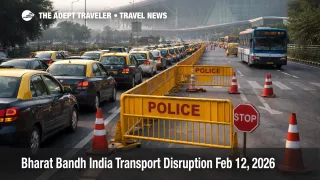
A nationwide Bharat Bandh action is expected to disrupt transport and city movement across India on Thursday, February 12, 2026. A joint forum of central trade unions, backed by farmer groups including Samyukt Kisan Morcha, has framed the shutdown around opposition to the labor codes and the announced India US trade deal, and organizers have said the action spans hundreds of districts. For travelers, the practical change is that road access and local transit can become unreliable for a full day, even if airports and rail networks remain open.
The core travel risk is not that your flight or train automatically cancels, it is that you cannot reach the terminal or platform on time when traffic flow is disrupted by marches, blockades, or sudden diversions. Reporting and live coverage has highlighted transport impacts in multiple places, including disruptions tied to bus and commercial vehicle movement in parts of Assam, Punjab, Odisha, and Karnataka, and stronger disruption expectations in states such as Kerala, Odisha, and Karnataka.
Who Is Affected
Travelers with fixed time commitments are the highest consequence group, especially anyone attempting airport transfers, rail station runs, or same day connections between modes. If you are departing from Indira Gandhi International Airport (DEL), Chhatrapati Shivaji Maharaj International Airport (BOM), Kempegowda International Airport (BLR), Chennai International Airport (MAA), Netaji Subhas Chandra Bose International Airport (CCU), or Cochin International Airport (COK), the risk is that curb to terminal time becomes volatile, and you lose time that cannot be recovered once airline cutoffs begin.
Intercity rail and coach travelers are also exposed because station access is a layered system. When local buses run thin, or when taxis and app rides surge in price and wait time, it becomes harder to reach the long distance service that might still be operating. That failure mode then cascades, a missed feeder ride becomes a missed reserved train, which becomes rebooking friction and, in the worst case, an unplanned overnight.
Visitors inside dense city cores should also assume last mile access can break in ways mapping apps do not predict well. Bandh dynamics often change by neighborhood, and blockades can shift from one arterial to another, so a trip that looks clear at the start can slow dramatically near government corridors, major junctions, market districts, or key approach roads. State level reporting has also emphasized that essential services may continue while other sectors, including banking and parts of transport, can see significant disruption, which matters if your day relies on in person transactions or branch visits.
What Travelers Should Do
Leave earlier than you normally would, and treat your ground transfer as the primary uncertainty. If you have a flight, aim to arrive at the airport area with enough slack to absorb a major slowdown on the final approach roads, not just the highway portion. If you are traveling to a major rail hub, build extra buffer for station security lines and platform changes, since a late arrival can erase your ability to adapt when the next departure is full.
Set a decision threshold for rebooking versus waiting before you are under time pressure. If missing your departure triggers hard penalties, such as an international flight, a separate ticket, a cruise embarkation, or a medical appointment, rebook to a safer timing, shift to a day earlier or later, or add a buffer hotel night near the airport or station. If your plan is flexible and the consequence is only arriving late, it can be rational to wait, but only if you have a backup that does not depend on multiple same day links.
Over the next 24 to 72 hours, monitor local, city specific advisories and credible transport updates, not only national headlines. Live coverage has shown that impact varies sharply by state and even by district, with some places reporting limited disruption while others see more direct transport effects. If you see credible reports of blockades on your corridor, switch from trying to thread through traffic to a simpler plan, move earlier, change pickup points, or reposition closer to your departure node.
For related planning logic on protest style disruptions and transfer buffers, see Jordan Protests Road Checks Delay Amman Transfers.
For a strike day example of how multi layer transport disruption breaks connections even when the main network is partially running, see Italy Transport Strike Jan 20, Trains and Metros Hit.
Background
Bharat Bandh days propagate disruption through the travel system because transport is layered and tightly coupled. The first order effect starts on streets and depots, fewer vehicles moving normally, intermittent roadblocks, and variable enforcement or diversion patterns that reduce throughput on key corridors. That is why taxis, app rides, and buses can become unreliable even when airports and stations remain open, and why organizers' claims about broad participation matter to travelers as an operational signal, not only a political one.
Second order effects show up quickly in time bound parts of travel. Airports have fixed deadlines for check in, bag drop, security, and boarding, and rail has fixed departure times with limited ability to hold for late arrivals. Once a traveler misses a departure, rebooking demand concentrates into fewer remaining options, which can create long queues, scarcity pricing, and same day inventory compression. The knock on layer then hits hotels and ground services, as displaced travelers add nights, drivers get rescheduled, and tours or meetings collapse because the party cannot arrive in a predictable window.
Sources
- Bharat Bandh today, February 12: What's open, what's closed during strike, Business Standard
- Bharat Bandh Today Highlights: joint forum of trade unions called nationwide strike, Mint
- Bharat Bandh today live updates, state wise impact, Moneycontrol
- Feb 12 Bharat Bandh: essential services and disruption notes, Onmanorama
- Bharat Bandh today: what remains shut and what is open, Business Today