

Jordan Protests Road Checks Delay Amman Transfers
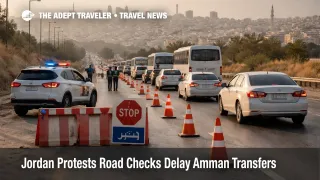
Jordan travelers should plan for slower transfers and more variable driving times because government travel advisories are emphasizing that demonstrations can flare with little notice, security conditions can tighten quickly, and authorities may set up checkpoints and roadblocks that disrupt normal traffic flow. The practical risk is not only being near a protest area, it is that a routine drive can turn into a long detour when circles, intersections, or highway approaches are restricted. For visitors, that can break tight itineraries, including morning departures, timed tour entries, and same day border crossing plans.
The change matters most because these disruptions propagate through travel logistics fast. When traffic slows unpredictably, a planned 45 minute hotel to airport run becomes a missed bag drop, a reissued ticket, and an unplanned overnight in Amman, Jordan. That is why corridor buffers, not just general caution language, are the core planning upgrade for this week.
Who Is Affected
Travelers moving around Amman, Jordan are the most exposed, especially those staying in neighborhoods that funnel into a small number of major circles and arterials, and those transiting near downtown areas, large mosques, government ministries, and diplomatic zones where demonstrations are more likely to draw security cordons. Even if a demonstration is not on your route, nearby closures can push traffic into the same alternates and create citywide knock on congestion.
Air travelers are a higher consequence group because Queen Alia International Airport (AMM) has hard cutoffs for check in, bag drop, security, and boarding, and a transfer delay is often not recoverable once you are behind the clock. This risk is amplified on Thursdays and Fridays, when demonstrations are more common and can create rolling roadblocks and checkpoints that change faster than mapping apps can model.
Intercity travelers are also affected, particularly those planning day trips that rely on predictable highway timing, including corridors that connect Amman to the Dead Sea area. Advisories have specifically flagged that protests near border areas can drive temporary closures and added security measures, including checkpoints and roadblocks, which is the same failure mode that turns a simple day plan into a cascading set of missed reservations and canceled operator departures.
What Travelers Should Do
For airport transfers, build buffer based on corridor and day, not optimism. If you are leaving a central Amman hotel for Queen Alia, treat 90 to 120 minutes as a normal planning range, then expand to 150 to 210 minutes on Thursday or Friday, or any day you see alerts of expected demonstrations, heavy police presence, or road closures. If you are coming from the Dead Sea area, plan a wider spread, and assume at least one checkpoint queue is possible even when the highway itself is open.
Set decision thresholds before you move. If your plan depends on a same day onward flight, a separate ticket, or a nonrefundable timed entry, rebook earlier or shift the plan to a lower risk day once you see credible reporting of closures or a formal advisory update. If the consequence is only a flexible activity, it can be rational to wait in place and move later, but only if you are not forced into walking through gathering areas, and only if your hotel location is not inside a likely protest cluster.
Over the next 24 to 72 hours, monitor three streams in parallel, your government travel advisory for Jordan, official embassy alert feeds if you are a citizen they serve, and credible local traffic and security reporting. If you hear civil defense sirens or see messaging tied to regional escalation, treat it as a signal that traffic behavior may change abruptly as people reroute or pause movement, and assume airport approaches will worsen immediately after. For the closest prior playbook on how this looks in Amman on a high risk day, use Amman Security Alert, Add Roadblock Buffers Jan 16.
Background
Protest and checkpoint risk in Jordan is an operational problem because it starts at the street level and then cascades through the rest of a trip. The first order effect is simple, police presence, cordons, and checkpoint queues reduce throughput on key arteries, and spontaneous gatherings can cause stop start congestion that is hard to predict. Official advisories consistently tell travelers to avoid demonstrations, and to expect road disruption with little notice, because conditions can change quickly even when events remain peaceful.
The second order ripple hits the travel system layers that are time bound. Airport processes have fixed deadlines, so a late arrival can become a missed flight even when the airport is operating normally. Missed flights then generate unplanned hotel nights, last seat fares, and rebooking friction that can consume an entire day, and they can also cascade into missed prebooked drivers or tours in the next city. Tour operators, in particular, may cancel or reroute if their access corridors are blocked, and that can force last minute itinerary redesign around what is still reachable by road.
A third layer is the corridor effect on intercity and border plans. Travelers sometimes assume that highways are binary, open or closed, but on higher alert days the more common pattern is intermittent controls, traffic holds, and short notice closures that make arrival times volatile. Jordan's Public Security Directorate announcements around weather related highway closures are a useful reminder that closures can be implemented quickly for safety or control reasons, including on major routes, and travelers should plan for reroutes that add both time and uncertainty. If your trip also involves entry timing, visas, or land crossings, keep Jordan Entry Requirements For Tourists In 2026 available so you can adjust crossings or arrival plans without compounding administrative risk.
Sources
- Message to U.S. Citizens: Security Alert: Personal Security and Preparedness, U.S. Embassy Amman (January 16, 2026)
- Travel advice and advisories for Jordan, Government of Canada
- Safety and security, Jordan travel advice, UK Foreign, Commonwealth and Development Office
- Regional risks, Jordan travel advice, UK Foreign, Commonwealth and Development Office
- Jordan Travel Advice & Safety, Australian Government Smartraveller
- Security Alert: Jordan, Situation in Israel, OSAC
- Desert highway reopens in both directions, PSD announces, Petra
- Jordan International Travel Information, U.S. Department of State