

Manchester Airport Rail Link Delays Feb 12 Points Failure
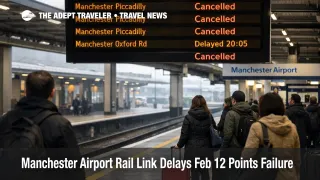
Rail access to Manchester Airport (MAN) was disrupted on Thursday, February 12, 2026, after a points failure near Heald Green reduced how many trains could safely run between Manchester Piccadilly and the airport. Travelers relying on Northern, TransPennine Express, or Transport for Wales services on the airport spur faced cancellations, short notice changes, and delays as operators worked around blocked or constrained track moves. If your flight timing is tight, the practical move is to stop treating rail as the only plan, switch to Metrolink or a road transfer early, and protect airline check in and bag drop cutoffs with a larger buffer than usual.
The key detail for travelers is that an airport corridor failure behaves differently than a generic commuter delay. When the rail spine into the terminal area loses capacity, platforms crowd quickly, remaining services can become uneven, and the "recovery" period often still includes residual cancellations even after lines reopen, which is why a stated end window does not guarantee a smooth trip in the final hours.
Who Is Affected
The most exposed group is anyone trying to reach Manchester Airport (MAN) from Manchester Piccadilly on a same day itinerary, especially short haul passengers with checked baggage and firm airline cutoffs. Travelers coming from farther afield also take on extra risk because many itineraries funnel into Manchester Piccadilly first, then depend on the short airport hop, so one failure point can break an otherwise well planned rail chain.
This disruption also hits arriving passengers who planned to use rail as the cheapest and fastest way into Manchester city center. When airport rail service is reduced, queues for taxis and rideshares tend to lengthen, pickup areas can become congested, and coach or local transit alternates fill up, particularly during mid day and late afternoon flight banks.
For recent Manchester area context on how rail disruption can propagate across TransPennine Express route families, see Manchester Airport Rail Disruption Hits TPE Routes. For a comparable airport rail breakdown that triggered broad mode switching and misconnect pressure, see South East England Rail Disruption Hits Gatwick Links.
What Travelers Should Do
If you are still traveling on February 12, 2026, treat your airport arrival time as the hard deadline, then work backward and add a conservative cushion. A practical rule for this corridor is to add at least 90 minutes beyond your normal plan, because you need time not only for the transfer itself, but also for platform crowding, longer waits, and the walk from the airport station into the terminals.
Use a decision threshold that forces action before you are committed. If the next rail option would put you inside your airline's check in or bag drop window, or if you would arrive with less than about 2 hours before a short haul departure, stop waiting for incremental updates and switch to Metrolink, a scheduled bus, or a taxi while vehicles are still available and before road congestion builds around peak pickup points.
Over the next 24 to 72 hours, watch for two signals, not one. First, monitor National Rail for residual disruption notes, because "lines reopened" often still means uneven service for several hours. Second, keep an eye on Network Rail and operator notices about upcoming Manchester Piccadilly engineering work in mid February 2026, because planned closures and altered timetables can reduce fallback options even after today's incident fades.
How It Works
A points failure is disruptive because points are the moving components that let trains switch from one track to another. When points fail, signallers often have to block or severely restrict movements through the affected area, which can reduce the corridor to a fraction of normal throughput or halt it entirely until the fault is fixed. On the Manchester Piccadilly to airport spur, that immediately translates into fewer trains reaching the airport station, more cancellations, and longer gaps between remaining services.
The first order effects stay on the rail asset, cancellations, platform crowding, and unpredictable departure patterns. The second order ripples spread quickly across the travel system because Manchester Airport is a timed node, missed rail arrivals become missed flight check in windows, which then become airline rebooking demand later in the day. As passengers switch modes, taxi and rideshare demand spikes, road approaches can slow, and last minute hotel inventory tightens near the airport and in Manchester city center when travelers are forced into an unplanned overnight.
This specific week also carries an additional fragility factor for the region because Network Rail has flagged major works affecting Manchester Piccadilly approaches from Saturday, February 14, 2026, through Sunday, February 22, 2026. Even if those works are separate from the February 12 incident, they matter for traveler planning because they reduce the margin for error, and they can make "tomorrow's backup plan" less available than you assume if you are moving trips within the same week.