

Fort Worth Protest at American Airlines HQ
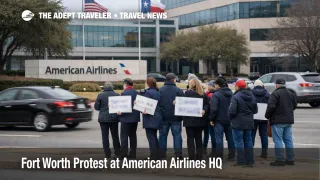
American Airlines flight attendants escalated their public campaign to remove CEO Robert Isom by protesting outside the airline's headquarters in Fort Worth, Texas. The demonstration took place on Thursday, February 12, 2026, after the Association of Professional Flight Attendants, APFA, staged it as a follow on action to a rare, unanimous no confidence vote earlier in the week. For travelers, the immediate issue is not that flights change today because of a protest, it is that labor groups are framing operational reliability as a leadership failure, which raises the odds that the next system stress test becomes messier to recover from.
The Fort Worth protest at American Airlines HQ matters because it formalizes a split between front line staffing groups and senior leadership at a moment when winter disruption recovery is still fresh in the system. APFA is tying its leadership demand to Winter Storm Fern fallout, crew support breakdowns, and a profitability gap versus Delta and United that the union argues reflects strategy and execution problems, not just weather. That framing is important for planning because when employees believe the operation is structurally under supported, recovery friction tends to show up first as slow rebooking, inconsistent messaging, and late day cancellations that strand connections.
For background on how the union pressure campaign has already intersected with traveler reliability planning on the site, see American Airlines No Confidence Vote Raises Flight Risk and American Airlines Fern Crew Fallout, U.S. Delay Risk.
Who Is Affected
The most exposed travelers are those whose itineraries depend on a connection through Dallas Fort Worth International Airport (DFW) or other American hubs, especially when the itinerary is built on minimum connection times, late day departures, or separate tickets. The protest itself does not reduce the schedule, but it signals continuing internal scrutiny of the systems that govern crew positioning, hotel sourcing, and disruption response, which are exactly the systems that fail first when weather, air traffic control constraints, or maintenance issues push the network off plan.
Travelers with hard arrival windows sit in the second high risk bucket. Cruise embarkations, prepaid tours, weddings, medical appointments, conferences, and any trip where arriving a day late breaks the purpose of the trip should treat American's current labor climate as a reason to reduce single points of failure. When recovery goes sideways, the penalty is rarely just a late arrival, it is also out of pocket hotel nights, lost first nights, and missed onward legs that are not protected across separate providers.
A third group to watch is anyone planning travel during the next meaningful disruption window, even if their route is not in Texas. Airlines are tightly coupled systems, and a major hub disruption can propagate into distant stations when the inbound aircraft or crew that "should" work an evening departure arrives too late, or becomes illegal on duty time. In those situations, even cities far from the original trigger can see rolling cancellations and overnights because there is not enough slack to rebuild the next day's network quickly.
What Travelers Should Do
Start with immediate buffers and a plan that assumes late day fragility. If you have flexibility, move to earlier departures, choose longer connections than the minimums, and avoid building an itinerary on the last flight of the night to a smaller destination where same day recovery seats may not exist. Keep essentials in a personal item, and keep receipts and screenshots if your trip is during a period of elevated disruption risk, because documentation often determines whether reimbursement or insurance claims are viable.
Use a decision threshold for rebooking versus waiting that is based on arrival certainty, not optimism. If the first delay erases your buffer, if your connection loses its fallback options, or if you are on separate tickets, rebook early while inventory still exists, even if it means accepting a longer routing. Waiting is only rational when later flights are plentiful, you can tolerate a later arrival, and you are tracking the hub wide picture rather than a single gate status that can change after crews time out.
Over the next 24 to 72 hours before departure, monitor three layers, American's travel alerts and waiver rules, hub level cancellation clusters, and whether delays are concentrating in late afternoon and evening banks. Late day clustering is a common signal that aircraft rotations and crews are still out of position, which is when reaccommodation collapses fastest. If those signals trend worse, a proactive change, even by one day, is often cheaper and less stressful than an airport day that turns into an involuntary overnight.
Background
A protest and a no confidence vote do not directly change flight schedules, but they do matter for travelers because they reflect how front line groups interpret operational performance and recovery capability. In APFA's February 9 statement, the union argues that repeated operational failures, including cases where crew members slept on airport floors during Winter Storm Fern disruptions, are symptoms of leadership and resourcing decisions. When a disruption hits, the first order problem is reduced departure rates and gate congestion at the affected hub, then the second order ripple spreads as aircraft miss turns, crews run out of legal duty time, and downstream flights cancel in cities far from the original trigger.
Those ripple layers are why winter events feel "over" to travelers in one city while the network still breaks elsewhere. If crew lodging, transportation, and scheduling tools are strained, usable crews effectively fall out of the system, even if aircraft and weather conditions improve. That recovery friction then increases demand for the same limited seats on later flights, and it compresses hotel inventory near hubs as displaced passengers and crews compete for rooms at the same time.
This week's escalation also sits alongside pressure from the pilots union. Reuters reported that Isom agreed to meet with the Allied Pilots Association after the union asked for board level engagement, and Reuters separately described unions pressing American's board to treat the profit gap versus Delta and United as a governance issue. For travelers, the practical takeaway is that labor dissatisfaction is now being expressed in operational terms, which means you should plan as if the next large disruption could produce a faster slide from delay to cancellation, and a slower path back to normal.
Sources
- AA Flight Attendants Issue Vote of No Confidence in CEO Robert Isom
- American Airlines Flight Attendants to Hold Protest Following Vote of No Confidence in CEO Robert Isom
- American Airlines flight attendants hold protest calling for CEO Robert Isom to step down
- American Airlines unions ratchet up pressure on board over lagging profit
- American Airlines CEO agrees to meet pilots union over concerns
- Storm tests American Airlines as stranded crews face hotel shortages, long waits for help