

UK Dual Nationals Passport Rule Triggers Feb 25 Check In
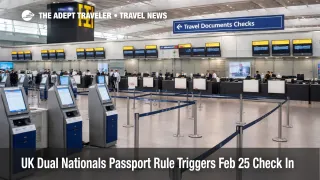
A tightened UK carrier enforcement posture is turning a long standing dual nationality document rule into a February 25, 2026 check in trap for some British dual nationals traveling to the United Kingdom. The people most likely to get caught are families and long haul travelers who have relied on a non UK passport at the airport, and assumed citizenship status alone would carry them through. The practical next step is to confirm, for every traveler, whether they must present a valid British passport for travel, and if not, whether they have the specific entitlement document that allows travel on another passport, before you leave home.
The change matters because it moves the failure point forward in the journey, much like the UK Electronic Travel Authorisation, ETA, rollout, but it is not the same problem. Under GOV.UK guidance, dual British or Irish citizens cannot get an ETA, and must instead prove permission to travel with a valid UK passport, a valid Irish passport, or a foreign passport containing a certificate of entitlement. From February 25, 2026, multiple sources, including the UK Parliament's Commons Library, flag that carriers may refuse boarding if a British dual citizen cannot show the correct document set.
Who Is Affected
This primarily affects British dual nationals who will present a non UK passport for travel to the United Kingdom, including dual citizens living abroad who do not currently hold a valid UK passport. It can also affect British and Irish dual nationals who assumed they could resolve issues by applying for an ETA, because GOV.UK states British and Irish dual citizens cannot obtain an ETA.
The most common real world failure scenarios are straightforward. A parent's UK passport is expired, a child has never held a UK passport, or a family has booked and checked in using one passport, then plans to present a different one at the airport. Another high friction scenario is when the airline record, advance passenger information, or ticket name is tied to one passport, but the traveler shows up with the other at bag drop, which can trigger manual document review at the counter when time is tight.
This is also a different issue than the February 25, 2026 ETA enforcement milestone for visa free visitors, even though both can end in denied boarding. ETA enforcement mainly affects non visa nationals who need digital permission to travel as visitors. The dual national trap affects British citizens who are exempt from ETA, but still must prove their right of abode with the correct physical document set. Both requirements converge at the same operational chokepoint, carrier checks before departure.
For related context on the carrier check model, see UK ETA Feb 25 Boarding Rule, Avoid Denied Boarding and UK ETA London Transit Requirements, February 25, 2026.
What Travelers Should Do
Start by treating February 25, 2026 as a document audit deadline, not a travel day problem. For each traveler, confirm whether they are a British citizen, including by descent, birth, or registration, then confirm what they will physically present at check in. If they are a British dual national, plan to travel on a valid UK passport, or ensure the non UK passport contains a certificate of entitlement, because GOV.UK explicitly warns you will not be able to travel without one of these options.
Use a hard decision threshold for rebooking versus waiting. If you do not have a valid UK passport in hand, and you are inside the window where a renewal is unlikely to arrive before departure, do not assume an ETA or airport day escalation will solve it. The primary workaround for traveling on the non UK passport is the certificate of entitlement, and reporting indicates it can be costly, which is exactly why this becomes a last minute budget and logistics shock for families. If neither route is feasible for your timeline, shifting travel dates is usually cheaper than letting the trip fail at the airport.
Over the next 24 to 72 hours, monitor two things: carrier messaging for your specific mode, airline, Eurostar, or ferry operator, and official UK guidance updates tied to February 25, 2026 enforcement. If you are booking new travel, align your booking passport, your ETA status if you are not a British or Irish citizen, and your check in document plan on day one, because fixing mismatches later often forces reissued tickets, revalidated advance passenger information, and missed connection protection.
How It Works
UK border policy is increasingly enforced upstream by carriers, meaning airlines, international rail, and ferry operators are expected to verify permission to travel before boarding. For visitors, that permission is often the ETA, which is checked digitally against the passport used for travel. For British dual nationals, the permission is not an ETA, it is the right of abode evidenced by a valid UK passport, a valid Irish passport, or a certificate of entitlement placed in the foreign passport.
That upstream enforcement model creates predictable ripples through the travel system. First order, check in failures strand passengers before departure, which triggers rebooking fees, fare jumps, and missed same day connections. Second order, once passengers miss the first leg, protected onward flights, rail segments such as Eurostar, and ferry sailings can fall out of sequence, and the traveler often loses the first hotel night, transfers, and timed tours, especially on separate tickets. As those stranded travelers rebook into later departures, seat scarcity increases on the next available flights, and hotel inventory tightens near major UK gateways, adding real cost even for travelers who ultimately reach the UK a day late.
For a broader traveler checklist that stacks passports, ETA, visas, and common border proofs in one place, use UK Entry Requirements For Tourists In 2026.
Sources
- Dual citizenship
- Electronic travel authorisation (ETA): guide for dual citizens
- No permission, no travel: UK set to enforce ETA scheme
- Important changes to UK entry requirements as of February 25, 2026
- Can a British citizen travel to the UK using a non-British passport?
- Dual nationals to be denied entry to UK from 25 February unless they have British passport