

Italy Rail Strike to Hit Trains Feb 27 to 28
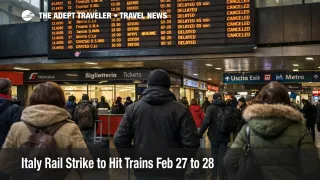
A national rail strike is on the late February calendar in Italy, with the transport ministry's official strike listings showing a 24 hour action starting at 900 p.m. on February 27, 2026, and ending at 859 p.m. on February 28, 2026. For travelers, the timing matters because it lands immediately after the newly shifted nationwide aviation strike window on February 26, 2026, turning what would have been separate risks into a single, compounded disruption period. If your itinerary stacks flights, airport trains, and regional transfers across multiple cities, this is the kind of cluster that breaks "perfect" same day plans.
The rail strike's first order effect is reduced reliability across high speed, long distance, and regional services, especially where tourists depend on rail as a fixed link between airports, city centers, and hotel check in windows. The second order effect is what makes the last week of February tricky, crowding and rebooking pressure moves outward into airports, roads, and lodging when travelers switch modes, miss evening arrivals, or lose connection margins.
Who Is Affected
Travelers building multi city itineraries that rely on the main tourist rail spine, Rome, Italy to Florence, Italy to Bologna, Italy to Milan, Italy, are the most exposed because disruption on that corridor tends to propagate across the network. When a high speed train is canceled or heavily delayed, the replacement seats fill quickly, platform assignments compress, and regional connections that tourists treat as routine become missed connections instead of short waits.
Airport rail users sit in the blast radius even if they are only taking "one train." Connections like Rome Fiumicino's Leonardo Express and Milan's Malpensa Express are common failure points during strike periods because a late arriving inbound train can force a flight recheck, a missed bag drop cutoff, or an unplanned overnight near the airport. The risk rises further if you are on separate tickets, or if your plan uses the last viable train of the night to reach a hotel in Florence, Venice, Naples, or the lakes region.
Day trippers also get caught. Routes tourists frequently treat as guaranteed, such as Florence to Pisa, Milan to Lake Como, Rome to Naples, and Naples to Sorrento area connections that start with rail, can become unreliable even when some trains run. During strike periods, a journey planner that still shows a timetable is not the same thing as an arrival time you can trust, especially when staffing and rolling stock positioning are constrained.
For readers following the Olympics travel thread in northern Italy, rail reliability has already been under pressure from infrastructure incidents, and a labor disruption layered onto that environment increases the odds of slowdowns and knock on delays. Related coverage that explains how rail disruption can spill into road congestion and hotel compression is in Italy Olympic Rail Sabotage Risk on Lake Como Line.
What Travelers Should Do
If you are traveling in Italy from February 26, 2026, through February 28, 2026, reduce fragility first. Build buffers into airport transfers, shift critical moves to a different day when you can, and avoid planning an arrival that depends on one specific train to preserve a hotel check in, a tour start time, or a cruise or flight connection. If you must travel, keep your plan flexible enough to switch to a later departure, or to a different mode, without losing the whole day.
Set a clear decision threshold for rebooking versus waiting. If your route includes an airport connection, a prepaid timed transfer, or any separate ticket chain, rebook once you see a cancellation notice, or once delays start consuming your last reasonable backup train. If your trip is flexible and you have multiple same day alternatives, it can be rational to wait for the operator's final service plan, but only if you have refundable lodging and you are not depending on the final train of the evening.
Over the next 24 to 72 hours, monitor the sources that actually change outcomes. Start with the transport ministry strike listing for timing, then check your operator's strike page for guaranteed trains, and your departure station's live notices for short notice service cuts. Also watch for airline and airport advisories for February 26, 2026, because flight disruption that day can force last minute rail rebooking into February 27 and February 28, which is exactly how the cluster turns into missed connections and hotel compression. For aviation context around the shifted strike window and minimum service framing, see Italy Feb 16 Air Strike, Flights Still at Risk.
Background
Italy's strike framework for essential services aims to preserve a baseline level of mobility, but travelers should still expect cancellations, reduced frequencies, and uneven reliability across operators and regions. The transport ministry's strike portal is the authoritative "calendar" layer, telling you the legal start and end of the action, while each rail operator publishes how minimum service is implemented in practice, including which trains are designated as guaranteed and what happens to trains already en route when the strike begins. Trenitalia's guidance, for example, explains that trains already traveling when the strike starts may still reach the final destination if it is reachable within a limited time window, otherwise they can terminate short of destination, which is a classic way a disruption strands travelers mid journey.
This is also why late February becomes a compounded risk period rather than a single bad day. First order disruption starts at the source, fewer crews and dispatch capacity, fewer trains operate, and gaps appear on the timetable. Second order effects spread across the system because the rail network is timed around connections and rolling stock cycles. A canceled high speed train can flood the next departure, displace seat inventory across multiple cities, and break regional links that feed hotels, tours, and onward transport. When travelers abandon rail, airports see more demand for short haul flights, roads see more congestion on tourist corridors, and hotels near hubs see higher walk in demand from travelers who miss evening arrivals.
Sources
- Scioperi, Ministero delle Infrastrutture e dei Trasporti, elenco scioperi
- Servizi minimi garantiti in caso di sciopero, Trenitalia
- Train and airport strikes in Italy to disrupt thousands of travellers this month, Euronews Travel
- Italy government to ban airport strikes during Winter Games, Reuters
- UPDATED: The transport strikes to expect in Italy in February 2026, The Local Italy