

Lovers' Arch Collapse, Sant'Andrea Access Changes
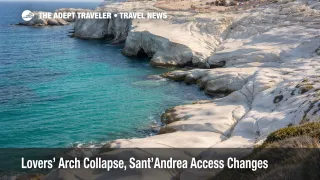
A signature rock arch on Puglia's Salento coast, popularly known as Lovers' Arch at Sant'Andrea in the municipality of Melendugno, collapsed into the Adriatic on February 14, 2026 after days of severe storm surf and heavy rain. Travelers arriving now, especially day trippers who built itineraries around the landmark photo stop near Torre Sant'Andrea, should expect changed access patterns, and possible safety controls near unstable cliff edges. The practical next step is to plan for alternate viewpoints, add buffer time for parking and short walks, and treat any posted barriers as non negotiable while authorities assess conditions.
The Sant'Andrea Lovers' Arch collapse changes Salento planning in plain terms, the landmark itself is gone, and the safest ways to experience the coastline may shift toward wider viewpoints and adjacent stops rather than the former arch overlook.
Who Is Affected
Independent travelers driving the Salento coast between Lecce, Melendugno, and Otranto are most affected because this is the kind of stop that often sits inside a tight chain, a morning beach, a midday photo break, then a timed lunch reservation or a late afternoon check in. When a single stop changes, the ripple is not just disappointment, it is timing friction, slower parking turnover, and re routing onto small coastal roads that already bottleneck during popular hours.
Small group tours and private drivers are also exposed because they typically sell the stop as a quick, reliable viewpoint. When the physical feature disappears, operators tend to substitute nearby coastal highlights, which can compress dwell time at later stops, shift pickup windows, and create more variability in arrival times at hotels in Lecce, Otranto, and seaside bases. The effect is amplified in peak season, but even shoulder season visitors can feel it when a newly famous "replacement" viewpoint concentrates demand.
There is a second layer that travelers often miss, coastal incidents propagate through the local travel system beyond the viewpoint itself. Once access is tightened near cliffs, foot traffic concentrates on fewer safe paths, parking queues lengthen, and roadside stopping increases as visitors try to "see it anyway," which can raise enforcement, and safety risks. Downstream, missed time slots can push travelers into later dinner seating, shorter museum windows, or rushed transfers to rail and bus connections, a pattern similar to other Italy disruption days where small delays cascade across the day's plan, not just the original site. Related travel friction can also stack if travelers are already navigating broader Italy transport variability in the same week, for example the separate Italy Feb 16 Air Strike, Flights Still at Risk story, or rail reliability concerns in other regions such as Italy Olympic Rail Sabotage Risk on Lake Como Line.
What Travelers Should Do
Travelers heading to Sant'Andrea in the next few days should plan to view the coastline from stable, obvious public viewpoints, and avoid any temptation to approach cliff edges or scramble down informal paths to "get closer." Storm driven collapses can leave fresh fracture lines and unstable overhangs, and additional small falls can occur after the headline event, especially when seas remain rough.
Set a decision threshold before you drive out. If the goal was specifically the arch photo, it is better to reframe the stop as a broader Torre Sant'Andrea sea stacks and coastal walk visit, and then re allocate time to an alternate Salento highlight rather than spending extra time searching for a "new angle" at the same spot. If on arrival you see barriers, restricted paths, or local officials directing flow, treat that as your signal to move on quickly and use a secondary viewpoint or a different coastal stop, because waiting for access to reopen can burn the best daylight, and cascade into late arrivals elsewhere.
Over the next 24 to 72 hours, monitor local signals that actually change your plan, not social media speculation. Watch for municipal safety updates from the Melendugno area, any regional statements about monitoring and erosion mitigation, and practical indicators on the ground such as newly placed fencing, taped off overlooks, or changed parking controls. If weather remains unstable, keep your coastal day flexible, and consider flipping the schedule to put inland activities earlier, then return to the coast when winds and surf are calmer.
Background
Rock arches on exposed coasts fail through a slow weakening process that becomes obvious only at the end. Repeated wave impact, salt weathering, and heavy rain can open fractures, undercut supports, and accelerate erosion, then a single high energy sea state delivers the final break. In this case, multiple reports tied the collapse to storm surges and intense rainfall impacting southern Italy, and regional officials framed the event within broader erosion and climate driven stress on coastlines.
For travelers, the system ripple matters as much as the geology. The first order effects sit at the source, a changed landscape, safety assessments, and possible temporary restrictions near unstable rock. The second order effects spread outward, crowds concentrate at substitute viewpoints, parking and road shoulders fill earlier, and short itinerary legs begin to slip. That slip changes the rest of the day, tour departure times drift, restaurant reservations are missed, and hotel check in windows tighten, especially for travelers stacking multiple Salento stops in one afternoon. When a famous landmark disappears, the "replacement stop" becomes the new pressure point, and local infrastructure that was adequate for distributed coastal demand can feel constrained.
Sources
- Crollo dell'Arco degli Innamorati: la Regione Puglia in contatto con il Comune di Melendugno
- Italy's famous Lovers' Arch collapses into the sea on Valentine's Day
- Maltempo, crolla arco dei faraglioni a Melendugno
- Crolla l'iconico Arco dell'Amore di Melendugno, simbolo del Salento
- Il sindaco di Melendugno e l'Arco dell'amore sbriciolato