

Flight Delays and Airport Impacts: February 13, 2026
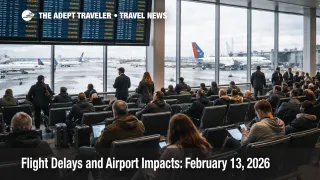
Wind is the main operational risk across several Northeast hubs on Friday, February 13, 2026, with the FAA flagging possible delays in Boston and the New York area, plus Philadelphia and the Washington, DC airport group. Travelers are most exposed if their itineraries touch General Edward Lawrence Logan International Airport (BOS), John F. Kennedy International Airport (JFK), La Guardia Airport (LGA), Newark International Airport (EWR), Philadelphia International Airport (PHL), Ronald Reagan Washington National Airport (DCA), Baltimore Washington International Airport (BWI), or Washington Dulles International Airport (IAD), because small throughput cuts at these nodes propagate quickly through connection banks. At the same time, low clouds could slow operations in Houston and across select leisure and mountain gateways, adding a second, separate delay pocket that can collide with Northeast disruptions.
The FAA's daily outlook for February 13, 2026 flight delays is straightforward: wind could drive delays in Boston, the New York area airports, Philadelphia, and the Washington, DC airport group, while low clouds could impact Houston, Tampa, Salt Lake City, and Denver.
Who Is Affected
Travelers connecting through the New York airspace complex are the most vulnerable group today, even when airport status pages show only modest averages, because wind driven spacing and runway configuration shifts can quickly turn into metering during peak arrival banks. When New York is constrained, the first order effect is fewer arrival slots, longer taxi times, and gate holds, which is exactly the kind of friction that breaks tight domestic connections and pushes international departures past check in and bag drop cutoffs.
Boston Logan and Philadelphia sit in the same wind exposed corridor and often share the same failure mode, arrival rates come down, then inbound aircraft arrive late and roll those delays forward into later departures. For travelers starting in smaller spoke airports, this is why a disruption that appears localized still shows up as missed connections far away, the aircraft and crew that should have arrived on time to operate your leg did not, so your departure is late before you ever board.
The other affected cohort is anyone routed through Florida and the Gulf Coast today, especially travelers headed to Southwest Florida International Airport (RSW) or connecting onward to cruises, resorts, or fixed time events. The FAA's current operations plan lists an extended ground stop at RSW due to low ceilings, alongside broader volume management for snowbird traffic and additional Florida flow evaluation. That combination matters because when Florida demand is high, reaccommodation options thin out fast, and a short ground stop can still create a long recovery tail.
Finally, travelers touching Denver International Airport (DEN) and the ski country airport set should expect uneven reliability. The FAA operations plan flags low ceilings in the ski corridor and lists active ground delay programs for Eagle County Regional Airport (EGE), plus additional programs for Montrose and Aspen area traffic. Even if DEN itself stays relatively smooth, those mountain constraints can absorb aircraft and crews, and then ripple back into Denver's later banks.
For continuity on how this week's patterns have been behaving, compare today's risk framing with Flight Delays and Airport Impacts: February 12, 2026. For a reminder of how fast a local stop can distort the national network, see El Paso Airspace Shutdown Tied to Drone Laser System.
What Travelers Should Do
Start with immediate actions and buffers. If your itinerary touches BOS, the New York area airports, PHL, or the Washington, DC airport group, check your connection margin and move risk forward, earlier departures and earlier connection banks are easier to protect because there is still inventory and schedule slack. If you are headed to Florida, verify RSW status before you leave for the airport, and assume that a ground stop can translate into a late arrival that misses cruise check in windows or onward hotel transfer cutoffs.
Use decision thresholds for rebooking versus waiting. If your connection is under 90 minutes through New York, Boston, or Washington, DC, treat any sustained delay trend as a trigger to change routes, because the safest alternates disappear first when banks compress. If you are on separate tickets, or you must arrive the same day for a fixed event, be more aggressive, move earlier or reroute through a different hub before the afternoon queue forms. If you are protected on a single ticket and have a longer buffer, waiting can make sense, but the cutoff is when you are down to the last same day option.
Over the next 24 to 72 hours, monitor the signals that predict whether today stays manageable or turns into irregular operations. Watch whether the wind forecast verifies at the Northeast airports named in the FAA daily outlook, then watch for FAA operations plan updates that expand ground stops, delay programs, or route restrictions. Also watch airline waiver language, because it determines whether you can shift flights without fees before phone queues and airport lines spike. If you want deeper structural context for why localized constraints can still feel systemwide, see U.S. Air Traffic Control Privatization: Reality Check.
How It Works
The FAA daily air traffic report is an early planning signal for where capacity is most likely to be reduced by wind, low ceilings, visibility, runway configuration limits, or airspace flow constraints. When conditions reduce the number of arrivals an airport can accept per hour, traffic managers meter inbound flights, hold aircraft at gates, and sometimes apply route restrictions so demand matches the reduced arrival rate. That first order effect is visible at the hub as longer taxi times, airborne holding, or gate holds.
The second order effect is what most travelers actually feel. Aircraft and crews fly multiple legs per day, so a late arrival becomes a late departure somewhere else, shrinking connection windows and forcing rebookings into already full flights. When demand is seasonally high, as it is for Florida snowbird travel and weekend leisure peaks, the system has less spare inventory, so even short operational pauses can cause longer lines, fewer same day alternates, and overnight knock on costs like added hotel nights and ground transport changes.