

LaGuardia Runway Closures Raise Delay Risk This Week
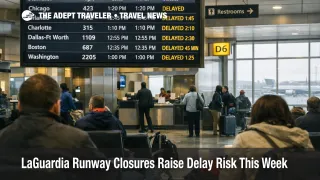
FAA operations planning for Tuesday, February 17, 2026, flags reduced operational flexibility at several major airports, with LaGuardia Airport (LGA) singled out for runway and taxiway constraints that can amplify even modest weather into longer delays. The near term problem is not a single dramatic event, it is a thinner margin for recovery when the system gets busy. If you are flying through New York this week, the practical next step is to assume higher misconnect risk, pad your plan, and be ready to route through alternate airports if your airline offers a waiver.
The FAA plan language is a traveler usable warning because it describes where capacity is already constrained before any ground stop or delay program is imposed. In plain terms, LaGuardia runway closures delay risk is higher this week because the airport has less room to absorb normal peaks, and the FAA is already planning around those limits.
Who Is Affected
Travelers using LaGuardia are the most directly exposed, especially anyone relying on tight turn times, short connections on protected tickets, or separate ticket pairings that depend on precise on time arrivals. Even if your flight does not touch LaGuardia, you can still feel the knock on effects if your airline rotates the same aircraft through the New York area, because delays there can push later legs out of sequence.
The FAA plan also lists constraints that can matter for travelers moving through other large nodes, including Chicago O Hare International Airport (ORD), Dallas Fort Worth International Airport (DFW), Orlando International Airport (MCO), San Diego International Airport (SAN), Charlotte Douglas International Airport (CLT), Ronald Reagan Washington National Airport (DCA), Boston Logan International Airport (BOS), Nashville International Airport (BNA), Albuquerque International Sunport (ABQ), San Antonio International Airport (SAT), and Teterboro Airport (TEB). You do not need to be flying to those airports to be affected, you only need to be flying an itinerary where one delay breaks a connection bank, crew duty day, or aircraft swap window.
Travel advisors should treat this as a week where small forecast changes can create disproportionate schedule impacts. When the system is already brittle, a light ceiling forecast, wind shift, or a brief runway closure window can trigger metering that turns into missed connections later in the day.
What Travelers Should Do
Start with immediate buffers. If your itinerary touches LaGuardia or any hub listed with runway, taxiway, ramp, or operational adjustments, build extra time on both ends, including a more conservative airport arrival plan and a larger connection cushion. Avoid planning that assumes you will land and immediately make a fixed time commitment, such as a cruise departure, a paid tour check in, or a same day event start, unless you have an alternate flight option that still works.
Use decision thresholds for rebooking versus waiting. If you have a connection under 90 minutes through a constrained hub, or you are booked on the last viable same day arrival, treat any widening delay trend or a new FAA traffic management program as a trigger to switch flights early, while seats still exist. If you have more slack and you are protected on one ticket, waiting can be rational, but the cutoff is when your buffer is gone and reaccommodation will likely spill into an overnight.
Over the next 24 to 72 hours, monitor the signals that precede cascade days. Watch whether FAA airport status pages shift from minor averages to formal programs, watch your inbound aircraft for gate holds at the origin, and watch for airline travel waivers that let you reroute via New York JFK, Newark, or Westchester, rather than forcing the same constrained airport. If you are traveling during evening banks, be extra conservative, because late day disruptions have less remaining schedule to recover.
How It Works
The FAA Command Center manages demand against reduced capacity using tools such as arrival metering, ground delay programs, and, when necessary, ground stops. When a runway or taxiway is closed, the first order effect is that an airport can accept fewer arrivals or departures per hour, and those limits show up as longer taxi times, gate holds, and controlled departure release times that are imposed before the aircraft even leaves its origin.
The second order ripple is where most travelers lose time and money. Aircraft and crews are scheduled to fly multiple legs in a day, so a delay that starts as a reduced acceptance rate at one airport can propagate into missed connections at a hub, crew legality problems that force cancellations, and aircraft positioning drift that leaves later flights without the planned equipment. That is how a New York constraint can turn into a late evening problem in a different region, and why hotel nights, rental car changes, and missed prepaid activities often spike after a capacity managed day.
For this week, the FAA plan matters because it stacks structural constraints on top of routine winter variability. When the system starts the day with less slack, it takes less weather to trigger formal initiatives, and it takes longer to unwind once delays start.
Sources
- Current Operations Plan Advisory (FAA ATCSCC)
- National Airspace System Status (FAA)
- LaGuardia Airport (LGA) Status (FAA)
- The Most Recent ATCSCC Advisory (FAA)
- Flight Delays and Airport Impacts: February 16, 2026
- US DHS Shutdown TSA Delays Raise Airport Line Risk
- U.S. Air Traffic Control Privatization: Reality Check