

Greece Ferry Sailing Bans at Athens Ports
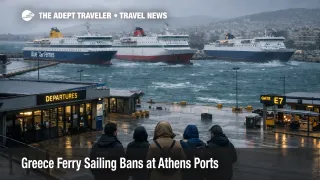
Ferry services from the Athens area ports of Piraeus, Rafina, and Lavrio were suspended during a severe wind event as authorities imposed sailing bans and operators canceled departures. Travelers headed to Greek islands were left waiting or forced to replan same day connections after winds were reported around 9 Beaufort in parts of the Aegean, a threshold that regularly stops many passenger vessels for safety reasons. If you are traveling through Athens, Greece, the practical move is to assume the ferry layer is temporarily unreliable, then rebuild your itinerary around confirmed sailings rather than published timetables.
The operational detail that matters is timing. Sailing bans can be imposed and extended quickly, and restarts are often staggered by route exposure, vessel class, and sea state, so "services resuming" does not mean every line is back to normal at once. Hellenic National Meteorological Service gale warnings are a strong signal for continued stop start operations across exposed corridors, even if conditions briefly improve near shore.
Who Is Affected
Travelers departing from Piraeus Port are exposed first because it is the largest gateway for many island routes, and disruptions there immediately cascade into terminal crowding, missed check in cutoffs, and rolling rebook queues. Travelers using Rafina Port and Lavrio Port are often even more exposed on Cyclades patterns because these routes can be more sensitive to crosswinds and sea state, and because many itineraries depend on morning departures to protect hotel check in and prebooked transfers on the islands.
Anyone chaining a ferry to a flight out of Athens International Airport Eleftherios Venizelos (ATH) is in the highest risk bucket. A canceled sailing does not only mean a delayed arrival to Athens, it can also eliminate the only realistic same day path back to the airport when the next sailing is sold out, vehicles cannot be accommodated, or operators restart with reduced capacity. That is how a weather day turns into an unplanned overnight on the "wrong" side of your flight.
Second order effects show up quickly outside the ports. When ferries stop, demand shifts into taxis, private transfers, and last minute hotel nights near Piraeus, Rafina, Lavrio, and around Athens International. At the same time, some travelers try to replace a ferry segment with domestic flights to islands with airports, which can tighten remaining seats and push fares up for near term departures. Even after a sailing ban lifts, the backlog behaves like a traffic jam, capacity returns gradually, and missed hotel nights, tours, and timed entries on the islands can turn into partial refunds or rebooking fees depending on supplier terms.
What Travelers Should Do
If you are traveling within the next 24 hours, protect the immovable pieces first. Lock in your flight status and lodging, then treat the ferry leg as the flexible variable. Do not travel to a port on a published timetable alone, instead, wait for a confirmed operator update that your specific sailing is operating, and be prepared for last minute changes if winds remain near gale force.
Use clear decision thresholds for rebooking versus waiting. If you must be at Athens International for an international departure, do not bet on a same day ferry return during an active gale warning cycle, shift to an overnight buffer on the mainland, or move your flight if you can. If your schedule can slip, it is often better to hold your island hotel and rebook to the first confirmed sailing after the ban lifts, but only after you verify that the restart is not limited to specific routes or vessel types.
Over the next 24 to 72 hours, watch three signals in parallel, the HNMS gale warnings, operator bulletins for your exact route, and whether departures restart broadly or in narrow windows. When services resume in waves, prioritize rebooking onto sailings that restore your critical path, then rebuild optional island hops later. If you are planning island hopping, consider simplifying to fewer moves until the weather pattern stabilizes, because one canceled leg can collapse the whole ladder. Related coverage that may help you compare patterns and restart behavior includes Greece Ferry Sailing Bans Hit Piraeus and Rafina and Greece Ferry Sailing Bans Hit Islands January 21, 2026 Greece Ferry Sailing Bans Hit Islands January 21, 2026.
How It Works
A Greece ferry sailing ban is a safety and traffic management decision, not a commercial choice, and it is typically driven by wind, sea state, and route exposure. When winds rise toward gale force, port authorities and the Coast Guard restrict departures because smaller vessels, fast craft, and open water routes face higher risk from crosswinds, wave height, and reduced maneuvering margins in harbors and channels. That is why suspensions can be uneven, sheltered Saronic Gulf services may sometimes operate while Cyclades routes pause, and longer Aegean crossings may restart later even after conditions improve near Athens.
The travel system ripple is predictable. First, capacity is removed at the source, ships remain docked, crews, vehicles, and passengers stop moving. Second, inventory gets reshuffled, passengers stack into fewer future sailings, and ferry operators manage restarts around vessel positioning and dock availability. Third, connected layers absorb the shock, hotels fill near ports and the airport, ground transport demand spikes, and travelers divert onto domestic flights when possible. The result is that the disruption can outlast the peak winds, because the backlog and rescheduling take time to unwind even after the sailing ban is lifted.