

Belarus Balloons Close Vilnius Airport, Delays Recur
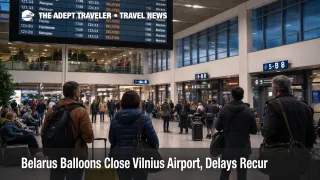
Vilnius Airport (VNO) halted operations on February 17, 2026, after balloons from Belarus entered Lithuanian airspace, prompting a short, safety driven stop that can still cascade into delays and missed connections. Travelers are affected most if they are arriving late in the day, connecting onward within Schengen on tight margins, or trying to reach time fixed plans such as tours, rail departures, or same night hotel check ins outside Vilnius, Lithuania. The practical next step is to plan for short notice interruptions, add buffer to connection and transfer plans, and pre choose alternate routings so you are not making decisions in a gate area during a reopening surge.
The change that matters for trip planning is that this is no longer a rare anomaly. Lithuanian officials and repeated reporting describe balloon driven airspace disruptions as recurring since early October 2025, which means a Vilnius itinerary should be treated as periodically brittle even when weather is fine and airline schedules look normal.
Who Is Affected
The first tier is anyone departing from, arriving into, or connecting via Vilnius Airport, especially on the last viable same day arrival. When operations pause, aircraft can hold, divert, or arrive out of sequence, and the passengers most likely to lose options are those with narrow connection windows and limited later flights.
The second tier is travelers whose plans depend on an on time arrival into Vilnius to start a same day ground leg. A short stop can break bus, rail, or car pickup timing, and it can also push arrivals past hotel reception hours for smaller properties. Even if flights resume quickly, the recovery tail can continue as airlines and ground handlers work through repositioning, baggage, and gate constraints.
The third tier is travelers using separate tickets, self built connections, or mixed carrier itineraries that depend on precise timing. If you are ticketed separately, a diversion or missed connection is more likely to become a self pay hotel night or a new ticket purchase. This is also where insurance documentation and proof of disruption becomes critical, because claims often depend on what the airline recorded and what you can show from notifications, receipts, and revised itineraries.
What Travelers Should Do
Start with immediate actions and buffers. If you see an alert that Vilnius Airport is restricting traffic, assume the effect can outlast the closure itself. Check your airline app, then cross check the airport operator update if available, and take screenshots of status changes, rebooking offers, and any waiver language. If you have a tight arrival connection to rail or bus, shift that leg to a later departure, or build an overnight buffer in Vilnius.
Use decision thresholds for rebooking versus waiting. If your connection margin is under 90 minutes, if you are on separate tickets, or if you are traveling on the last arrival that still makes your plan, treat a closure alert as your trigger to move early. The reason is inventory, once the system reopens, many travelers are competing for the same limited later seats, and airlines often prioritize protected itineraries. If you have slack, and you are on a single ticket with a protected connection, waiting can be reasonable, but only until your buffer is gone and your reaccommodation is likely to spill into an overnight.
Over the next 24 to 72 hours, monitor the signals that predict repeat disruption and slow recovery. Watch for Lithuanian government and airport operator updates about airspace violations and operational restrictions, then watch your aircraft's inbound leg on the day of travel, because late arriving equipment is a common post stop failure mode. If you want a practical model for how a full stop, even a short one, can ripple into reroutes and next day fragility, see El Paso Airspace Shutdown Reroute Risk for Flights. For a broader view of how system brittleness turns small disruptions into misconnect spikes, see LaGuardia Runway Closures Raise Delay Risk This Week.
How It Works
An airspace safety stop forces an airport to pause arrivals and departures until authorities determine the risk has cleared. In this case, the trigger is balloons entering Lithuanian airspace from Belarus, which officials have tied to a longer running pattern of airspace violations that can threaten civil aviation. The first order effects are straightforward at the source, departures stop, inbound flights may hold or divert, and the airport's planned gate and staffing rhythm breaks.
The second order ripple is where most travelers lose time and money. Aircraft and crews are scheduled to operate multiple legs in a day, so a stop that lasts about an hour can still push later rotations out of sequence. That drift can show up as delayed inbound aircraft on unrelated routes, missed connections onto other European flights, and late evening cancellations when crews hit duty time limits. It also spreads into the ground system, because stranded or late arriving passengers compress demand for hotels, taxis, rideshares, and next morning transport, and that is how a short operational halt can translate into overnight cost pressure in Vilnius and disrupted onward travel to other parts of Lithuania and the Baltics.
For traveler decision making, the key is treating Vilnius as periodically constrained and planning alternates that you can execute quickly. Depending on your origin and airline options, that may mean rerouting via another regional gateway, shifting your travel day earlier, or building an overnight buffer before time fixed commitments. The pattern matters more than the single incident, because repeating closures train the network to behave unpredictably, even when a reopening happens quickly.
Sources
- Vilnius airport closed due to weather balloons from Belarus, Lithuania crisis management centre says (Reuters)
- Lithuania submits evidence to UN aviation body over Belarus balloons (LRT)
- Vilnius Airport halts flights again after suspected Belarus balloon incursion (Reuters)
- Balloons from Belarus disrupt Lithuanian airport for 2 successive nights and add to tensions (AP News)