

Argentina Strike Hits EZE Flights February 19, 2026
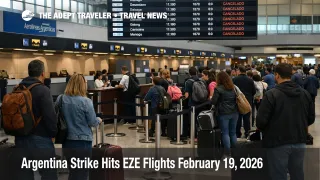
A 24 hour CGT general strike in Argentina is disrupting aviation and urban transport on Thursday, February 19, 2026, with a heavy concentration of traveler impact in Buenos Aires, Argentina. Passengers using Buenos Aires Ministro Pistarini International Airport (EZE) are the most exposed, especially anyone departing on February 19 or connecting from long haul arrivals to domestic legs. The practical next move is to treat February 19 as a low reliability travel day, shift travel into February 18 or February 20 to 21 where your ticket rules allow, and lock in ground transport alternatives early because buses, trains, and the Buenos Aires Subte are also affected.
The strike is no longer a warning, it is live disruption with hard numbers. Aerolíneas Argentinas reported 255 cancellations affecting roughly 31,000 passengers, which is a large enough cut that rebooking pressure will spill into other carriers and nearby international gateways.
On the airline policy side, American Airlines has already published a change fee waiver for Buenos Aires Ministro Pistarini International Airport itineraries, allowing eligible travelers to move flights into the February 18 to 21, 2026 window without a change fee, subject to the carrier's conditions.
Who Is Affected
Travelers scheduled to fly on February 19, 2026 to, from, or through Buenos Aires Ministro Pistarini are the core impact group, because a one day cancellation wave at a hub instantly turns into a multi day queue when seat supply is limited. If your itinerary includes a long haul arrival and a same day domestic connection, your risk is higher than it looks on paper, because even when the international flight lands, the domestic leg may be canceled, delayed, or sold out for reaccommodation. This is the ugly reality of strike days, the disruption is not just the flight you booked, it is the downstream inventory that would have saved you.
Travelers relying on airport access by public transport are also affected, even if their flight technically operates. When buses, trains, and the Buenos Aires Subte are disrupted, travelers arrive in uneven surges, curbside congestion builds, and check in cutoffs become harder to meet. This raises missed flight rates and forces last minute reissues that can be more expensive than a proactive rebooking decision.
There is also a regional ripple that matters for travelers trying to detour. When Buenos Aires capacity drops, passengers reflow to routings via São Paulo, Brazil, Santiago, Chile, and Montevideo, Uruguay, and that creates scarcity on seats that would normally have been optional. In practice, that means the "just reroute me today" request often fails unless you are flexible on dates, cabins, and connection points.
What Travelers Should Do
If you are traveling on February 19, 2026, act like you are managing a supply problem, because you are. Use your airline app or website to see if you have already been canceled, then move quickly while remaining inventory exists, especially on nonstop or one stop options that do not depend on a tight domestic connection. If your carrier has published a waiver, use it now, and if you are on American Airlines and meet the eligibility rules, the published Buenos Aires waiver is the cleanest path to shift into February 18 to 21 without paying a change fee.
Set a hard decision threshold for rebooking versus waiting. If you are protecting a cruise embarkation, a wedding, a timed tour, a visa expiry, a medical appointment, or any commitment where a one day slip becomes a financial loss, treat February 19 as a rebook now situation, not a monitor situation. If your plans are flexible and you can absorb an overnight, you can wait for day of operations, but only if you have a realistic backup plan for airport access and lodging if you get pushed to February 20 or later.
Over the next 24 to 72 hours, monitor operational signals, not commentary. Watch for additional airline bulletins, schedule change emails, and flight status changes inside the carrier app, because those update faster than news coverage. Separately, verify your airport access plan with whatever transport you can actually control, for example a pre booked car service, a hotel car, or a taxi plan with extra time, because public transport gaps can turn a nominally operating flight into a missed departure.
Background
A general strike hits travel through staffing and throughput chokepoints, not through aircraft alone. On the aviation side, when check in, baggage handling, ramp services, and operational control staffing thin out, airlines cut schedules because they cannot reliably process passengers, bags, and turns at scale. That produces the first order effect, cancellations and long lines, and then the second order effect, aircraft and crew mispositioning that disrupts the next day's network as planes and crews are not where the timetable assumes they will be.
The surface transport layer makes the disruption bigger than the flight schedule. When metro and rail options are reduced, travelers shift to roads, taxi demand spikes, and congestion eats the buffer that normally protects airport arrivals. Even travelers whose flights operate can fail at the last mile, which is why strike days often show a second wave of missed departures after the first wave of cancellations.
If you want a reference point for how to think about these days operationally, the pattern is similar to other strike driven travel days where the best outcome comes from moving early and simplifying the itinerary, rather than showing up and hoping the system holds. Two recent examples worth scanning are Strike Risk at Brussels Airport Flights March 12 and Feb 24 Italy City Transit Strike, Rome and Milan.
Sources
- Argentine labor reform faces key vote in lower house as unions stage nationwide strike
- A nationwide union strike in Argentina tests its leader Milei's flagship labor overhaul
- General strike begins: Protest against Milei's labour reforms underway
- Aerolíneas Argentinas canceló 255 vuelos por el paro de la CGT: afectará a más de 31.000 pasajeros
- Travel alerts, American Airlines