

Carnival Fleet IT Outage Disrupts Boarding
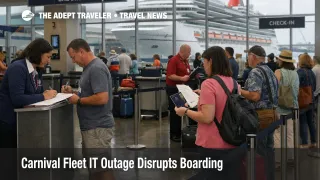
Carnival Cruise Line reported widespread IT problems that began during planned maintenance and then spilled into live operations across multiple ships. The disruption slowed debarkation and embarkation processes, and it also knocked out or degraded guest facing tools such as the Carnival HUB app and other onboard systems that normally keep boarding, payments, and schedules flowing. Passengers on affected sailings faced delayed terminal processing and, in some cases, cash only workarounds when account charging systems were not fully available. For travelers with upcoming departures, the practical move is to treat embarkation day like a partial offline scenario, meaning bring printed or saved documents, carry backup payment methods, and watch for last minute arrival window changes from Carnival.
The Carnival fleet IT outage matters because it turns a normally automated chain, identity verification, boarding group control, and onboard account activation, into a manual process. When that happens at scale, lines lengthen, departure times drift, and the downstream parts of a vacation, tours, transfers, and same day flights after the cruise, start breaking at the edges.
Who Is Affected
The highest risk group is anyone embarking on a ship during the affected turnaround days, because the chokepoint is the terminal pipeline itself. Reports indicated delayed processing on multiple vessels, including ships specifically named in industry coverage for embarkation delays and late departures tied to the outage. When a ship is still alongside late, it is not only an inconvenience, it is a time compression event that pushes everyone, check in staff, port agents, security, and shore excursion operators, into the same shrinking window.
A second exposed group is passengers who depend on digital tools onboard to manage spend and timing. When the HUB app is down or intermittent, travelers can lose their normal self service loop for daily schedules, excursion details, onboard messaging, and sometimes account information. Separately, when onboard charging systems are degraded, some venues may revert to cash only, which is manageable if you planned for it, and frustrating if you assumed every transaction would flow through your Sail and Sign account without friction.
A third group is anyone chaining tight logistics around embarkation day. That includes passengers with pre booked private transfers timed to a typical boarding window, travelers arriving on separate tickets the same morning as sail away, and families with prepaid shore excursions scheduled close to port departure. The first order effect is slow terminal throughput. The second order ripple is that late departures can cascade into shortened port calls, missed excursion meet times, and rework for drivers and tour operators who planned around a published all aboard time. Even when the itinerary does not change, the stress shifts to ground transport and customer service, which then spills into backlogs that can affect subsequent sail dates when adjustments, refunds, or goodwill credits need processing.
What Travelers Should Do
First, assume you may need to operate without the app for parts of embarkation day and the first evening onboard. Save offline copies of your booking confirmation, boarding pass, assigned arrival time, and any pre purchased packages where you will need proof, and keep a printed copy in your carry on if you are traveling with family or a group. Bring physical government issued ID that matches the reservation exactly, and do not rely on a single device battery to carry your entire check in.
Second, set decision thresholds for when to wait versus when to act. If Carnival sends a message pushing your arrival window later, follow it, because showing up early when systems are constrained is how you end up standing in the longest line. If you have independent ground transport booked, contact the provider as soon as you see a delay notice and renegotiate the pickup time, because drivers will otherwise arrive into terminal congestion, miss you, or charge wait time. If you are flying in on embarkation morning, the smarter threshold is to move to an earlier flight or arrive the night before, because a partial IT outage removes the slack you normally count on in the terminal.
Third, monitor the next 24 to 72 hours for signals that actually change your plan. The key indicators are direct Carnival communications about embarkation timing and any continuing reports of payment or account charging issues onboard, not general social chatter. If you board and notice charging systems are unstable, preserve optionality, keep more than one credit card available, carry a modest amount of cash for the casino or small purchases, and keep receipts so adjustments can be handled later without a memory fight. Travelers who want a broader playbook for tech disruptions across travel suppliers can also review how other operators handled offline workarounds in Germany Deutsche Bahn Booking Outage After DDoS, because the traveler tactics are similar even when the asset is different.
Background
A cruise turnaround is a tightly timed reset. A ship arrives, thousands of passengers disembark, cabins are flipped, provisioning lands, and a new sailing boards in a few hours. IT systems sit inside almost every step, they validate identity, manage boarding groups, reconcile guest counts, activate onboard accounts, and feed the apps that replace paper schedules and paper tickets. Carnival said the disruption was tied to IT issues that occurred during planned maintenance, and it emphasized that navigation and safety systems were operating, which points to a business systems outage rather than a ship control problem.
The way this kind of failure propagates through the travel system is predictable. First order effects land at the terminal and onboard point of sale, meaning slower check in, slower boarding, and degraded access to digital tools. Second order ripples show up across at least two adjacent layers. Shore excursion operators and port agents lose timing predictability, which can lead to meet time misses and rework fees, and ground transport providers see pickup windows drift, which increases no show disputes and wait time charges. Then the third layer, customer service and accounting, absorbs the backlog, because every manual workaround tends to generate more exceptions, more receipts, and more post trip adjustments than a clean digital flow. For another example of how cruise disruptions force travelers into rapid rebooking and documentation mode, compare this incident to Celebrity Infinity Piraeus Malfunction Cancels Sailing, where the trigger was mechanical, but the traveler safeguards, written proof, buffers, and fast triage, look very similar.