

JetBlue Adds JFK Houston Flights May 2026
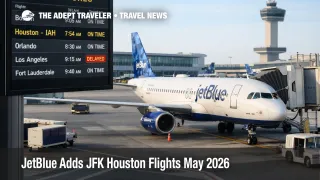
JetBlue will restart nonstop service between John F. Kennedy International Airport (JFK) and George Bush Intercontinental Airport (IAH) with twice daily flights beginning May 21, 2026. The change matters most for travelers who want a predictable, nonstop option between two large business markets, and for anyone building protected connections through JFK onto JetBlue's broader network. The practical next step is to treat this as a capacity add that improves nonstop availability, but still plan for New York area variability, especially if you are pairing the flight with fixed time commitments like meetings, events, or same day onward travel.
The published schedule shows two departures each day from JFK and two returns from Houston. Southbound, JetBlue lists Flight 1381 departing at 754 a.m. and arriving at 1059 a.m., plus Flight 281 departing at 141 p.m. and arriving at 448 p.m. Northbound, JetBlue lists Flight 1382 departing at 1150 a.m. and arriving at 427 p.m., plus Flight 282 departing at 544 p.m. and arriving at 1023 p.m. JetBlue says the goal is a schedule that works for same day trips, longer stays, and connections across its network, and flights are available for purchase now.
Who Is Affected
This route is most useful for travelers who previously had to choose between connecting itineraries, other airlines, or nearby airport substitutes to get between New York and Houston. It also matters for travelers who start in Houston and want a single ticket connection through JFK to JetBlue destinations across the East Coast, Latin America, the Caribbean, and some transatlantic markets, because adding a nonstop leg into JFK can reduce the number of moving parts compared with multi stop itineraries.
The timing is not random. Houston and the New York New Jersey host region are both scheduled to stage multiple 2026 FIFA World Cup matches, and large event demand tends to pull forward bookings, harden hotel cancellation policies, and tighten last minute inventory. Houston's host committee lists matches on June 14, June 17, June 20, June 23, June 26, June 29, and July 4, 2026. The New York New Jersey host committee lists matches on June 13, June 16, June 22, June 25, June 27, June 30, July 5, and July 19, 2026. If you are traveling around those windows, the risk is not just higher fares, it is fewer good flight times, longer lines for changes, and a higher chance that your preferred hotel category sells out first.
What Travelers Should Do
Start with immediate actions and buffers. If your dates are fixed, price the nonstop against your current plan, then decide whether the time savings is worth it given your connection exposure and your tolerance for late day recovery issues in New York. For World Cup weeks, assume rideshare surge pricing, heavier traffic to and from airports, and more friction on late arrivals, then build a buffer that matches the cost of missing your first commitment.
Use clear decision thresholds for rebooking versus waiting. If you are holding a tight same day agenda, treat a schedule change notification or a widening delay trend as a trigger to move to the earlier departure out of JFK, or to shift your trip by a day, while seats still exist. If your plans are flexible and you are on a single protected ticket, waiting can be rational, but only if you have a realistic backup flight the same day and you are not relying on a separate ticket connection that will not be protected.
Over the next 24 to 72 hours after you book, monitor the things that actually change outcomes. Watch for aircraft and schedule adjustments in your reservation, because airlines can fine tune departure times and frequencies after a route announcement. Keep an eye on hotel cancellation terms in both markets, because event demand often pushes properties to stricter cutoffs, and the penalty is usually more painful than paying slightly more for flexibility up front. If your trip overlaps match days, confirm your ground plan before you land, because the airport to hotel leg is where travelers tend to lose the most time when the city is under load.
For travelers who routinely route through New York airports, it is also worth reading LaGuardia Runway Closures Raise Delay Risk This Week as a reminder of how quickly small capacity constraints turn into late day knock on delays across the region. If you want the longer view on why airlines keep fighting for usable aircraft and usable slots, and why that matters for fares and availability, FAA Delays on Boeing 737 MAX 10 Hit Airline Capacity is the right background frame.
Background
Route restarts look simple, an airline adds a flight, and travelers get more choice, but the travel system response is more layered. The first order effect is straightforward seat supply on a city pair, which can reduce the need for connections and can put competitive pressure on alternative routings. The second order ripple shows up in how airlines allocate aircraft and crews across banks, because adding two daily roundtrips is not just four flights, it is four chances per day for a late inbound to disrupt the next leg, and four opportunities for misconnect pressure to build at the edges of the schedule.
Events add another layer. When both endpoints are hosting marquee matches, demand does not just rise, it concentrates into narrow date bands, which means the system has less slack. Hotels harden policies, airport access gets slower, and the cost of a missed connection increases because the next available seat might be tomorrow, not later tonight. That is why the correct traveler posture is not excitement about a new route, it is operational realism: buy flexibility where you can, protect connections on one ticket, and keep your ground plan as deliberate as your flight plan.