

Navitaire Outage India Check In Delays Feb 19
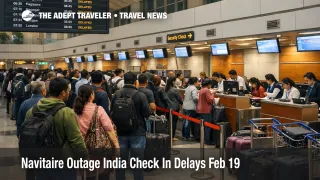
A global outage in Navitaire systems disrupted airline check in and day of departure processing across India on February 19, 2026, forcing airport teams to fall back to manual workflows at major hubs such as Indira Gandhi International Airport (DEL) and Chhatrapati Shivaji Maharaj International Airport (BOM). Passengers on carriers that rely on Navitaire, including IndiGo, Air India Express, Akasa Air, and SpiceJet, were the most directly exposed to longer queues, reissued boarding passes, and delayed bag acceptance. Travelers should treat the rest of the day as irregular operations, arrive earlier than normal, and carry offline proof of booking details in case the same failure mode repeats.
The Navitaire outage India check in problem is not only the initial outage window, it is the residual backlog and data cleanup that follows, which can keep lines longer and connections tighter even after the core systems return.
Who Is Affected
The most affected travelers are those flying on airlines that use Navitaire for reservations and departure control functions, because a slowdown or outage hits the basic steps that move people from curb to gate, including check in, boarding pass issuance, and exceptions handling. Multiple reports in India said Air India was largely unaffected because it operates on a different system, which matters in practice because it creates a two speed airport where some queues move normally while others compress into fewer staffed counters.
Travelers with checked bags are more exposed than carry on only passengers, because baggage acceptance is where manual processing can become a hard bottleneck, and where cutoffs become non negotiable when the line grows. Travelers on tight domestic to international transfers are also high risk, because even a short check in delay can remove the buffer you planned to use for security, terminal transfers, and boarding. Reporting from Indian outlets described airports switching to manual processing and experiencing extended queues during the morning peak at Delhi and other large stations, with delays recorded across multiple flights.
What Travelers Should Do
Treat this as a throughput problem, not an inconvenience problem. Arrive earlier than you normally would for the same airport and flight type, because the limiting factor is counter capacity and exception handling, not the walking time to your gate. If you have a checked bag, assume bag drop can move slower than the security line, and plan your curb arrival accordingly.
Decide your rebooking threshold before you get trapped in a line. If your connection is tight, if your onward flight is on a separate ticket, or if you must arrive the same day for a time sensitive event, your best move is usually to shift to a later departure or a simpler routing as soon as the airline offers a workable option. Waiting for the line to clear can be rational if you have slack in the schedule, but it is the wrong bet when you are already inside the minimum connection time window.
Over the next 24 to 72 hours, monitor for replay outages and cleanup effects. A Navitaire related statement reported that a planned maintenance change led to network instability, and that teams resolved the issue after roughly 50 minutes, which is exactly the kind of incident profile that can reappear if the change is rolled forward again or if deferred work introduces instability. Watch your airline app and airport advisories, keep your phone charged, and carry a screenshot or saved copy of your booking and boarding credentials so you can continue moving if systems slow down again.
How It Works
Navitaire is part of the airline passenger service and day of departure stack, meaning it sits on the critical path between your booking record and the operational steps that validate identity, assign seats, issue boarding passes, and reconcile bags to passengers. When that layer fails, airports revert to manual processes that are slower by design, because every exception becomes a human decision and every reissue becomes a counter transaction instead of a self service action. Coverage of the February 19, 2026 disruption described a morning outage window that pushed airlines into manual processing, which then created visible queues at major airports.
The disruption propagates in predictable layers through the travel system. The first order effects are check in bottlenecks, delayed baggage acceptance, and missed departure slots when flights cannot complete boarding on time. The second order effects show up later in the day as aircraft and crews arrive out of position, which compresses later departure banks and increases misconnect risk, especially at hubs where domestic arrivals feed international departures. That is why a short early window can still produce a long tail of delays even after the vendor declares recovery.
If you want a parallel mental model, read the operational dynamics in Germany Deutsche Bahn Booking Outage After DDoS, because the mechanism is the same, digital systems fail, travelers shift to staffed help, lines lengthen, and the cascade becomes a physical throughput problem. For deeper context on why modern travel operations are increasingly exposed to brittle digital dependencies, Cosmic Rays, Bit Flips, and the Airbus A320 "Icarus" Recall frames the broader resilience problem in systems terms.
Sources
- Navitaire outage briefly jolts IndiGo, Akasa, AIX check-ins
- Airline ops hit by Navitaire outage in India, Europe
- Technical glitch briefly disrupts airline operations across India
- What Is Navitaire, And Why A Glitch Grounded Flights Across India?
- All about Navitaire outage that disrupted flight operations in India and Europe