

Newark Airport Shutdown After JetBlue Smoke Feb 19
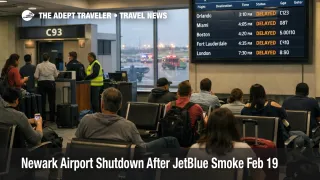
A short but high leverage disruption at Newark Liberty International Airport (EWR) is driving a longer recovery tail after JetBlue Flight 543, bound for West Palm Beach, returned to Newark and passengers evacuated via slides following reports of smoke. Flight operations were suspended or heavily constrained while emergency response worked the event and the aircraft was cleared, with broad operations resuming after roughly an hour. That sounds contained, but Newark is a major Northeast node, so even a one hour stop can knock aircraft and gates out of sequence and create cascading delays into the evening bank.
The Newark airport shutdown changes the decision math because the best same day options disappear fast once the system loses timing. When arrivals bunch up after a stop, the airport and airlines burn gate capacity catching up, and that pushes the next wave of departures late even if the original emergency is already over.
Who Is Affected
The most exposed travelers are anyone connecting through Newark tonight on a tight itinerary, especially if the second leg is a long haul international departure, a Florida departure that runs on full seasonal loads, or a last flight of the night with limited protected options. Reuters reported that the event drove substantial delays, and cited FlightAware data showing roughly 31 percent of inbound flights and 30 percent of outbound flights delayed during the disruption window.
Travelers on separate tickets are in a worse position than travelers on a single protected reservation because a short ground stop can turn into a misconnect that is operationally normal but financially painful. The airline will focus on reaccommodating customers it has a contractual duty to move, and that leaves separate ticket travelers competing for whatever is left, often at walk up pricing.
This also hits travelers who are not even touching Newark, because aircraft and crews are scheduled as rotations. A JetBlue or partner aircraft that arrived late into Newark does not magically reset, it departs late on its next leg, and the crew's duty clock keeps running. That first order delay at Newark becomes second order schedule drift, then missed connections at downstream hubs, and, in the worst case, a crew legality problem that forces a cancellation later in the night.
What Travelers Should Do
Take immediate actions that preserve options. Open your airline app, confirm your flight status, and then check whether your inbound aircraft is already late, because that is the fastest predictor that a "cleared" airport will still deliver a delayed departure. If you are connecting, treat anything under 90 minutes as fragile tonight, and move to an earlier bank or a longer connection if you still see inventory.
Use a clear decision threshold for rebooking versus waiting. If you are on the last viable bank into your destination, or you have a fixed deadline like a cruise all aboard time, an international check in cutoff, or a paid car pickup window, you should rebook proactively even if your current delay looks moderate. The system penalty for waiting is that reaccommodation queues lengthen, and the remaining seats consolidate into fewer flight options.
Over the next 24 to 72 hours, monitor whether today's disruption turns into rolling irregular operations. Watch for airline waiver language, because it determines whether you can change flights without fees, and monitor FAA flow programs and airport status pages for the New York area if weather or staffing constraints stack on top of the incident recovery. For structural context on why short ATC and airport constraints can ripple across the system, see U.S. Air Traffic Control Privatization: Reality Check.
How It Works
An airport "shutdown" or ground stop is rarely just about the hour flights were paused. The real impact is the loss of timing across arrival and departure banks. When Newark stops accepting or launching aircraft, arrivals queue, departures stack at gates, and the airport's gate plan becomes a constraint of its own because inbound flights need somewhere to park.
The first order effect is obvious at Newark, late arrivals, delayed departures, gate holds, and crowded rebooking lines. The second order ripple is what travelers feel hours later and sometimes hundreds of miles away. Aircraft arrive late to their next stations, crews run closer to duty limits, and airlines start swapping aircraft to protect higher priority routes, which can reshuffle seat maps and bump standby odds.
A third layer shows up in the New York area catchment. Once Newark is constrained, some travelers and airlines look to John F. Kennedy or LaGuardia as alternates, but those airports share the same airspace complex and often share the same capacity pinch points, so alternates can be operationally "open" while still having thin seat inventory. That is why the practical move is not just choosing another airport, it is choosing another bank, another routing, or another day when the network has slack.
For recent context on how Northeast constraints can turn small local delays into systemwide misconnect risk, see Flight Delays and Airport Impacts: February 7, 2026.
Sources
- Traffic disrupted at Newark airport after JetBlue engine failure
- Passengers evacuated via slides in incident that temporarily suspended flights at Newark airport
- Newark Airport reopens after aircraft emergency caused ground stop, FAA says
- FAA Daily Air Traffic Report
- Air Traffic Control System Command Center Advisory, 02/18/2026 Operations Plan