

Greece New Testament Tours Rise as Israel Trips Shift
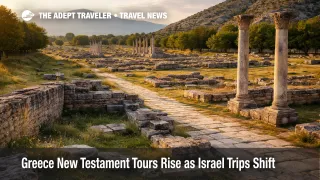
Greece New Testament tours are gaining share inside faith travel as Greece posted 40.7 million inbound visitors in 2024 and operators report rising demand for Apostle Paul focused itineraries across the mainland. Churches, schools, and small groups are the most affected travelers, because they plan far ahead and need predictable ground logistics. If you are building a 2026 program, the practical move is to lock flights and Athens lodging early, then treat islands and Turkey add ons as optional layers you can adjust based on sailing schedules and inventory.
The Greece New Testament tours story is not about a single new route or a single promotion. It is about substitution and throughput, travelers still want scripture anchored experiences, but they are redirecting to a destination that has broad air lift, mature guiding capacity, and sites tied to Acts and the epistles. Bank of Greece final 2024 data shows both scale and momentum, and that scale matters because it pushes scarcity into the exact parts of the trip that group travel depends on, coaches, licensed guides, and mid range Athens hotels.
Who Is Affected
The first group exposed is church and community groups that historically ran Israel centric programs and now need an alternative that still supports sermons, study plans, and academic goals. Multiple reports on Israel's recovery show tourism volumes remain well below pre war baselines, even as aviation capacity and passenger totals have improved from 2024 lows. That gap is enough to change risk tolerance for many planners, especially when they are responsible for seniors, first time international travelers, or groups that require firm departure dates tied to school calendars.
The second group is independent travelers and couples who want a biblical through line but prefer a mainstream European vacation structure. Greece works for them because they can blend biblical narrative with classical heritage without building a fragile itinerary. Philippi and the Via Egnatia corridor give a tangible anchor for Acts, while Athens and Corinth offer dense museum and archaeological layers that reduce the need for long coach days. Philippi's UNESCO listing is a useful signal here, it tends to correlate with better visitor infrastructure, clearer interpretation, and more predictable access rules.
The third group is cruise travelers using Athens as an air gateway, then adding Patmos and western Turkey as a packaged biblical extension. Bank of Greece reporting separates cruise receipts and shows that cruise activity is not a side note, it is a material contributor, which means ports, hotels, and air seats can tighten around turnaround days. Industry forecasts from the Hellenic Ports Association point to continued cruise growth, which is good for choice, but it also raises the planning penalty for late booking.
What Travelers Should Do
Start with the core architecture of the trip and make it resilient. Book flights into Athens early, then hold a refundable Athens hotel buffer on the front end and back end if your budget allows, because delayed arrivals, missed connections, or a single schedule change can otherwise break a group program. If you are building a Paul focused route, keep the mainland spine simple, Thessaloniki, Philippi, Athens, Corinth, and then decide later whether the islands or Turkey belong.
Set decision thresholds for rebooking versus waiting before you collect deposits from travelers. If your group is substituting for Israel, be explicit about what the Greece program delivers, Acts and the Pauline letters in the places they were written to and preached in, rather than a one for one replacement of Jerusalem centered narratives. If leaders want Revelation content, treat Patmos as its own module and make it optional, because sea conditions, port calls, and capacity constraints can affect the island layer more than the mainland layer.
Over the next 24 to 72 hours of active trip planning, monitor only signals that change inventory and risk. Watch flight capacity into Athens for your preferred days, hotel sell through around cruise turnaround windows, and whether your itinerary depends on weather sensitive links like ferries. If you are adding islands, use recent patterns as your planning posture, including the operational reality explained in Greece Ferry Sailing Bans at Athens Ports. If you are using Piraeus heavily, treat cruise schedule disruption as a low probability but high impact event, and plan buffer the way Celebrity Infinity Piraeus Malfunction Cancels Sailing illustrates.
How It Works
The mechanism is straightforward. Faith travel is demand that is sticky, but not perfectly location specific. When a core destination becomes harder to sell to a group, whether due to security headlines, insurance constraints, airline schedule volatility, or simply member anxiety, planners do not stop selling travel. They substitute to the closest product that still satisfies the teaching goal and the logistics constraints. Greece fits because the New Testament footprint is real, and because Athens acts as a high connectivity hub with predictable services, which reduces schedule fragility.
The first order effect lands in itinerary design. Operators lean into Apostle Paul narratives that map cleanly onto modern transport corridors, northern Greece for Philippi and Thessaloniki, then Athens and day trips for Corinth. That keeps transfers short and reduces the number of hotel changes, which is what usually breaks groups. The second order ripple shows up across at least two other layers. One ripple is cruise packaging, Patmos and Ephesus become add ons because they let planners widen the biblical scope without changing the mainland spine, and because cruise operators can carry the complexity of port sequencing. UNESCO context underscores why those add ons sell, Patmos is formally recognized for its monastic and pilgrimage heritage, and Ephesus is recognized for its multi period significance that includes early Christian layers.
Another ripple is capacity competition within Greece itself. Bank of Greece data shows 2024 was not just busy, it was record scale, and receipts grew even as per trip measures shifted. When inbound volume is that high, group travel competes with leisure weekends, cruise pre stays, and event tourism for the same beds and the same coaches. This is why "Greece is affordable" is not a plan, it is a hypothesis that only holds if you buy inventory early, choose shoulder season, and avoid the most compressed Athens dates.
Finally, there is a cross border planning layer when groups add Turkey. Ephesus is a common inclusion because it is close to Aegean cruise routes and it helps planners round out an early church narrative. The operational tradeoff is border and documentation complexity, you move from a single country trip to a multi jurisdiction program, which can change passport validity rules, shore excursion requirements, and insurance assumptions. If you are shifting from Israel travel planning, use a current entry checklist like Israel Entry Requirements For Tourists In 2026 as a template for the kind of documentation rigor you should apply, even when your substitute trip is in Greece.
Sources
- Developments in the balance of travel services: 2024 (Bank of Greece)
- Greece Welcomed 40.7 Million Visitors in 2024, Tourism Revenue Tops €21.6 Billion (GTP Headlines)
- Cruise Tourism Breaks Records in Greece: €1.1 Billion and 5 Million Passengers in 2024 (GTP Headlines)
- Greek Cruise Industry Sets New Records in 2024, Over 10% Growth Expected for 2025 (GTP Headlines)
- Israel's main airport receives passenger boost from Gaza ceasefire (Reuters)
- Faith Based Travelers Turn to Biblical Greece for a More Stable Journey (PR Newswire)
- Archaeological Site of Philippi (UNESCO World Heritage Centre)
- The Historic Centre (Chora) with the Monastery of Saint John the Theologian and the Cave of the Apocalypse on the Island of Patmos (UNESCO World Heritage Centre)
- Ephesus (UNESCO World Heritage Centre)