

Heavy Snow Vienna Airport Shutdown, 150 Flights Canceled
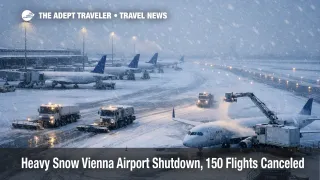
Vienna International Airport (VIE) temporarily shut down flight operations on Friday after heavy snowfall overwhelmed normal winter operations. The airport operator said the suspension was extended until 1100 GMT, and that only limited departures could begin from midday, with arrivals resuming around 1300 local time. Travelers are the ones paying the bill, about 150 of roughly 232 flights scheduled through midday were already cancelled, and the restart typically brings long, uneven delays as deicing, gates, and crews reset.
The practical travel reality is simple. Even after wheels start moving again, the schedule does not snap back. Once an airport loses a morning bank, the network has to rebuild rotations and crew legality, and Vienna is a connecting node where that rebuild can spill into the entire day.
Who Is Affected
Anyone traveling to, from, or connecting through Vienna today is exposed, but not equally. The most fragile itineraries are those with short connections, separate tickets, and onward commitments you cannot slide by a day, cruises, weddings, work starts, or timed entry tours. A hub shutdown blows up the connection math because flights that would normally carry misconnected passengers are the same flights being cancelled or delayed.
You are also affected if Vienna is your gateway to nearby cities by ground transfer. When Vienna drops capacity, passengers reroute, hotels fill, and rail corridors load up, especially toward Bratislava, Brno, Budapest, and Prague. That secondary demand is not theoretical, it shows up as sold out evening trains, long taxi lines, and higher last minute hotel rates.
Airlines based at Vienna are the most operationally constrained because their crews and aircraft are tied to Vienna's deicing and stand availability. Austrian Airlines has already flagged that weather conditions at Vienna can drive delays and cancellations on February 20, 2026, and it is the carrier most likely to manage the largest volume of disrupted passengers through its own rebooking channels.
What Travelers Should Do
If your flight is cancelled, do not go to the airport to "see what happens." Your leverage is highest online while seats still exist, and your risk is highest in the terminal when you are competing for the same limited rebooking inventory. Check your airline app, email, and SMS, then rebook, reroute, or request a refund from wherever you are warm, fed, and not standing in a snow soaked line.
Use decision thresholds, not vibes. Rebook now if you have a connection under 90 minutes at Vienna, any separate ticket onward leg, or a must arrive commitment today. Waiting can be rational if you are on a single protected ticket, your itinerary is point to point, and you can tolerate arriving late tonight or tomorrow, but only if you are seeing consistent movement in departures and arrivals, not just optimistic status messages.
Over the next 24 to 72 hours, monitor operational signals that predict tomorrow's pain. Watch the rolling cancellation count, and watch whether airlines start protecting passengers over Munich, Prague, Budapest, or Zurich, because that is a clue that Vienna's recovery is not clean. If you reroute, favor itineraries with longer layovers and fewer legs, because crew duty limits after a shutdown are a common Saturday morning failure mode.
Background
Snow shutdowns propagate through the travel system because the airport is not a single bottleneck, it is a stack of bottlenecks. First order, runway and taxiway clearing and deicing limit how many aircraft can move per hour, and once that rate drops below the schedule, cancellations become the only way to restore safety and spacing. Second order, aircraft and crews end up out of position, which means the next city pair on that aircraft's rotation fails even if the weather improves, and duty time limits force carriers to cancel flights that "could" operate in a purely mechanical sense.
Vienna's role as a Central Europe connector adds another layer. When Vienna loses a morning bank, it breaks same day onward connectivity across short haul Europe and some long haul flows, then pushes displaced passengers into later banks that are already full. That crowding is why a restart at midday can still yield all day disruption. Overland travel becomes the pressure valve, rail and coach absorb some demand, hotels absorb the rest, and both can tighten quickly when hundreds of passengers are forced into unplanned overnights.
Recent disruption elsewhere in the region is a reminder that recovery is rarely neat once the system loses its normal cadence. Weather driven constraints have been repeatedly stressing European transport, including Storm Nils Spain, Portugal Transport Disruption Updates, and non weather failures can still create similar rolling effects, such as Cologne Bonn Airport Security Glitch Delays Flights. For broader tactics that apply across cancellations, waivers, and missed connections, keep Flight Delays bookmarked as you rebuild your itinerary.