

Cologne Bonn Airport Security Glitch Delays Flights
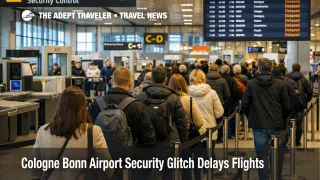
A security checkpoint technology failure at Cologne Bonn Airport (CGN) triggered evacuations in the security areas and a temporary stop to departures on February 13, 2026. Germany bound travelers, plus anyone using CGN for a connection, were caught in a reset event where passengers already past screening had to be pushed back out and screened again. If you are flying through Cologne Bonn in the next few days, the practical move is to treat security screening as the limiting factor, build buffer time, and be ready to rebook before queues and missed connections compound.
The Cologne Bonn airport security glitch matters because this was not a weather delay you can simply "wait out." It was a process integrity break in the sterile area, which forces a full compliance response, including evacuations, searches, and rescreening, before the system can safely restart.
Cologne Bonn Airport said the Federal Police evacuated the terminals' security area around 630 a.m. local time as a precaution after a temporary technical malfunction involving new CT screening technology. About 800 passengers who were already in the secure area had to leave and undergo another security check, and access to the security area was temporarily closed. The airport reported operations resumed around 930 a.m., with significant queues and delayed flights as the backlog cleared through the afternoon.
Reuters, citing local reporting and flight tracking, described a several hour halt, with departures starting again shortly after 900 a.m. local time, and noted the airport's scale as one of Germany's busier airports. The exact minute matters less than the pattern morning shutdowns burn through departure slots, then force airlines into a recovery sequence of retimed rotations and constrained gate planning.
Who Is Affected
Travelers departing CGN are the most directly exposed, because the security checkpoint is the choke point that determines whether you even reach your gate. Passengers connecting at Cologne Bonn also face elevated misconnect risk, especially when the inbound arrives on time but the outbound departs late enough to cascade into missed onward rail, hotel check in windows, or evening curfews at smaller destination airports. Anyone on separate tickets should assume the second carrier may treat a missed flight as a no show unless you rebook proactively and keep documentation aligned.
Airlines get hit in a different way than passengers. A stop in departures creates aircraft positioning drift, meaning the airplane that is supposed to operate a later city pair might be late, stuck on the wrong stand, or arrive without a legal crew pair for the next sector. That is how an incident that "ends" mid morning can still produce rolling delays across later waves, including flights that never touch the original security lanes.
The secondary ripple is mode switching. When airport departures become unreliable, travelers try to substitute rail or nearby airports, but that only works if those alternatives have usable inventory and stable systems. If you are thinking about rail as a fallback inside Germany, read Germany Deutsche Bahn Booking Outage After DDoS first, because disruption layering is a real risk when you stack two fragile links back to back.
What Travelers Should Do
Start with an operational posture, not a hopeful one. Confirm your flight status with your operating carrier, then plan to arrive earlier than you normally would for screening, because rescreening backlogs tend to reappear in bursts as airlines re time departures into new banks. If you can select seats, choose something that lets you move quickly on arrival, because missed connections often become a footrace once gates start turning again. If you are traveling with checked bags, keep essentials in your carry on, because baggage systems and passenger flows rarely recover at the same pace.
Set a rebooking threshold before you are trapped inside the airport. If your delay pushes you beyond a critical commitment, like a same day international connection, a cruise departure, or a paid tour, you should usually rebook as soon as your airline offers a workable alternative, even if it is less convenient. Waiting for the "original flight" is only rational when the next option is meaningfully worse and you have real confidence the airport is clearing security throughput steadily. For travelers already dealing with Germany wide irregular operations, Lufthansa Strike Germany Rebooking and Refund Rules is a useful reference for how cleanup phases create hidden ticketing and reimbursement failures.
Over the next 24 to 72 hours, monitor three things that predict whether CGN is truly stable. Watch official airport updates for security lane availability and queue warnings, watch your airline for schedule retimes that signal aircraft and crew repositioning, and watch connection feasibility, not just departure time, because late day banks are where drift usually shows up. If you must travel, favor routings with fewer segments and longer connection times, and avoid stacking separate tickets unless you are willing to absorb a misconnect. If you want the deeper systems view of why "a small tech fault" can force a full reset, Cosmic Rays, Bit Flips, and the Airbus A320 "Icarus" Recall is the right mental model: complex safety systems fail conservatively, and conservative failures are expensive.
Background
Airport security screening is built around a sterile area concept, once you pass screening, the airport must be confident that everyone and everything in that zone is cleared to the required standard. When a new technology rollout produces a malfunction that could compromise that assurance, authorities typically take the conservative path, evacuate the secure area, search as needed, and rescreen people who were already inside. Cologne Bonn Airport said the February 13 event was tied to the introduction phase of new CT technology, and that technicians and the manufacturer worked to identify and correct a technical fault before resuming access and departures.
This kind of disruption propagates through the travel system in layers. The first order effect is immediate screening bottlenecks and lost departure slots, which pushes flights into later windows and reduces the margin for on time performance the rest of the day. The second order effects then show up outside the checkpoint itself, aircraft and crew positioning drift, gate conflicts, and constrained rebooking inventory, plus hotel demand spikes for forced overnights and rail spillover when passengers choose to abandon air travel. Even after operations resume, some travelers will still lose the day because a multi hour morning halt often breaks tight connections, and the recovery bank may not align with onward schedules.