

Italy Lombardy Rail Strike Feb 27 to Feb 28
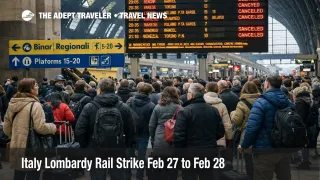
A national rail strike is set to disrupt train service across Italy, with Lombardy facing acute risk because so many itineraries funnel through Milan rail corridors. The action is scheduled from 900 p.m. on Friday, February 27, 2026 to 859 p.m. on Saturday, February 28, 2026, local time in Italy. Travelers should assume cancellations, reduced frequency, and crowded remaining departures, then plan around guaranteed time windows and a realistic overnight fallback.
The practical problem is timing. This strike window starts late Friday evening, then covers most of Saturday, which is when many travelers try to reposition after a disrupted flight day, or when weekend city breaks and ski transfers are in motion. In Lombardy, that translates into pressure on Milan area platforms, airport rail links, and the regional trains that connect into long distance services.
Trenord, which runs most regional rail in Lombardy, says Saturday service will operate in guaranteed time slots from 600 a.m. to 900 a.m. and from 600 p.m. to 900 p.m. Outside those windows, trains can be canceled or heavily reduced, and the remaining options can fill fast.
Who Is Affected
Travelers based in Lombardy, Italy, or transiting through the region, carry the highest exposure, especially anyone using Milan as a hinge point between airports, city centers, and onward rail. If your plan depends on a specific train time to make a flight, a cruise departure, or a timed tour check in, you are in the risk group, because even one cancellation can break the whole chain.
Saturday travelers are the most exposed because the strike runs through most of the day, and because guaranteed windows do not cover midday. Trenord also notes a narrow Friday evening carve out, trains scheduled to depart by 900 p.m. Friday and arrive at their final destination by 1000 p.m. are planned to operate, but anything later is a gamble.
Airport rail users should treat this as a real misconnect scenario. Trenord specifically flags that if airport services are canceled, replacement buses may be used for Malpensa related routes, including a non stop replacement between Milano Cadorna and Malpensa Airport for the RE54 line, and between Stabio and Malpensa Airport for the S50 route. If you are trying to protect an international departure, plan for slower transfers, longer lines, and fewer options if you miss the last workable connection.
What Travelers Should Do
Make the decision early on whether this is a must travel weekend or a discretionary one. If the trip is optional, shifting your rail travel off Saturday, February 28, 2026 is the cleanest risk reduction, because you are removing yourself from the constrained day when demand concentrates into a few protected windows. If you must travel, target departures inside the guaranteed windows, and treat anything outside them as a bonus rather than a plan.
Set clear thresholds for rebooking versus waiting. If your itinerary includes an airport transfer by rail on Saturday, and your planned train falls outside the 600 a.m. to 900 a.m. or 600 p.m. to 900 p.m. guaranteed windows, assume it may not run, and secure an alternate path now, such as a date shift, a private transfer, or an overnight near the airport or station. If your train is within a guaranteed window but you have a tight onward connection, add buffer anyway, because a "running train" can still mean platform crowding and slower station flow.
Over the next 24 to 72 hours, monitor operator specific strike pages, not social chatter. Trenitalia points travelers to guaranteed train lists for medium and long distance services during this strike window, and Rete Ferroviaria Italiana, which manages the rail network, notes that service changes can occur even before the official start and after the official end of the strike. That matters because the edges are where travelers get trapped, late Friday arrivals that do not materialize, and early Sunday knock on delays that break return plans.
Background
Rail strikes do not fail like a simple on off switch. The first order effect is staffing, fewer crews, fewer dispatch and station resources, and fewer trainsets turned on time, which produces cancellations and longer gaps between departures. In Lombardy, those gaps matter more than usual because Milan functions as a high throughput switchyard for regional, airport, and long distance services, so when frequency drops, the remaining trains absorb displaced demand and become crowded.
The second order ripple is mode shift, and it is usually where costs spike. When rail capacity is constrained, travelers push into taxis, rideshare, rental cars, and intercity coaches, which then face their own constraints, weather, traffic, limited inventory, and higher prices at short notice. Hotels become the pressure valve, especially near major stations and near airports, because travelers who miss the last workable connection often have no same night alternative that preserves a morning obligation.
This particular window also stacks with late February air disruption risk in Italy, which makes the Milan area rail network a likely fallback for travelers trying to salvage itineraries. If you are exposed on both modes, treat it as a cluster risk, protect your most time sensitive segment first, then build a plan that does not require a perfect handoff between stressed systems. For related context, see Italy Aviation Strike To Hit Flights Feb 26, 2026 and Italy Rail Strike to Hit Trains Feb 27 to 28.
Sources
- Sciopero 27-28 febbraio 2026 (Trenord)
- Strikes on February 27-28, 2026 (Trenord, English notice)
- Servizi minimi garantiti in caso di sciopero (Trenitalia)
- SCIOPERO NAZIONALE DEL TRASPORTO FERROVIARIO (RFI Infomobilità)
- Sciopero aerei e treni, gli orari delle mobilitazioni previste per il 26, 27 e 28 febbraio (Sky TG24)