

Romania Snow Disrupts Bucharest Airport, Roads, Rail
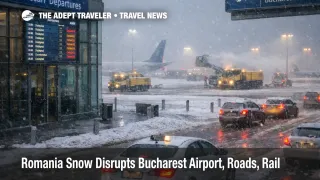
Heavy winter weather across Romania has created a true multi modal disruption, with flight irregular operations around Bucharest, major road restrictions that can cut off airport access, and rail delays that can stretch for hours. Travelers are most exposed if they are using Bucharest as a single gateway, then relying on a same day transfer by road or train to another city or resort area. The practical move is to protect your itinerary early, build time for a forced overnight, and be ready to reroute through a neighboring country if road and rail conditions do not stabilize.
Romania snow disrupts transport because it is not one failure point. It is a stack, runway and ramp throughput, de icing and visibility constraints, road clearance and stranded vehicles, plus rail line blockages from fallen trees and infrastructure impacts, all interacting at once. Reporting on the storm described widespread transport disruption alongside significant power outages, which adds friction when travelers need hotels, updates, and ground transport at the same time.
Who Is Affected
Anyone flying to, from, or connecting through Bucharest Henri Coandă International Airport (OTP) is exposed, but the higher risk group is travelers who must also complete a same day transfer by car or rail. When main routes into Bucharest are closed or heavily restricted, it is easy to end up with an airport that is technically operating while passengers still cannot reliably reach it, or cannot leave it, on schedule.
Leisure travelers heading for mountain and resort corridors should treat transfers as the fragile leg. Even if your flight lands, a closed motorway segment or a wave of stranded vehicles can make the last 60 miles the part that breaks the day. Local reporting described road and highway closures and heavy accumulation in multiple regions, which is the kind of condition that turns an airport arrival into an unplanned overnight in the capital.
Rail passengers are also in the blast radius, especially those using Bucharest North Station as a connection node. Snow driven line issues, including trees onto overhead lines, can generate delays that cascade across the timetable, and that forces missed onward links even when your first segment runs.
Finally, the power outage dimension matters more than travelers want to admit. A large outage footprint increases the odds of hotel inventory tightening, payment and connectivity hiccups, and slower local recovery, even after snowfall rates ease. Reuters reported about 200,000 homes without power at peak, which is enough to create real operational drag.
What Travelers Should Do
If you are traveling within the next 24 hours, act like the ground network is the constraint, not the flight. Check your airline status, but also map your airport transfer options, and assume the fastest route may not be usable. If your plan depends on landing at OTP and immediately continuing by car, build a buffer that includes an overnight in Bucharest, because a road reopening can lag the airport recovery, and a reopened road can still be impassable if stranded vehicles choke it.
Use decision thresholds to avoid wishful waiting. Rebook now if you have a connection under 90 minutes, if you are on separate tickets, or if a same day rail transfer is required to save a hotel night or a tour start. Waiting can be rational if you are on one protected ticket and you can accept arriving a day late, but your cutoff should be when the last flight or last train option becomes the only remaining viable path, because that is where rebooking scarcity turns into forced expensive choices.
Over the next 24 to 72 hours, monitor the signals that predict whether the system is actually improving. Watch official weather warnings, watch whether authorities are still reporting stranded vehicles and corridor closures, and watch whether trains are reporting hour scale delays rather than minute scale lateness. If conditions persist, consider a controlled reroute via nearby hubs like Sofia Airport (SOF) in Sofia, Bulgaria, or Budapest Ferenc Liszt International Airport (BUD) in Budapest, Hungary, then continue by train or car on cleared corridors. That is not comfortable, but it is often more reliable than betting everything on a single stressed gateway.
Related winter disruption playbooks can be useful for pattern recognition, even when the country is different, because weather recovery failures tend to rhyme across Europe. Heavy Snow Vienna Airport Shutdown, 150 Flights Canceled shows how a morning shutdown turns into all day misconnect risk. Schiphol De Icing Delays Raise Winter Connection Risk explains why de icing and apron throughput can break a hub even when runways look nominal.
Background
Snow disruptions propagate through a travel system because airports, roads, and rail are coupled by time and by capacity. First order, heavy snowfall reduces safe throughput, runways and taxiways take longer to clear, de icing queues grow, and visibility can slow arrivals and departures. Ground access then becomes the second choke point, especially when motorway closures, restrictions, or stranded vehicles block the corridors that feed the airport and central stations. When that happens, even a modest flight schedule reduction can cause outsized passenger disruption, because late arriving travelers miss trains, drivers time out, and hotels absorb the overflow.
The second order ripple is where costs explode. Delayed or diverted flights push passengers into the same limited set of hotels and rebooking channels at once, while rail delays remove the pressure valve travelers normally use to escape the airport region. Reuters and other reporting tied the storm to blocked roads, delayed trains, and widespread outages, which is the classic profile for multi day recovery risk if the weather system stalls.