

TSA PreCheck Status Unclear at US Airports in Shutdown
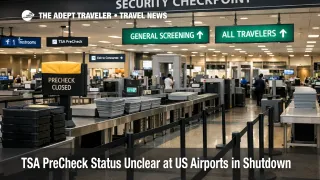
The Department of Homeland Security said it would suspend expedited Trusted Traveler processing at airports and ports of entry during the ongoing partial shutdown tied to a lapse in DHS funding. That change affects travelers who normally use TSA PreCheck for faster airport security screening and Global Entry for faster U.S. re entry processing after international trips. In the hours after the announcement, the Transportation Security Administration said TSA PreCheck remained operational with no change for the public, but warned it could adjust operations case by case if staffing constraints emerge.
For travelers, the practical takeaway is not the political blame game, it is operational uncertainty. If your trip assumes PreCheck will be open at your home airport, or that Global Entry kiosks will speed your connection after an international arrival, treat that assumption as fragile until DHS funding is restored. Even brief interruptions push more people into general lanes, which raises average wait times, increases line volatility, and makes early morning peaks and late afternoon departure banks harder to predict.
Global Entry is the cleaner operational story because DHS said U.S. Customs and Border Protection officers assigned to Global Entry processing would be reassigned to serve the broader arriving traveler population. That shift can help keep the whole arrivals hall moving, but it removes the time saving "escape hatch" that frequent international travelers rely on, and it increases misconnect risk for anyone connecting onward on a single ticket with a short minimum connection time.
Who Is Affected
Any traveler departing from a U.S. airport during the shutdown window can be affected, because even partial reductions in expedited lane availability ripple into the standard screening lanes. Travelers who paid for TSA PreCheck or Global Entry are the most directly impacted because the value proposition is speed and predictability, and both are being put at risk by staffing and resource reallocation decisions during the funding lapse.
The largest practical impacts typically show up at big hubs where a high share of passengers normally flows through PreCheck lanes, and at airports with heavy international arrival banks where Global Entry participation is high. When expedited lanes shrink or pause, the "extra" passengers do not disappear, they simply re join the same general queue that also includes infrequent travelers, families with more screening friction, and passengers who are already stressed by unfamiliar procedures. That mix slows throughput per minute at the checkpoint and increases the chance that TSA consolidates lanes to match staffing, which is how a localized staffing problem becomes a visible line problem.
This matters beyond the checkpoint. Longer screening lines can create late gate arrivals that force airlines to close boarding earlier, especially for regional connections and for international departures with document checks. When flights depart late, the delay propagates into aircraft rotations and crew duty limits, which can convert a morning queue problem into afternoon cancellations or missed connections in a different city. On the arrivals side, slower passport control increases curb congestion, strains ground transport supply, and can force unplanned hotel stays if a missed connection strands passengers overnight.
What Travelers Should Do
If you are flying on February 22, 2026, or in the days immediately after, plan as if you will use general screening and standard arrivals processing, then treat any expedited lane availability as a bonus. Build extra time into airport arrival, and do not anchor your plan to "normal" PreCheck throughput if you are departing during early morning peaks or holiday style surges. If your itinerary includes an international arrival and a tight onward connection, increase your connection buffer or rebook to a later flight where possible.
Use a clear decision threshold for rebooking versus waiting. If your trip has a hard start time, such as a cruise embarkation, a same day wedding, or a paid tour departure, rebook to protect the outcome rather than gambling on variable queues. If you have flexibility and you are on a single airline ticket, waiting can be reasonable, but only if you can tolerate a longer airport day and you have a backup flight option that same evening. Avoid separate tickets and self connections, because the system will not protect you if a line delay makes you miss the second leg.
Over the next 24 to 72 hours, monitor three things: DHS and TSA operational updates, your airport's reported checkpoint wait times, and airline waiver behavior. A key signal is whether airports begin consolidating checkpoints or whether TSA starts limiting PreCheck availability by terminal or by time window. If you see waivers issued for your route or airport, use them early, because once lines build, rebooking inventory and call center capacity usually tighten at the same time. For more structural context on how shutdown driven staffing strain turns into travel disruption, see Government shutdown travel: What to expect if it drags on.
Background
TSA PreCheck and Global Entry are part of DHS Trusted Traveler programs, which move pre vetted travelers through dedicated lanes using different screening rules and staffing patterns than standard lanes. The operational advantage is not just speed, it is predictability, because the program design concentrates low friction passengers into a flow that can be processed faster per officer. When a shutdown forces resource triage, agencies can shift personnel away from "premium lanes" and toward the general population to keep base throughput stable, but that trade changes the shape of queues, and it usually increases wait time variance for everyone.
This is why even a partial pause, or even a case by case reduction, matters. Airports run on banked schedules, and security and customs are choke points, not optional amenities. If those choke points lose staff, or if they lose the expedited segmentation that keeps the system smooth, the second order effects show up quickly: missed boarding windows, misconnected passengers, displaced crews, and higher hotel demand around major hubs. Travelers can mitigate the risk by adding buffer, avoiding tight connections, and choosing itineraries with slack, but they cannot "opt out" of the system constraints when staffing and lane configuration change mid day.
If you are a frequent flyer who normally relies on technology assisted identity checks and expedited flows, remember that those layers depend on stable staffing and consistent lane configuration. Recent expansions, such as TSA PreCheck Touchless ID at more airports, improve throughput when operations are stable, but they do not eliminate the basic reality that a funding lapse can force agencies to simplify operations by pushing more travelers into fewer, more general processes. See TSA Touchless ID Expands To 65 Airports By Spring for how the expedited stack normally works when it is fully staffed.
Sources
- 1 Week into Democrats' Shutdown, DHS Implements Emergency Measures to Conserve Resources and Protect Americans
- TSA says PreCheck still operational after previous announcement of suspension during funding fight
- Government shutdown forces DHS to suspend Trusted Traveler programs
- DHS reverses course on suspending TSA PreCheck after outcry
- TSA PreCheck(R) reaches milestone with 20 million members