

TSA PreCheck Suspension Reversed at US Airports
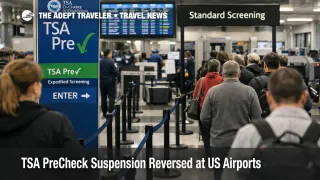
The Department of Homeland Security reversed course on a plan that would have closed Transportation Security Administration PreCheck lanes at U.S. airports during the ongoing partial government shutdown. TSA said PreCheck remained operational for travelers, while warning that airports could still see case by case operational adjustments if staffing constraints worsen. At the same time, DHS said the U.S. Customs and Border Protection Global Entry program is shut down for as long as the shutdown continues, which removes the expedited arrivals lane many frequent international travelers rely on.
The practical change is not that every airport snaps back to normal overnight, it is that the worst case security line shock was avoided, but uncertainty remains. When agencies signal they may consolidate lanes or adjust staffing hour by hour, the traveler experience becomes less predictable, especially during early morning departures and late afternoon peaks when airports are already operating near their throughput limits.
Who Is Affected
Domestic flyers who usually count on PreCheck time savings are still in the blast radius because "operational" does not mean "identical everywhere." If an airport has to reassign officers, consolidate checkpoints, or shorten PreCheck lane hours to cover standard screening, the line you see can change quickly even within the same terminal. That is why this story still matters for travelers who never touch an international flight, a small staffing change at document check can back up the whole checkpoint and push late arrivals into missed boarding windows.
International arrivals are the cleanest, most predictable pain point. With Global Entry processing suspended, pre approved travelers are pushed into standard arrivals processing, which lengthens queues and increases variability. The first order effect is longer time from gate to curb. The second order ripple hits connections, ride pickup congestion, and hotel nights, because a 30 minute arrivals delay can break a tight onward connection, and a wave of misconnects can drain same day rebooking inventory across multiple cities.
This also propagates across the broader travel system in ways travelers do not see until it is too late. When a large share of passengers reaches gates late because screening is slower, airlines face higher rates of denied boarding at cutoffs, more baggage that misses flights, and more customer service demand. That demand competes with storm recovery staffing and rebooking workflows, which is exactly how a "lane policy" story can become a multi day schedule reliability problem.
What Travelers Should Do
Take immediate steps that preserve options. For departures, plan your airport arrival as if you will use standard screening, then treat any fully staffed PreCheck lane as a bonus. If you have a must arrive event, shift to an earlier departure or a nonstop now, because once lines build and flights delay, the remaining seats disappear fast.
Use a hard decision threshold for rebooking versus waiting. If your itinerary includes an international arrival with a connection that is under two hours, or you are on separate tickets, the rational move is to rebook to a later onward flight or route through an airport where you have more slack. Waiting only makes sense when you are protected on one ticket, you have multiple same day backups, and you can absorb a longer day if arrivals processing runs slow.
Over the next 24 to 72 hours, monitor the signals that predict your odds, not the headlines. Watch for TSA statements about staffing driven adjustments, your airport's posted checkpoint wait times, and airline waiver behavior for storm and shutdown disruptions. If waivers appear for your route, use them early, because waiver windows close and hold times climb at the same time. For deeper planning context, see TSA PreCheck Status Unclear at US Airports in Shutdown and Government shutdown travel: What to expect if it drags on.
Background
TSA PreCheck and Global Entry are DHS "Trusted Traveler" programs designed to segment low risk, pre vetted travelers into faster processing flows. That segmentation is the point, it increases predictability by keeping a high throughput lane running with different procedures and staffing patterns than standard screening and standard arrivals. When a shutdown forces staffing triage, agencies tend to protect baseline throughput for the majority of travelers by reallocating personnel away from premium lanes, which increases variance for everyone and removes the time savings frequent travelers paid for.
This is why the reversal is meaningful but not a full return to normal. Keeping PreCheck open reduces the chance of immediate checkpoint gridlock at major hubs, but the "case by case" caveat matters because it tells you the system can still degrade locally. Meanwhile, suspending Global Entry changes the shape of international arrivals banks, and those banks drive downstream connections, curbside congestion, and missed flight cascades that can extend beyond the airport where you land.
Sources
- Global Entry program halted amid government shutdown, Homeland Security confirms
- DHS reverses decision to suspend TSA PreCheck and Global Entry due to shutdown
- DHS says TSA PreCheck still operational after announcing suspension amid partial shutdown
- DHS reverses course on suspending TSA PreCheck after outcry