

Italy Aviation Strike Disrupts Flights Feb 26, March 7
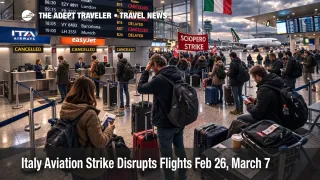
Italy's aviation system is facing a wider disruption window than a single strike date, because a 24 hour aviation action on Thursday, February 26, 2026 is now paired with credible reporting that points to additional action on Saturday, March 7, 2026. Leisure travelers, business travelers, and anyone using Italy as a connection point are the most exposed, especially on short haul itineraries that depend on fast aircraft turns and full staffing. The practical move is to treat February 26 as an avoidable risk day when you can, and to build a backup plan for early March return trips before inventory tightens.
The Italy aviation strike Feb 26 risk has widened because the system is now staring at a two wave stress test, flight and ground disruptions first, then potential air traffic flow restrictions if March 7 proceeds. That combination changes how you should hedge connections and round trips.
Who Is Affected
Travelers flying into, out of, or within Italy on February 26 are directly exposed, but the bigger trap is anyone whose itinerary depends on a tight chain. That includes cruise passengers trying to protect embarkation days, travelers using separate tickets, and travelers mixing rail and air on the same day.
The most vulnerable airports are the large gateways where cancellations immediately spill into missed connections and rebooking queues, including Leonardo da Vinci Fiumicino International Airport (FCO), Milan Malpensa Airport (MXP), Milan Linate Airport (LIN), and Venice Marco Polo Airport (VCE). When staffing falls away at check in, baggage acceptance, gate handling, and ramp operations, even flights that still operate can inherit long processing times and late gate changes. ENAC explicitly notes protected time windows from 700 a.m. to 1000 a.m. and from 600 p.m. to 900 p.m. local time, when flights must still be operated, but that does not mean the airport is running normally around those flights.
Carrier participation matters because it determines whether you are dealing with scattered delays, or a schedule collapse. The transport ministry strike calendar lists a nationwide aviation action on February 26, and also lists 24 hour actions for ITA Airways staff and for easyJet pilots and cabin crew that same day. ITA Airways also says it canceled about 55 percent of its February 26 operation, and some flights on February 25 and February 27, which is a strong signal that the disruption radius is already extending beyond the headline date.
The March 7 risk is different in kind. Multiple reports describe March 7 action tied to ENAV staffing at the Rome area control center, which can force air traffic flow restrictions that ripple across the national network, including flights that never touch Rome. If air traffic control capacity is constrained, you can see en route holding, departure metering, and longer block times, which then cascade into crew duty time limits and downstream cancellations later in the day.
What Travelers Should Do
If you have flexibility, move critical travel off Thursday, February 26, 2026, even if the fare is slightly higher, because the expensive failures are missed onward connections, forced hotel nights, and last minute replacement tickets. If you must fly that day, target flights that depart inside ENAC's protected windows, then add buffer anyway, because protected windows do not guarantee normal staffing at curbside, check in, security, or baggage.
Set decision thresholds now, not at the airport. If you are on separate tickets, or if a delay would leave you with under two hours for a domestic or short haul connection, or under three hours for a long haul connection, treat that as a reroute trigger instead of waiting in line and hoping. If your airline offers a fee free change or refund path for disrupted flights, use it early, because the best routings disappear fast once mass cancellations post. ITA Airways says affected passengers can change without penalty or request a refund under specific conditions, and it sets an action deadline of March 8, 2026 for its February 26 disruption handling.
Over the next 24 to 72 hours, monitor three signals that tell you whether this is widening as March 7 approaches. First, watch whether airlines publish expanded canceled flight lists, not just generic advisories. Second, watch for airport operator updates that point to staffing strain, because that is what turns a manageable strike day into an all day queue problem. Third, watch for confirmation language around ENAV and flow measures, because air traffic control constraints can hit flights across Italy even when ground staff are available.
For related context on how the late February strike stack interacts with rail fallbacks, see Italy Aviation Strike Hits Flights February 26, 2026 and Italy Lombardy Rail Strike Feb 27 to Feb 28.
Background
A strike day breaks the travel system in layers, and the first layer is rarely just the flight itself. When airline and airport workgroups stop work, the immediate choke points are check in, baggage flow, gate handling, and ramp sequencing, which means a flight can be technically operating while the airport behaves like it is under a capacity restriction. That is why the ENAC protected windows help preserve a minimum level of service, but do not guarantee smooth processing, especially during peaks when disrupted passengers are competing for fewer staff and fewer open counters.
The second layer is network recovery. Airlines need aircraft and crews in precise places, and a one day disruption strands both, which is how February 27 and February 28 can stay messy even after the formal strike period ends. ITA Airways stating it canceled some flights on February 25 and February 27 is the kind of operational tell you should take seriously, because it implies aircraft rotation and crew positioning stress, not just a clean one day pause.
The third layer is traveler behavior and spillover. When flights cancel, travelers self reroute into rail and road, which crowds remaining seats and pushes up last minute hotel demand in hub cities. That spillover is not hypothetical, Euronews explicitly flagged the risk that cancellations and disruptions can extend beyond the strike day, and it also pointed to March 7 action linked to ENAV, a combination that increases the odds of a longer period of elevated disruption rather than a single bad day. If March 7 proceeds as an air traffic control focused action, it can create a different style of disruption, fewer outright cancellations early, but more widespread delays and missed connections as flight times stretch and crews time out.
Sources
- Scioperi (Ministero delle Infrastrutture e dei Trasporti)
- Voli garantiti in caso di sciopero (ENAC)
- Sciopero nazionale settore trasporto aereo 26 febbraio (ITA Airways)
- Airport strikes in Italy postponed to avoid travel chaos during Winter Olympics. Here's the new date (Euronews)
- Scioperi nel traporto aereo, Salvini minaccia la precettazione (Corriere della Sera)