

Flight Delays and Airport Impacts: Feb 24
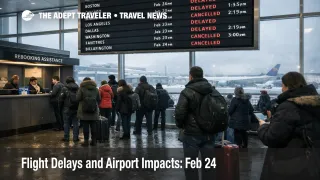
Feb 24 flight delays are shifting from peak storm shutdowns into an uneven recovery day, which is often when travelers get caught by knock on cancellations and missed connections. The FAA's current operations plan flags wind constraints across the Northeast corridor, possible stop or delay programs at the Boston, New York, and Philadelphia airports, plus a probable stop or delay program at San Francisco International Airport (SFO).
The FAA also lists a ground stoppage at John F. Kennedy International Airport (JFK) due to snow or ice, and multiple airport closure notices concentrated in New England, a sign that the smallest airports and the most weather exposed fields can lag the big hubs in reopening. Meanwhile, airline cancellations remained elevated nationwide into Tuesday, February 24, 2026, even as conditions improved, which is consistent with aircraft and crew repositioning taking at least a full schedule day to normalize after a major Northeast event.
Which Travelers Are Most Likely To Feel Disruption
The highest risk group is anyone whose itinerary touches the Northeast hub complex, even if their origin city looks fine. That includes travelers connecting through Boston Logan International Airport (BOS), Newark Liberty International Airport (EWR), JFK, LaGuardia Airport (LGA), and Philadelphia International Airport (PHL), plus travelers trying to protect same day onward plans like cruises, last trains, timed events, or one night hotel stays.
A second exposure group is travelers using small regional airports that can remain closed longer than the major hubs, either because snow removal takes longer, staffing is thinner, or approaches remain constrained by ceilings and winds. The FAA closure notices include Rhode Island T. F. Green International Airport (PVD), Martha's Vineyard Airport (MVY), Cape Cod Gateway Airport (HYA), and Nantucket Memorial Airport (ACK), among others.
The third group is travelers nowhere near the Northeast who are still flying on aircraft rotations that were supposed to originate in the Northeast on February 23. Even when today's local weather is acceptable, yesterday's cancellations can strand aircraft and time out crews, which shows up as late day cancellations, downgauged aircraft, or missed connection banks at out of region hubs.
What Travelers Should Do Now
Treat Feb 24 as a recovery day with hidden failure points, then act early while seats still exist. Before you leave for the airport, check your flight status, then check where your aircraft is coming from, because a late inbound is often the earliest honest warning that your departure is about to slide or cancel. If your routing touches JFK, assume snow or ice constraints can create stop start operations and gate pressure, even if posted arrival delays look modest at the moment.
Use a real decision threshold for rebooking versus waiting. Rebook sooner if you have a tight connection, you are on separate tickets, you are on the last practical departure that still meets your downstream constraint, or you must arrive on February 24. Waiting is only rational if you can see multiple later options that still work for your trip, and you are protected under one reservation so the airline owns the reaccommodation problem.
Over the next 24 to 72 hours, monitor the signals that actually change outcomes. Watch FAA command center planning for language that upgrades "possible" stop or delay programs into active programs at BOS, the New York airports, or PHL, and watch whether San Francisco moves from "probable" into actual flow control, because that can tighten West Coast rebooking capacity at the same time the Northeast is trying to recover.
Why Recovery Days Stay Fragile
The mechanism is simple, capacity returns in pieces, and the network needs time to heal. First order effects are runway availability, deicing cycles, and spacing aircraft farther apart in wind and lower visibility, which limits arrivals per hour and backs up gates. Second order effects are aircraft and crew mispositioning, airlines cannot run the planned rotation, so cancellations migrate away from the storm footprint and hit later in the day, often on flights that look fine in the morning.
There is also a structural layer that makes the Northeast uniquely able to export disruption. The New York and Philadelphia airspace complex is tightly coupled, so when multiple airports degrade together, there is no nearby alternate that is truly independent. That is why recovery can look "better" on delay boards while travelers still lose itineraries via missed connections, tight reaccommodation inventory, and uneven reopening of smaller fields. For deeper context on why New York area constraints can ripple nationwide even outside storms, see U.S. Air Traffic Control Privatization: Reality Check. For the prior day's FAA signal and the core Northeast airport set, see Flight Delays and Airport Impacts: Feb 23.
Sources
- Current Operations Plan Advisory (FAA ATCSCC) (Feb 24, 2026)
- FAA Flight Delay Information Summary (Ground Stoppages, Closures)
- FAA Airport Delay Information, BOS
- FAA Airport Delay Information, JFK
- FAA Airport Delay Information, PHL
- US airlines cancel over 2,000 flights as storm disruption continues (Feb 24, 2026) (Reuters)