

Italy Late Feb Strikes Hit Flights and Trains
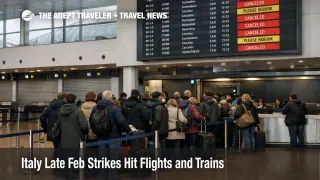
Italy is facing a stacked disruption window in the final days of February, with aviation strike action centered on Thursday, February 26, 2026, followed immediately by rail disruption risk that starts Friday night, February 27, and runs through most of Saturday, February 28. What is new since the last 48 hours is the more traveler actionable confirmation pattern from operators and the system itself, the practical impact is not confined to the headline dates. Airports are warning of delays and cancellations on February 26, and the aviation regulator's protected flight windows are clear, but airline schedule trimming and recovery effects can push disruption into Wednesday evening, February 25, and into early Friday, February 27.
For travelers, the key change is how you should hedge round trips and cross mode itineraries. If you were counting on flying on February 26 and using trains on February 27 or February 28 as the backup, that hedge is weaker than it looks, because the rail network is also entering a reduced service window.
Which Trips Are Most Exposed Across Air, Rail, and Cities
The highest risk itineraries are the ones that depend on tight timing between a flight, a ground transfer, and a second leg. That includes same day international connections through Leonardo da Vinci Fiumicino Airport (FCO), Milan Malpensa Airport (MXP), Milan Linate Airport (LIN), and Venice Marco Polo Airport (VCE), and it also includes anyone planning to land in Milan or Rome on February 26, then reposition by train on February 27 or February 28.
Date by date, here is the operational reality travelers should plan around. Wednesday, February 25 is the first edge day, some carriers may preemptively adjust late evening flights to protect aircraft and crews for the next morning, and airports can start showing early staffing strain at check in, baggage, and gates as the system braces for the next day. Thursday, February 26 is the headline aviation strike day, Italy's civil aviation authority notes protected time windows of 700 a.m. to 1000 a.m. and 600 p.m. to 900 p.m. local time, but outside those windows, travelers should expect a higher probability of cancellations, slower ground handling, and missed connections. Friday, February 27 becomes a transition day, even if you are not flying, it is the day airline networks try to recover aircraft and crews, and it is also the night the rail strike window begins at 9:00 p.m. local time, which can break late evening station, airport rail, and regional repositioning plans. Saturday, February 28 is the rail strike's core day, meaning travelers trying to "escape the flight mess" by switching to trains can hit cancellations, reduced frequency, and crowding that forces hotel nights in hub cities.
How To Protect Your Itinerary Now
If you can move travel, the cleanest risk reduction is to avoid flying within Italy on Thursday, February 26, 2026, and to avoid critical train moves in Italy on Saturday, February 28, 2026. The tradeoff is simple, rebooking early can cost more, but waiting often costs the itinerary when same day inventory disappears and recovery lines form at disrupted hubs.
If you must fly on February 26, target departures that sit inside the protected windows, then still add buffer for airport processing, because protected windows are about minimum flight operations, not a promise that curbside, counters, and baggage will run normally. Keep your connection logic conservative, if a delay would leave you with under 3 hours to make an international connection at Rome Fiumicino or Milan Malpensa, treat that as a reroute trigger before you leave for the airport, not after you are already in line.
For reroutes, the practical play is to reduce dependence on Italy domestic feeders and single point connections. For long haul travelers, that often means shifting the connection to a nearby non Italian hub, then entering Italy on a later date, or by a different mode, rather than trying to force a same day salvage through Milan or Rome. For intra Europe travelers, consider a neighboring hub airport connection, then ground transport into your final Italian city once the rail window reopens, or prebook a private transfer for the specific segment you cannot afford to miss. The point is not that any one alternate hub is "safe," it is that you are lowering exposure to the exact workgroups and recovery bottlenecks concentrated inside Italy on these dates.
Passenger rights are straightforward on the core guarantees, and conditional on compensation. Under EU air passenger rights rules, if your flight is cancelled, you are generally entitled to a refund or rerouting, and you are also entitled to care, such as meals and accommodation, when you are stuck waiting, even when the root cause is outside the airline's control. Whether cash compensation applies depends on the specific cause the airline documents, and strike driven disruption can fall into different buckets depending on whether it is airline staff, airport handling, or air traffic control.
Why Strikes Spill Beyond a Single Day
A strike day breaks travel in layers, not just in the obvious cancellation count. In aviation, the first order failure is staffing at check in, baggage acceptance, gate handling, and ramp operations, which is why airports can look "open" while throughput collapses and queues grow. Italy's aviation authority explicitly frames minimum protected flight windows during strikes, but that protection does not prevent long processing times around those windows when staffing is constrained.
The second order effect is network recovery. Aircraft and crews have to be in precise places, and when rotations break, the impact often shows up at the edges, late flights the evening before, early flights the morning after, and out of position aircraft that force downstream cancellations. That is why travelers should treat Wednesday night, February 25, and Friday morning, February 27, as meaningful risk periods even though the strike headline is February 26.
Then rail amplifies the situation. When flights cancel, passengers self reroute into trains, and when trains are also constrained, remaining capacity crowds fast, which is how "I will just take the train instead" turns into a hotel night in Milan, Rome, or Venice. Operators also make clear that service effects can spill slightly before the official start and after the official end, which matters for late Friday and early Sunday repositioning.
Sources
- Voli garantiti in caso di sciopero (ENAC)
- Scioperi (Ministero delle infrastrutture e dei trasporti)
- Giovedì 26 febbraio sciopero nazionale del trasporto aereo (Venice Airport)
- Servizi minimi garantiti in caso di sciopero (Trenitalia)
- Sciopero 27-28 febbraio 2026 (Malpensa Express, Trenord notice)
- Air passenger rights (Your Europe, European Union)