

Italy April 10 Air Strike Risks Afternoon Flights
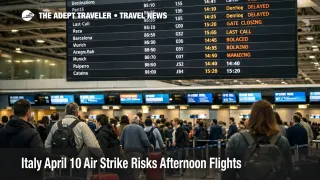
Italy April 10 air strike risk is back in focus because Italy's official strike registry shows a cluster of air sector actions set for Friday, April 10, 2026, centered on a four hour window from 100 p.m. to 500 p.m. local time. The Ministry's listings include a national ENAV stoppage, additional ENAV ACC Rome actions, Milan related ENAV actions, and an interregional ENAV action at Naples. ENAC's standing rules still preserve protected flight bands from 700 a.m. to 1000 a.m. and 600 p.m. to 900 p.m., which makes early and later departures safer bets than midafternoon flights. Travelers with Italy flights on April 10 should treat midday departures, short connections, and same day onward plans as exposed now.
Italy April 10 Air Strike: What Changed
The core change is not a full day shutdown, but a concentrated operational hit in the middle of the day. Italy's strike board shows a national four hour action for ENAV personnel, a separate national four hour action for Techno Sky personnel, multiple ENAV ACC Rome notices in the same time band, Milan related ENAV actions, and an interregional four hour action for ENAV personnel at Naples airport, all tied to April 10. Naples Airport is also flagging the same April 10 ENAV strike window on its public site.
That structure matters because ENAV sits in the air navigation chain, not just at a single counter or gate. ENAV says it manages Italian airspace through control towers at 45 airports and four Area Control Centres, handling takeoffs, landings, ground movements, and en route assistance across Italian airspace. When that layer is hit, the problem can move beyond one airport and into sequencing, spacing, and recovery across multiple airports and rotations.
Which Italy Itineraries Are Most At Risk
The most exposed travelers are those flying to, from, or through Italy in the 100 p.m. to 500 p.m. window, especially if the itinerary depends on Rome, Milan, or Naples as a connection point. Rome and Milan matter because the strike notices include ACC related ENAV actions, while Naples has its own airport specific ENAV action in the same period. Protected flight bands help, but they do not protect every bank equally, and they do not stop late inbound aircraft or crew knock on effects from spilling into later departures.
Island itineraries deserve a more careful read than a simple cancel versus operate assumption. ENAC's minimum service rules say flights scheduled inside the 700 a.m. to 1000 a.m. and 600 p.m. to 900 p.m. protected bands must operate, and outside those bands the rules still preserve certain additional services, including one intercontinental departure per continent, if scheduled, and one daily island connection, if scheduled. That means some April 10 flights outside the protected bands may still run, but travelers should not treat every ticketed midday departure as equally safe.
In an earlier Adept Traveler article, Italy April 10 Airport Strikes Threaten Midday Flights laid out the original strike cluster. The current decision value is narrower and more practical, the protected bands are clearer, Naples remains part of the risk map, and the question now is whether your specific flight sits inside a defendable operating window or in the weaker afternoon bank.
What Travelers Should Do Now
The cleanest move is to avoid the 100 p.m. to 500 p.m. local band on Friday, April 10, when the itinerary matters more than fare convenience. If a no fee change or schedule shift is available, moving into the protected morning or evening bands is usually the safer play. If you cannot move, check whether your airline has already retimed the flight, whether it appears on a guaranteed service list, and whether a misconnect would break a cruise embarkation, a separate ticket, or a nonrefundable hotel night.
For connections, the threshold is blunt. Keep the plan if your Italy arrival lands well before midday, or your onward departure sits in the evening protected band with enough slack to absorb delay. Rework it if the trip depends on a same airport or same city afternoon transfer through Rome, Milan, or Naples, especially on separate tickets. Waiting may save money, but on strike days early rebooking often saves the itinerary.
For wider labor context, Europe Transport Strike Dates 2026 for Flights and Trains remains useful because it explains how Italy's rolling transport actions can stack across airports, rail links, and onward transfers.
How ENAV Disruption Can Spread Into the Evening
The main mechanism is recovery drag. ENAC's rules require full efficiency of necessary services in the protected bands, but outside those windows service can fall to a lower functional level, and that can slow departures, arrivals, and airport flow even when the system does not fully stop. First order, some afternoon flights may cancel or leave late. Second order, aircraft rotations slip, evening departures inherit earlier disruption, and travelers arriving late into Rome, Milan, or Naples can lose rail, ferry, hotel, or ground transfer margins.
What happens next depends on airline behavior over the next few days. The strongest signal will be whether carriers publish waivers, targeted schedule trims, or protected flight lists before April 10. In an earlier Adept Traveler article, Italy Aviation Strike to Disrupt Flights Feb 16, 2026 showed the same pattern, a posted strike window matters, but the larger traveler risk comes from missed recovery, compressed seat supply, and fragile onward plans after the formal stoppage ends.