

Italy April 10-11 Transport Strikes Trap Flights, Rail
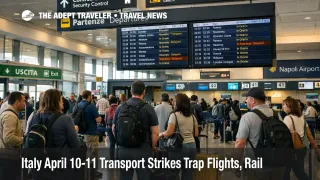
Italy April 10-11 transport strikes now look more dangerous than a single bad aviation afternoon. Italy's transport strike registry shows a cluster of ENAV related air traffic actions on Friday, April 10, 2026, centered on 100 p.m. to 500 p.m. local time, then a separate national 24 hour rail action on Saturday, April 11, 2026, affecting RFI infrastructure maintenance staff. For travelers, that turns a contained flight disruption window into a weaker next day recovery picture, especially for anyone planning to salvage a delayed flight with a same day or next morning train. The practical move is to treat Friday afternoon flights as exposed, and to avoid assuming Saturday rail will be a clean backup.
Italy April 10-11 Transport Strikes: What Changed
The April 10 aviation side is still a four hour stoppage, not a full day shutdown, but the follow on risk is what changed. Italy's strike board lists an interregional ENAV action at Naples from 100 p.m. to 500 p.m., and the same registry includes national rail stoppages on April 11 for RFI infrastructure maintenance staff, each listed as 24 hours. That combination matters because the first disruption hits aircraft sequencing and airport flow on Friday, while the second can weaken one of the most common recovery tools, long distance and regional rail, on Saturday.
Protected flight rules still make April 10 uneven rather than uniformly bad. ENAC's strike framework says flights in the protected bands, 700 a.m. to 1000 a.m. and 600 p.m. to 900 p.m., are guaranteed, with additional protections for certain island and intercontinental services. That lowers the risk for some morning and evening departures, but it does not stop earlier delays from pushing aircraft, crews, and passenger flows out of sequence into later banks.
In an earlier Adept Traveler article, Italy April 10 Air Strike Risks Afternoon Flights mapped the aviation window. The new decision point is broader, a traveler who loses a Friday afternoon flight or arrives too late for a planned train may hit a weaker rail network on Saturday instead of a normal recovery day.
Which Italy Trips Are Most Exposed
The clearest exposure group is travelers flying to, from, or through Italy on Friday afternoon, especially through Rome, Milan, and Naples, then relying on rail on Saturday to finish the trip. That includes open jaw trips, cruise embarkation plans, airport to city transfers, and any itinerary built on separate tickets. It also includes people arriving on Friday evening who expect Saturday trains to rescue a missed connection or reposition them for a hotel change.
Naples matters because the registry explicitly lists an ENAV airport action there on April 10. Rome and Milan matter because ENAV's network role is national, not local, and its four Area Control Centres handle en route traffic across Italian airspace while controllers at 45 airport towers handle takeoffs, landings, and ground movements. When that layer is disrupted, the problem can spread beyond one airport into wider flow management and slower network recovery.
Rail exposure on April 11 is more nuanced. The ministry registry confirms the national RFI infrastructure maintenance strike, but operators had not yet published a detailed April 11 service pattern in the sources reviewed for this piece. Trenitalia's standing strike rules say long distance guaranteed trains will still run from published lists, and regional services maintain essential service windows under strike rules, but travelers should not assume their preferred train will operate unchanged simply because some trains are protected.
What Travelers Should Do Before Friday
If your April 10 flight sits inside the 100 p.m. to 500 p.m. local window, the safest play is to move it earlier into the protected morning band or later into the evening protected band if your carrier offers a no fee change. If the trip matters more than fare convenience, this is not the date for a tight Italy connection or a same day handoff to a cruise, ferry, or long rail sector.
If you cannot move the flight, change the recovery plan instead. Treat Saturday rail as conditional, not guaranteed, until Trenitalia, Italo, or other operators publish their specific April 11 protected services. A hotel night near the arrival airport or port may be cheaper than betting the whole trip on a delayed Friday arrival plus a disrupted Saturday train. Travelers with separate tickets should be especially aggressive here, because a protected flight does not protect a separate rail booking, and a running train does not restore a missed embarkation or timed tour.
The threshold is blunt. Keep the plan only if you land well before the April 10 strike window, or if your onward transport does not depend on Friday afternoon flight punctuality or Saturday morning rail. Rework it if the itinerary depends on an afternoon connection, a late airport arrival, or a Saturday train that has not yet been confirmed as operating.
Why the Risk Lasts Into Saturday
The mechanism is recovery drag across two transport layers. ENAV manages the airspace and airport control functions that determine spacing, sequencing, departures, and arrivals, while Techno Sky maintains the hardware and software behind those systems across ENAV's operational sites. When those functions are hit in the same aviation window, delays can spill into later aircraft rotations and evening arrivals. If travelers then pivot to rail on April 11, they run into a separate disruption layer affecting RFI infrastructure maintenance staff.
That is what makes this a transport trap instead of two unrelated notices. First order, Friday afternoon flights may cancel or run late. Second order, the usual recovery options, train swaps, late city moves, and next morning repositioning, can also weaken on Saturday. The result is a higher chance of forced hotel nights, missed port check in windows, and costly last minute switches to private car transfers or replacement flights.
What happens next depends on operator communication over the next 24 to 48 hours. The most useful signals will be airline waiver notices for April 10, protected flight lists where applicable, and rail operator publication of guaranteed April 11 trains. Until those appear, the correct read is not panic, but respect for a back to back disruption pattern that narrows the normal recovery ladder across Italy.