

Jalisco Unrest, Flights Resume to Puerto Vallarta, Guadalajara
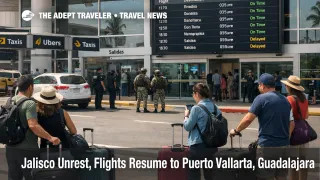
U.S. and Canadian carriers are restarting service to western Mexico after two days of cartel linked violence in Jalisco disrupted both airport access and airline operations. As of Tuesday, February 24, 2026, Grupo Aeroportuario del Pacífico, the airport operator, said Licenciado Gustavo Díaz Ordaz International Airport (PVR) and Guadalajara International Airport (GDL) were operating regularly and had reached about 95% of scheduled flights. That shift matters for travelers because the main constraint moved from "no flights" to "end to end reliability," meaning your risk is now mostly in last mile mobility, rebooking inventory, and whether your airline's schedule is fully restored.
Puerto Vallarta Flights Resume, What Changed on February 24
The operational change is that airlines that paused or cut service over February 22 and February 23 are now putting aircraft back into rotation to PVR and GDL, and airports are reporting mostly normal throughput. United publicly stated that it resumed operations to Puerto Vallarta and Guadalajara, and it told customers to check flight status directly because schedules were still stabilizing.
The airport operator's framing is also important for decision making. In its February 24 update, Grupo Aeroportuario del Pacífico said both airports were operating regularly and that remaining cancellations were part of a restart process, rather than an indication that terminals were closed. For travelers, this is the difference between "the airport is open" and "the system is dependable," because airlines can still cancel if crews cannot position, if ground handling is thin, or if access roads are intermittently blocked.
Which Travelers Should Still Treat This as a Live Disruption
Travelers currently in Puerto Vallarta, Mexico, or Guadalajara, Mexico, with near term departures are the most exposed, especially anyone who needs a same day return to the United States or Canada without flexibility on routing. Even when flight schedules repopulate, a restart day compresses options, and that pushes more passengers into the same handful of open seats, later departures, and standby lists.
The other high exposure segment is anyone who must move through the airport transfer corridor at set times, including early morning departures, late evening arrivals, and trips with timed connections, weddings, cruises, or prebooked excursions. When a security event disrupts roads, taxis, and rideshare, airlines can technically operate while travelers still cannot reach the airport reliably. That is why the most traveler facing pain in this episode showed up as cancellations and missed departures, even when some official messaging emphasized that airports were operating.
What Travelers Should Do Now
If you are trying to fly home from PVR or GDL in the next 24 to 72 hours, treat your seat as the scarce asset, not the airport itself. Check your reservation status inside your airline app, confirm your flight is still operating, and do not assume yesterday's cancellation pattern still applies, because restart waves can flip quickly as crews and aircraft reposition. United is explicitly directing customers to verify status through its own channels, and that advice applies across carriers during any restart.
If your airline offers a waiver, the decision threshold is simple. Rebook proactively if you have a tight onward connection, a same day must arrive commitment, or a transfer that requires long ground travel. Wait, or hold a later flight, if you have lodging flexibility, you can accept a next day arrival, and you can get to the airport with extra buffer. On a restart day, the downside of waiting is that the "good" inventory disappears first, and you end up with worse departure times or forced overnights.
For ground movement, build a larger buffer than you would on a normal vacation departure. Even with reports of improving road conditions, the transfer corridor is where uncertainty lingers longest, because it depends on local transport capacity, checkpoint friction, and whether a route stays clear long enough for the travel system to trust it. If you want the most practical, corridor first framing of what broke during the peak disruption, and why, see Mexico Violence Disrupts Puerto Vallarta Travel Corridors.
Why the Disruption Happened, and Why Flights Were the First Domino
This disruption followed a Mexican security operation targeting cartel leadership in Jalisco, and the retaliatory response included road blockages, vehicle fires, and broader instability that made movement unpredictable. U.S. Embassy messaging during the peak window urged U.S. citizens in Jalisco to shelter in place, which is a strong signal that even routine travel behaviors, like driving to the airport, carried elevated risk for a short period. In operational terms, that is what pushes airlines toward cancellations, because crew transport, vendor access, and passenger ability to reach the terminal become unreliable even if runways are intact.
The second order effect is what travelers feel after flights begin to return. A two day pause strands passengers, forces airlines to reposition aircraft, and creates a backlog that competes for the same limited seat inventory. At the same time, hotels, ground operators, and drivers restart on staggered timelines, so the trip can fail at the transfer layer even after the flight layer improves. That is why the current phase is best understood as "recovery," not "all clear," and why traveler decisions should focus on mobility and schedule slack rather than headlines alone. For a practical checklist of what tends to remain uneven during restart windows, see Mexico Unrest Recovery Phase, What Is Operating Now.
Sources
- How Civil Unrest in Mexico Is Impacting Travelers in Puerto Vallarta and Guadalajara
- Air Canada to resume flights to Mexico's Puerto Vallarta from Tuesday
- United Airlines resumes flights to Puerto Vallarta and Guadalajara
- Guadalajara airport in chaos; Puerto Vallarta flights canceled
- Puerto Vallarta (GAP airport information page)
- Guadalajara (GAP airport information page)