

Mexico Unrest Recovery Phase, What Is Operating Now
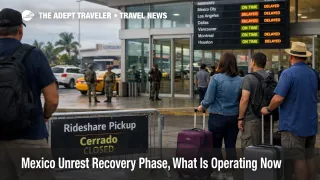
Travelers planning Mexico itineraries on February 24, 2026 should expect the Mexico unrest recovery phase to feel uneven, even as officials say roadblocks are clearing and airlines begin restoring schedules. The key traveler problem is the gap between "the airport is open" and "your trip will operate end to end," especially where ground access, transfers, and supplier confidence lag behind headlines. If you are arriving, departing, or connecting through western Mexico, treat mobility as the risk window, not just the flight. If your trip is later, expect fast changing waivers, rebooking pressure, and insurance rules that tighten once an event becomes "foreseeable."
The Mexico unrest recovery phase is now defined less by structural closures and more by partial restarts, modified schedules, and uneven ground conditions that can still break a tightly timed itinerary.
Mexico Unrest Recovery Phase, What Changed for Travelers
The newest operational shift is that airlines and operators are moving from "pause" to "restart," but they are doing it on staggered timelines. Air Canada, for example, has told customers it will resume service to Puerto Vallarta (PVR) with a modified schedule on Tuesday, February 24, 2026, and to Guadalajara (GDL) on Wednesday, February 25, 2026, while also adding seats to help displaced travelers get home sooner.
At the same time, U.S. government messaging has emphasized shelter guidance and minimizing movement in specific places during ongoing security operations, which is the clearest signal that "service resumes" does not automatically mean "transfers are routine again."
For what has been verified about airport operations versus rumors, and why access roads matter as much as runway status, see Puerto Vallarta Airport Disruption, What's Verified.
Where "Open" Still Means Unreliable Movement
The highest friction remains in itineraries that require predictable ground movement during a restart window, airport runs, intercity drives, day trips that depend on highway corridors, and late night transfers with thin backup options. Even when roadblocks are reported as cleared, the travel system needs time to reassemble, crews reposition, buses and vetted drivers get back on schedule, and suppliers rebuild confidence that routes will stay clear long enough to commit to service.
This is also where adjacent destinations can see second order effects. When travelers self reroute away from higher friction corridors, rebooking demand spills into nearby airports and hotel markets, which can tighten inventory, raise last minute prices, and push people into less ideal routings. That pattern is already visible in how waivers and flexible change windows are being used to move travel dates rather than simply canceling trips.
If your plans are on Mexico's Caribbean side, the risk model can be different, and more corridor specific, rather than a blanket shutdown assumption. See Cancun Travel Safety After Jalisco Unrest Alerts.
What Travelers Should Do Before They Move
If you are traveling in the next 24 to 72 hours, split your plan into two checklists, flight reality and ground reality. Flight reality means confirming your operating carrier's status, reading the waiver terms carefully, and rebooking early if you cannot tolerate a same day cancellation. Delta's agency bulletin and other carrier waivers are a practical proxy for how long airlines believe irregular operations risk could persist for affected tickets.
Ground reality means treating the airport transfer as a decision point you manage proactively. Use dispatched or hotel arranged transport, add buffer to reach the terminal, avoid improvising curbside plans, and be willing to delay movement if official guidance is still telling people to shelter or minimize travel in specific zones. The U.S. State Department's Mexico advisory also underlines why travelers should avoid casual, unvetted transport choices, especially when conditions are fluid.
If your trip is in the coming weeks and you are uncomfortable, separate "can I cancel" from "can I change." Many travelers will do better financially by using supplier flexibility, shifting dates, or converting bookings to credits, because standard insurance often hinges on covered reasons and "foreseeability," not on fear or discomfort. Allianz, for example, explicitly warns that travel insurance does not cover losses arising from expected or reasonably foreseeable events, even when a peril is generally listed as a covered reason, which is why timing and policy wording matter.
For a practical insurance decision framework by traveler time window, see Jalisco, Puerto Vallarta Violence Travel Insurance Options.
Why Operations Lag Behind Headlines
This recovery phase is structurally normal after a sharp security disruption. Airlines may resume flights once they believe airside operations are stable, but the rest of the travel stack, crews, ground handlers, hotel transfer desks, tour operators, and local transport networks, often restarts more slowly because it depends on predictable corridors and sustained stability, not a single all clear moment.
Insurers also recalibrate quickly, but in a different way. They do not "decide safety," they decide whether a claim is payable under the contract, and many plans draw a hard line around foreseeability. Some products offer specific upgrades for riot or civil disorder related cancellation or interruption, but travelers should assume there are strings, purchase windows, documentation requirements, and policy language that can vary significantly.
The practical takeaway is that travelers should measure normalizing conditions by what is actually operating, airport access, verified ground transport availability, restored flight banks, and supplier waiver behavior, not by whether a destination is technically "open." That distinction is what keeps a recovery phase from becoming a second disruption, missed flights, extra nights, and cascading costs.
Sources
- Key events in Mexican operation to capture cartel leader 'El Mencho'
- Air Canada to resume flights to Mexico's Puerto Vallarta from Tuesday
- Civil unrest in Mexico
- Jalisco Mexico Civil Unrest, Bulletin 1
- Mexico updates, Embassy says many cities 'returned to normal'
- Mexico Travel Advisory, United Mexican States
- Trip Cancellation Insurance: Covered Reasons Explained
- Optional Coverage Upgrades and Bundles