

Mexico Violence Disrupts Puerto Vallarta Travel Corridors
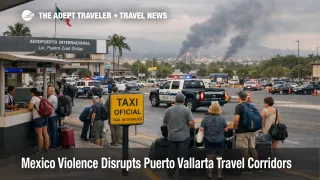
The most important traveler takeaway from the February 22-23, 2026 violence in western Mexico is that many visitors were not threatened inside major resorts, but mobility collapsed fast. Roadblocks with burning vehicles, reported shootouts, and transport suspensions turned the airport transfer layer into the main risk window, and that drove airline cancellations and stranded passengers around Puerto Vallarta, Mexico, and Guadalajara, Mexico.
A second takeaway is about information hygiene. Widely shared claims of a direct "attack on the airport terminal" have circulated, but official reporting available so far has emphasized roadblocks and operational disruption, not a confirmed assault on the terminal itself. Travelers should plan around what is verifiably breaking first, ground access, crew positioning, and airline operations.
Mexico Violence Travel Impacts, What Changed For Travelers
This flare up followed a high profile security operation in Jalisco and rapid cartel retaliation that included dozens of roadblocks and arson attacks, with airlines canceling flights to Puerto Vallarta as smoke plumes rose over the city.
For travelers, the immediate impacts showed up in three places. First, flight schedules became unreliable because crews and ground staff could not move safely or predictably, which is why embassy messaging emphasized that airports could be "open" while airline operations were still disrupted. Second, the airport to resort transfer corridor became the most fragile link, especially as advisories noted ride share suspensions in Puerto Vallarta and roadblocks affecting airline operations. Third, tourists and residents reported visible smoke from vehicle fires in and around the metro area, meaning some travelers in higher elevation hotel zones, or with clear sightlines, could plausibly see smoke even if they were not near the incidents.
Which Travelers Were Most Exposed
Resort guests who stayed on property were generally the least exposed to direct danger in the reporting available so far. There have been strong indicators of disruption near city nodes and corridors, but no widely corroborated, official reporting that named a specific beachfront resort as having been attacked during this episode. The operational reality is that large resorts are controlled environments with security and limited access points, while the roads between nodes are open, unpredictable, and easier to disrupt.
Airport travelers were exposed differently. Reports and advisories described panic movement in at least one airport terminal environment and significant flight cancellations in both Guadalajara and Puerto Vallarta, which is consistent with a system where travelers can end up stranded landside with limited transport options. What is not confirmed in the sources above is a sustained, direct assault on Licenciado Gustavo Díaz Ordaz International Airport (PVR) or Miguel Hidalgo y Costilla Guadalajara International Airport (GDL) terminals. The better framing is that airports were caught in the blast radius of road access disruption and staffing constraints, which is enough to break departures and arrivals even without structural damage.
Travelers on the road, including anyone attempting an airport run, were the most exposed group. Canada's advisory language referenced roadblocks with burning vehicles, shootouts with security forces, explosions, and suspended taxi and ride share services in Puerto Vallarta, which is exactly the combination that turns a normal 25 to 45 minute transfer into a high variance, high consequence decision.
What Travelers Should Do Now
If you are currently at a resort in Puerto Vallarta or the surrounding hotel zones, treat the resort footprint as the stable zone until official guidance narrows and local transport is reliably operating again. Do not "test" the situation with quick errands, because the risk is not the lobby, it is getting caught between closures or reroutes with no clean exit.
If you are scheduled to depart from PVR or GDL, the decision threshold is whether you can reach the terminal using hotel coordinated transport on a route your operator confirms is clear, with extra buffer for detours. If you cannot get that confirmation, or if roadblocks are active, the safer move is usually to delay movement and push the airline for rebooking, because being early does not help if the access corridor is the constraint. Expect airlines to stage resumptions unevenly, often by using larger aircraft to clear backlogs once crews can position.
If your trip has not started yet, your risk is mostly "arrival into a broken ground layer." Waiting 24 to 72 hours for clearer on the ground normalization can be cheaper than arriving into cancellations, closed transport options, and forced extra nights. Use official advisories and airline waiver windows as your practical signals, not viral clips.
Why The Violence Hit Travelers Where It Did
Cartel retaliation tactics such as burning vehicles and creating roadblocks are designed to slow security operations, but they also sever the exact corridors tourism depends on, airport approaches, highway connectors, and city arterials. That mechanism explains why travelers asked, "Are resorts in danger," while airlines canceled flights and advisories focused on movement. You can have a resort that is physically calm while the transport layer outside is failing.
It also explains why proximity is hard to answer precisely in real time. Many public reports describe smoke over Puerto Vallarta and burning vehicles at specific commercial nodes, but official sources rarely publish a clean, minute by minute map that tells travelers "how close" an incident was to a given resort. In practical terms, the relevant measure is not miles, it is whether your route crosses disrupted corridors, and whether your operator can verify a clear path at the time you need to move.
On casualties, Mexican authorities reported multiple deaths among security forces and suspected cartel members, plus at least one bystander death in the retaliation wave. None of the reporting cited above confirms that a visiting tourist was killed or injured during this specific episode, but that can change as investigations publish more detail, so travelers should monitor official updates if they need high confidence before moving.
Sources
- Key events in Mexican operation to capture cartel leader 'El Mencho'
- US citizens urged to shelter in place amid unrest in Puerto Vallarta
- US State Department urges US citizens to stay safe in Jalisco after El Mencho killing
- US Tourists Across Mexico Told to Shelter in Place
- Puerto Vallarta's Civil Unrest Triggers 'Shelter in Place' Orders, Flight Cancellations