

China 30 Day Visa Free Entry Expands, Checks Tighten
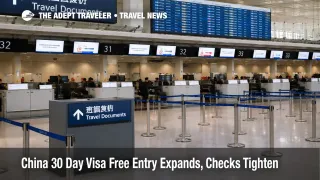
China 30 day visa free entry expanded again, and the practical change is bigger than it looks. China's Ministry of Foreign Affairs now lists 50 countries whose ordinary passport holders can enter visa free for up to 30 days for specific short stay purposes, under a policy window that generally runs through December 31, 2026. The first order benefit is obvious, fewer visa appointments, fewer processing delays, and faster trip planning for eligible travelers. The first order risk is also predictable, more travelers will show up at check in assuming "visa free" means "no paperwork," and airlines will still deny boarding when eligibility, purpose, or passport document type does not match what China allows.
China 30 Day Visa Free Entry, What Changed
The Chinese Foreign Ministry's current FAQ says ordinary passport holders from 50 countries can enter mainland China without a visa for up to 30 days for business, tourism, family or friends visits, exchange visits, and transit. The same guidance also makes the enforcement point explicit, Chinese border inspection authorities can deny entry when a traveler's purpose does not match the visa free categories, or when the traveler is otherwise not admissible under China's rules.
The time bounded element matters for planning. The Foreign Ministry guidance says Brunei has no stated end date, Russia's ordinary passport arrangement runs through September 14, 2026, and the remaining countries in the 50 country set run through December 31, 2026. Separately, Reuters has reported on the broader policy extension through the end of 2026 as part of China's inbound travel push.
Who Benefits, and Who Gets Stuck at Check In
If you hold an ordinary passport from one of the listed countries, the upside is that short notice trips become easier to execute, and itinerary changes become less constrained by visa appointment timing. The travelers most likely to get stuck are the ones whose real trip purpose is not covered by the waiver, or whose documents look valid to them but fail at the airline's rule check.
The Chinese Foreign Ministry guidance is clear that the visa waiver does not apply to work, study, or news coverage, and it warns that travel documents other than an ordinary passport, including temporary or emergency documents, do not qualify for visa free entry. That is where denied boarding happens in practice, because a traveler can be "from an eligible country," but still be ineligible if they are using the wrong document type, if their stay will exceed 30 days, or if their stated purpose reads like employment, long term study, or media activity rather than a short stay visit.
For travelers outside the 50 country list, nothing about this change creates new eligibility, and the risk is misreading headlines and assuming a visa step disappeared when it did not. U.S. passport holders, for example, are still generally dealing with China's transit without visa rules as a separate path, with different constraints, rather than this 30 day unilateral visa free bucket.
What Travelers Should Do Before Departure
Treat this like a document rule change, not a vibes based travel hack. Even when no visa is required, China's guidance recommends carrying proof that matches your stated purpose, including invitation letters, air tickets, and accommodation reservations, because border officers can ask, and airline agents may ask before they let you board. For a normal leisure trip, that usually means a booked first night stay, a reachable hotel address, and a return or onward ticket that matches the dates you are claiming. For business, it often means a basic invitation or meeting confirmation that aligns with your timeline and cities.
Also plan around the 30 day clock correctly. China's guidance says the 30 days is calculated from the day after entry, not the calendar day you land. That sounds minor until you are trying to leave "on day 30" and a delay pushes you into an overstay situation. If your itinerary is tight, build slack, and avoid stacking nonrefundable hotels and onward flights on the assumption that every segment will run on time.
Finally, do not let the passport itself become the surprise failure. If your passport has any status risk, for example it was ever reported lost, replaced, or is under renewal confusion, solve that before you fly, because carriers and borders treat document validity as binary once a system flags it. Adept Traveler's earlier reporting on passport status failures is a useful reminder that "it looks fine" is not a reliable standard at the airport. U.S. Passports Flagged Lost Can Block Entry Abroad
Why Airline Checks Tighten, and Where Friction Shows Up
Airlines do not have discretion here, they are financially exposed when they transport inadmissible passengers, so they push document checks upstream to the check in desk, and increasingly to online check in prompts. The IATA Travel Centre describes its Timatic based documentation database as a centralized source used across the industry to determine passport and visa requirements for boarding decisions. When a destination expands visa free access to a large set of nationalities, the rule set gets more complex, not less, because purpose, stay length, passport type, and edge case exclusions become the real gatekeepers.
That is why the second order effects you flagged are the right ones to expect. In the near term, you typically see more manual checks at counters, more passengers pulled aside to clarify whether their trip is "business" versus "work," and longer queues at big international departure banks. You also see more same day rebookings and hotel churn when someone learns at the airport that their passport is not an ordinary passport, their purpose is outside the waiver, or their intended stay exceeds 30 days, and they cannot fix that without a visa.
If you want a tighter, traveler facing explanation of how this specific waiver applies to Canada and the United Kingdom, including the common document stack that prevents last minute surprises, this companion piece stays aligned with the on the ground check in reality. China Visa Free Entry for Canada, UK Travelers 2026
Sources
- FAQs on Visa-free Entry into China (Ministry of Foreign Affairs of the PRC)
- List of Countries Covered by Unilateral Visa Exemption Policies (National Immigration Administration)
- IATA Travel Centre, Passport, Visa and Health Requirements
- China grants UK and Canada visa-free entry, raising total to 79 countries (AP)
- China extends visa-free policy to end-2026, adds Sweden to scheme (Reuters)