

Los Cabos Says SJD Normal After Puerto Vallarta Violence
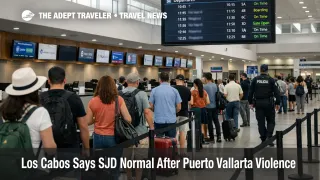
Los Cabos airport status is unchanged after the February 22 to 23, 2026 cartel linked unrest centered in parts of western Mexico that disrupted travel in and out of Puerto Vallarta, Mexico, and Guadalajara, Mexico. The Los Cabos Tourism Board said Los Cabos International Airport (SJD) remained fully operational, and that hotels, visitor services, and ground transportation continued without disruption, positioning Los Cabos as outside the operational impact zone that triggered flight pauses elsewhere.
That matters now because the most common traveler mistake in a fast moving security story is assuming "Mexico is shut down" or, in the other direction, assuming "it is all fine everywhere." The verified situation is narrower: the U.S. Embassy and Consulates in Mexico issued shelter guidance tied to specific named locations during the event, and then issued an update on February 24, 2026, saying U.S. citizens were no longer urged to shelter in place, alongside notes that conditions and restrictions could still vary by city.
Los Cabos Airport Status, What Changed for Travelers
The practical change is not at SJD, it is in traveler decision making. The Los Cabos Tourism Board's message is aimed at preventing itinerary overreactions for Cabo San Lucas, Mexico, and San José del Cabo, Mexico, after widely shared images of roadblocks, vehicle fires, and flight cancellations in other regions raised understandable concern. Their statement emphasized continuous airport operations, normal hotel activity, and functioning transfers, while also describing an ongoing security framework that runs year round in coordination with municipal, state, and federal authorities and the tourism sector.
At the same time, the broader travel system did shift this week. Puerto Vallarta and Guadalajara saw airline disruptions during the peak risk window, and official U.S. Mission messaging later moved to a de escalation posture on February 24, 2026, which is often the first signal travelers use when deciding whether to move between lodging, airports, and ground transport corridors.
Which Trips to Los Cabos Still Need Extra Caution
Los Cabos travelers are in a different risk bucket than travelers moving through Jalisco this week, but that does not mean "no risk." Baja California Sur was not part of the U.S. Embassy shelter guidance tied to the February 2026 security operations, and the U.S. State Department's Mexico advisory continues to list Baja California Sur at Level 2, Exercise Increased Caution, which is a persistent baseline rather than a new downgrade.
The travelers who should be most conservative are those with complex ground movement plans that extend beyond the Los Cabos tourist corridor, or those mixing regions on the same trip, for example arriving into SJD but then planning onward domestic flights, long drives, or multi state itineraries on short timelines. This week's disruption pattern reinforced a recurring mechanism in Mexico security events: resorts and airports may remain physically open, while the mobility layer, meaning highways, transfer corridors, ride share availability, and driver willingness, is where travel breaks first.
What Travelers Should Do Now
Travelers flying into, or out of, Los Cabos in the next 24 to 72 hours should treat this as a verification exercise, not a vibes exercise. Confirm your flight status directly with your airline, confirm your transfer with your hotel or a reputable provider, and keep your movement plan simple on arrival day, because the easiest way to turn a normal airport day into a bad travel day is stacking fragile dependencies like tight connections, late night arrivals, and unverified ground transport.
Rebook only if your itinerary depends on passing through the specific corridors that were affected earlier this week, or if your airline is still recovering aircraft and crew rotations into the airports that saw pauses. If your trip is Los Cabos only, and your bookings and transfers are confirmed, the available reporting and the tourism board statement support staying the course while maintaining normal situational awareness.
Monitor three things before departure: the U.S. Mission Mexico security updates for any new city specific guidance, your airline's schedule reliability, and on the ground guidance from your hotel or host about transfers and recommended routes. This is the shortest loop that catches meaningful changes without consuming your whole day.
Why Los Cabos Was Not Hit, and Why That Matters
The Los Cabos Tourism Board leaned on two arguments: distance and operating posture. Geographically, Baja California Sur sits across the Gulf of California, also called the Sea of Cortez, from many of the mainland areas that saw the most visible disruption, which reduces the odds of immediate spillover that would affect airport access and resort corridors. Operationally, their statement describes a standing security coordination model that is meant to keep tourist zones predictable even when other regions face instability.
The travel mechanism is the important part for travelers deciding what to do next week, not just this week. In the February 2026 event, the highest friction came from roadblocks, vehicle fires, and uncertainty around safe movement, which can force airlines to pause service even when terminals are intact. When that happens, travelers outside the immediate area can still be affected through second order effects like aircraft repositioning delays, oversold recovery flights, and more conservative carrier risk decisions, which is why destination specific statements like Los Cabos' matter for calming misinformation without pretending security risk is zero.
Sources
- Los Cabos Tourism Reassures Travelers Following Gang Violence in Western Mexico
- Airports, Destinations provide updates following events in Jalisco
- Security Alert, Ongoing Security Operations, U.S. Mission Mexico, February 22, 2026
- Security Alert, Update 7, Ongoing Security Operations, U.S. Mission Mexico, February 24, 2026
- Mexico Travel Advisory, Travel.State.Gov
- Puerto Vallarta, Guadalajara Airports Resume Flights
- Mexico Violence Disrupts Puerto Vallarta Travel Corridors