

Puerto Vallarta, Guadalajara Airports Resume Flights
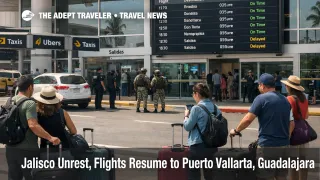
Flights are restarting at Licenciado Gustavo Díaz Ordaz International Airport (PVR) and Miguel Hidalgo y Costilla Guadalajara International Airport (GDL) as carriers bring schedules back after the February 22, 2026 security operation and the violence and roadblocks that followed. The practical change for travelers is that getting out, and getting in, is becoming feasible again through the two main air gateways tied to Puerto Vallarta's resort zone and Guadalajara's metro area, even if some itineraries are still running on recovery logic such as aircraft and crew repositioning.
Air Canada said it would resume full operations to Puerto Vallarta starting Tuesday, February 24, 2026, and resume Toronto to Guadalajara service on Wednesday, February 25, 2026. That single carrier move matters because it is a proxy for wider normalization, once a large international operator restores multiple city pairs, it usually signals that airport access, staffing, and flight planning conditions are stable enough to run a full day of turns.
At the same time, U.S. Mission messaging shifted from shelter guidance to "no longer urged to shelter in place" in its February 24 update, while still describing constraints such as curfews for U.S. government staff in some locations and advising awareness around road conditions. That is not a blanket "all clear," but it is an operational step down from the highest restriction level that affected traveler movement decisions over the weekend.
Which Travelers Benefit First, and Where Risk Still Concentrates
The travelers who benefit first are those with time sensitive returns to the U.S. and Canada, and anyone whose trip is structured around fixed check out dates, pre paid onward flights, or work schedules. Once flights restart, the immediate bottleneck usually stops being "is there a flight," and becomes "can I reach the airport reliably, and can I get reprotected if my first option cancels," especially when road disruptions were part of the original failure mode.
If you are inside a major resort corridor, the risk window is still most concentrated in the transfer layer, meaning the roads between your hotel zone and the airport, plus the time you spend curbside and landside before you are through security. Weekend reporting around this event repeatedly showed that mobility can collapse faster than conditions inside hotels, and that mismatch is what strands people, even when resorts themselves are not the target.
For travelers headed to Jalisco, the decision is less about whether airports have reopened, and more about whether your arrival day includes any fragile dependencies, such as late night arrivals, long intercity drives, or a tight same day connection onward. Even in a recovery phase, flight schedules can look "normal" while the system is still clearing backlog, restoring staff commuting patterns, and rebalancing equipment rotations that broke during the disruption.
What Travelers Should Do Now
If you are trying to fly out of Puerto Vallarta or Guadalajara in the next 24 to 72 hours, treat the trip to the airport as part of your risk plan. Leave earlier than you normally would, confirm your ground transport before you commit to leaving your lodging, and use official local updates to sanity check whether any remaining blockages or checkpoints sit on your route.
Rebook now if your itinerary is time critical and you see viable inventory, especially nonstop options, because recovery days can sell out quickly when multiple canceled flights re flow into the same limited seat pool. Wait, or accept a later departure, if you have flexibility and your airline is running a protected rebooking policy, because extra capacity sometimes appears after carriers reposition aircraft and add sections. Air Canada, for example, said it added seats as it resumed service.
Monitor three things before you leave for the airport, your flight status in the airline app, airport and road condition updates, and any refreshed U.S. Mission security messaging for the specific metro area you are in. The most common way travelers get caught on "normal operations" days is by assuming that the airport status automatically implies that the road corridor is friction free.
Why This Disruption Hit Airports, and How Recovery Actually Works
This event disrupted travel because the violence response leaned on tactics that attack movement, not terminals, particularly roadblocks and arson that can sever the airport access layer even when the airport itself is physically intact. Once access roads become unreliable, airlines face a dual problem, crews cannot position reliably, and passengers cannot reach check in, both of which force cancellations that then propagate into the next day as aircraft and crews end up out of sequence.
Recovery is usually staged. First, authorities restore basic movement and reduce the highest risk guidance such as shelter instructions. Second, airlines restart a modified schedule that prioritizes repositioning aircraft, getting crews legal on duty time, and moving stranded passengers. Only after that does the timetable look normal again, and even then, knock on effects can linger through missed connections, limited same day reaccommodation, and hotel extensions when travelers cannot align new flights with check out times.
Separately, security actions can continue in the background even as commercial life resumes. Reuters reported an additional troop deployment into Jalisco after the cartel leader's death, which signals that authorities are trying to prevent follow on instability. For travelers, that typically translates into variable checkpoints and localized slowdowns, rather than broad airport shutdowns, but it is still a reason to keep buffers in your plan for the rest of the week.
Sources
- Air Canada to resume flights to Mexico's Puerto Vallarta from Tuesday
- Civil unrest in Mexico
- Security Alert Update 6: Widespread (Mexico), Ongoing Security Operations (Feb. 24)
- Widespread (Mexico), Ongoing Security Operations
- Mexico sends 2,000 soldiers to Jalisco after cartel leader's death
- Mexico Violence Disrupts Puerto Vallarta Travel Corridors
- Mexico Unrest Recovery Phase, What Is Operating Now
- Puerto Vallarta
- Guadalajara