

Mexico Embassy Update, Flights Normal, Roads Lag
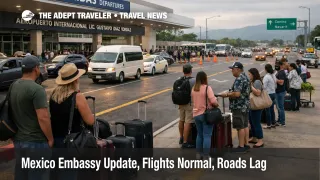
The practical change is not that flights suddenly became risk free, it is that official U.S. posture has shifted from shelter guidance toward an "operations resuming" framing, while still flagging that road clearing and localized ground friction can lag behind airport status. In other words, air service can look normal on a departures board while the trip still fails at the access layer, which is the drive from a resort zone, a city hotel, or a cruise terminal to the airport curb.
This matters most in western Mexico's current restart window after the February 22, 2026 security incidents, because the failure mode is not usually "the terminal is closed." The failure mode is that roadblocks, checkpoint slowdowns, ride availability gaps, and last mile uncertainty turn a predictable transfer into a high variance bet, and that is how travelers miss flights even when the airline is operating.
A second, quieter change is that "returned to normal" is not a binary condition. It is a systems statement that commercial life is broadly functioning again, not a promise that every corridor is friction free, every route is clear, or every transfer is predictable at rush hours and peak checkout times.
Which Travelers Are Most Exposed To Ground Access Friction
The highest exposure group is anyone with a same day airport run in Jalisco, especially travelers trying to reach Licenciado Gustavo Díaz Ordaz International Airport (PVR) or Guadalajara International Airport (GDL) from hotel zones, outlying neighborhoods, or any route that depends on a single primary highway corridor. If you have a fixed departure time and a tight check in window, you are the traveler most likely to get punished by a "normal ops" headline.
Cruise passengers sit in a different, but related, risk bucket. Even if a ship is calling and the port is open, the on shore experience can still degrade sharply when roads to the terminal, tour staging areas, or the first outbound routes are uncertain. That creates pressure on cruise line port call decisions, shore excursion timing, and passenger expectations, even when the ship itself remains safe offshore and the pier is physically accessible.
The third exposure bucket is hotel guests caught in churn, meaning early checkouts to make flights, late checkouts because flights were missed, and forced extension nights when a traveler chooses not to move during a corridor restart. That is where you see second order stress on inventory, customer service, and refund decisions, even after officials say conditions are stabilizing.
For readers who want the earlier operational baseline for what was breaking first, and what was verified versus rumor during the peak disruption phase, see Puerto Vallarta Airport Disruption, What's Verified and Mexico Unrest Recovery Phase, What Is Operating Now.
What Travelers Should Do Now, Buffers, Thresholds, And Go No Go Rules
Treat transfer time as the decision variable, not the flight schedule. If you would normally budget 45 minutes to reach the airport, plan like it could be 90 to 120 minutes during a restart window, and do not assume the fastest route on a mapping app is the safest or most reliable route in a security operation aftermath. Your goal is to arrive early enough that a localized slowdown does not force an on the fly reroute decision under pressure.
Proceed with your trip if two conditions are true, you can get a vetted transfer arranged in writing through your hotel, a trusted operator, or an established transport desk, and you can maintain enough buffer that a delay does not cause a missed flight or a missed cruise all aboard time. Rebook or delay if your plan depends on improvised transport, late night movement, or a tight airport arrival window that leaves no room for corridor uncertainty.
Use simple go no go thresholds. If official messaging in your specific metro area still urges minimizing movement, or if your driver or hotel cannot confirm a reliable pickup path to the airport, that is a no go for discretionary movement. If you see credible reports of active roadblocks on your likely corridor, or if local transport services are suspended in your area, that is also a no go for last minute airport runs, and you should move earlier, reroute, or rebook.
Over the next 24 to 72 hours, watch three signals, U.S. Mission Mexico updates for your specific location, airport operator and airline schedule normalization statements, and ground truth from your hotel or transfer provider about which corridors are reliably open. The fastest way to get trapped is to monitor only flights while ignoring the access layer that actually determines whether you can reach the plane.
Why "Normal" Can Still Mean Friction, Mechanism And Ripple Effects
Security incidents that lean on roadblocks, arson, and movement disruption break travel differently than an airport closure. Airports can remain physically intact and staffed, airlines can publish a normal schedule, and yet passengers and crews cannot move reliably through the perimeter road network. That mismatch is why "the airport is open" can be true at the same time "you cannot safely get to the airport" is also true for pockets of travelers.
First order impact is straightforward, missed flights, delayed check in, late arriving crews, and short notice cancellations when airlines cannot position aircraft and staff predictably. Second order impact is where the traveler pain spreads, misconnects cascade through hubs, hotels fill with forced extension nights, and cruise lines weigh whether a port call is worth the operational uncertainty if roads to the terminal and excursion corridors cannot be trusted.
The current embassy posture matters because it is an official signal that broad commercial life is resuming, but it also reinforces the key calibration point travelers need, the risk is concentrated in movement, not necessarily inside resorts or inside terminals. The traveler who wins this week is the one who treats ground access as the main constraint and plans buffers accordingly.
Sources
- Widespread (Mexico), Ongoing Security Operations (Feb. 23)
- Airport operations gradually resuming after violence erupted following killing of drug lord "El Mencho," Mexico says
- Jalisco government: Order restored in Puerto Vallarta and Guadalajara
- Mexico president says "no risk" for 2026 World Cup fans
- Tourist Operations "Return to Normal" in Western Mexico Following Unrest