

Puerto Vallarta Airport Disruption, What's Verified
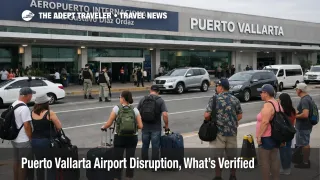
Puerto Vallarta airport disruption hit Licenciado Gustavo Díaz Ordaz International Airport (PVR) on February 22, 2026, after a major security operation in Jalisco triggered retaliatory violence, road blockages, and a rapid pullback by airlines. What travelers need to know is that widely shared claims of a direct cartel attack on the terminal or runway have not been confirmed in official statements surfaced so far. Instead, the verified story is operational: roadblocks and security conditions around the airport corridor disrupted access, prompted airlines to cancel or suspend service, and left many passengers unable to get to the airport safely or reliably.
The airport operator's translated messaging, as reported by Travel Weekly, said internal terminal operations and security inside the facilities had not been impacted and that the airport was under protection by Mexico's National Guard and the Secretariat of National Defense. In the same update stream, Travel Weekly also reported the U.S. Embassy security alert language that "no airports have been closed," while noting that roadblocks impacted airline operations and that taxis and rideshares were suspended in Puerto Vallarta.
Puerto Vallarta Airport Disruption, What's Verified At PVR
As of the latest official and major outlet reporting available on February 23, the confirmed travel impact at PVR is mass cancellation and suspension decisions by airlines, not a published assessment that the runway, terminal, or airfield was damaged by an attack. Multiple outlets reporting on the airport operator's position describe a security posture that shifted to reinforced protection at the airport, alongside large scale flight cancellations driven by airline decisions during the unrest.
On the airline side, Reuters reported that Air Canada temporarily suspended operations to Puerto Vallarta and that United Airlines canceled flights to the destination, citing safety concerns. Delta published an exception policy for Jalisco, Mexico civil unrest that explicitly covers travel to or through Puerto Vallarta (PVR) and Guadalajara (GDL), which is a practical signal that disruption was expected to persist beyond the first shock window for affected tickets. Alaska Airlines also posted travel advisory language covering Puerto Vallarta alongside other airports, tied to "civil unrest near Mexican airports."
On "damage" and "fatalities" at the airport itself, the most important point is the absence of verified, airport specific casualty reporting in the sources above. The broader violence tied to the operation produced deaths and injuries elsewhere, but that is not the same thing as fatalities at the airport terminal or on the airfield. If new, official reporting confirms airport specific casualties or physical damage, it should change traveler decisions immediately, but that confirmation is not present in the airport operator framing carried by Travel Weekly and the airline advisories cited here.
Which Travelers Are Most Exposed Right Now
The highest risk group is anyone who needs to physically move to or from PVR while road conditions, taxi availability, and security operations remain volatile. Even when an airport is technically "open," a traveler's trip fails at the ground layer if you cannot reach the curb, clear check in, or leave the terminal safely. The U.S. Embassy alert language reported by Travel Weekly is explicit that roadblocks impacted airline operations and that taxis and rideshares were suspended in Puerto Vallarta, which directly attacks the normal airport transfer plan most visitors rely on.
Outbound passengers with tight international connections face the next layer of exposure. When airlines cancel a bank of flights, rebooking inventory tightens quickly, and the knock on effect can strand travelers for multiple nights even after conditions improve. This is especially true for travelers on separate tickets, travelers returning to time sensitive obligations, and travelers whose home airports have limited nonstop service to Puerto Vallarta.
Inbound travelers, including vacationers arriving to resorts, are exposed in a different way. Landing is not completion. If official transport options are paused, and if hotels advise shelter in place, the arrival can stall at the terminal, or worse, push travelers into improvised transport choices. Canada's Mexico advisory explicitly warns that shelter in place orders were in effect in Jalisco and that the security situation could deteriorate rapidly, which is a strong hint that travelers should treat movement as a risk window, not a routine step.
What Travelers Should Do Now
If you are booked to fly on February 23 or within the next 72 hours, treat your decision as two separate problems: whether your flight will operate, and whether you can safely reach the airport and leave it. Start with the airline, because "airport open" does not mean "your airline is flying." Check your carrier's advisory and waiver page, and rebook proactively if your trip purpose cannot tolerate a same day cancellation, because rebooking early usually beats waiting for inventory that may not come back evenly.
If you are already in Puerto Vallarta, default to minimizing movement until official restrictions and local transport availability normalize. The U.S. Embassy alert language reported by Travel Weekly and Canada's advisory both point in the same direction, shelter in place guidance can coexist with partial airport operations, and that mismatch is exactly how travelers get stranded on the wrong side of a road closure. If you must move for an essential reason, coordinate through your hotel or a vetted operator rather than improvising at the curb.
If you are planning travel later this week, the decision threshold is whether the disruption is clearly contained to February 22 and February 23, or whether it is extending into a rolling risk window. Delta's advisory structure, which covers impacted travel dates and rebooking terms, is a useful proxy for how long airlines think the irregular operations risk could last. If your trip is discretionary, delaying departure until the travel advisories and airline schedules stabilize is often cheaper than arriving into a broken ground transport layer and then paying for extra nights and last minute changes.
For additional context already published on Adept Traveler, see Puerto Vallarta Feb 22 Shelter In Place Travel Guidance and Puerto Vallarta Violence Disrupts Flights Feb 22.
Why This Happened, And How The Disruption Spreads
The trigger for the February 22 disruption was a high profile security operation in Jalisco targeting cartel leadership, followed by retaliatory violence that included road blockages and fires across parts of the region. That mechanism matters because it explains why airports can appear structurally intact while travel still collapses. The airport depends on the same roads as passengers, crews, ground handlers, fuel deliveries, catering, and security reinforcements. When those corridors become unpredictable, airlines often stop flying before an airport formally "closes," because the risk is operational reliability and passenger movement, not only runway condition.
The second order effect is rumor driven passenger behavior. Multiple outlets described panic and airport crowd movement in the region, and in situations like this, unverified "active attack" claims can produce dangerous surges toward exits, missed screening steps, and travelers scattering into less controlled spaces. That is one more reason to treat official airline notifications and embassy or government advisories as the decision anchor, rather than social media clips that rarely distinguish "near the airport," "on the access road," and "inside the terminal."
For "when flights return," there is no single universal restart time because each airline restores service on its own safety assessment and crew positioning realities. However, reporting citing Mexico's president indicates flights were expected to resume quickly once roadblocks were cleared, with an expectation of normalization by Tuesday in at least some messaging. Travelers should treat that as directional, not guaranteed, and confirm with the operating carrier before traveling to the airport.
Sources
- Air Canada, United Airlines halt flights to Mexico's Puerto Vallarta
- Update: U.S. travelers in several Mexican cities are urged to shelter in place
- Travel advice and advisories for Mexico
- Jalisco, Mexico, Civil Unrest | Delta Air Lines
- Travel Advisories, Alaska and Hawaiian Airlines
- Flights expected to return to Puerto Vallarta after cartel violence erupts in Mexico