

G Adventures Mexico Tour Hit by Jalisco Roadblock
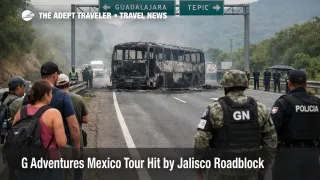
A G Adventures group traveling from Puerto Vallarta, Mexico, toward Guadalajara, Mexico, was forced off its route on February 22, 2026 after their vehicle was stopped on the highway by what the company described as unauthorized individuals. According to G Adventures spokesperson Kimberly Greiner, travelers and staff exited the vehicle, and the vehicle was then set on fire and used as a roadblock. No guests or staff were injured, and the group has been staying on a military base while G Adventures arranges travel home.
This incident matters for travelers because it shows the real failure mode in fast moving security events: you can be far from the original trigger and still get caught at the mobility layer, meaning highways, transfers, and corridor access. Even when airports, hotels, and tourist services appear to be operating, the trip can break when a single road corridor becomes unpredictable.
For travelers monitoring broader conditions in the region, the U.S. government's security messaging during the peak window included shelter guidance for Jalisco locations, including Puerto Vallarta and Guadalajara, which is a strong signal that routine movement, including airport transfers, can become the highest risk activity in the short term.
Who Is Most Exposed on Mexico Tour Corridors
The most exposed travelers are not necessarily the ones inside a resort or inside a terminal. It is travelers who must move on fixed schedules through exposed corridors, especially those doing overland segments between Puerto Vallarta and Guadalajara, or anyone relying on a single departure day with tight timing, limited rebooking options, or prepaid pickups.
Group tours have a specific risk profile here. They often run timed, multi stop days, with a fixed vehicle, a fixed route, and limited ability to improvise when a corridor changes quickly. If your itinerary includes an overland day in Jalisco, the right question is not "is my hotel open," it is "is my corridor stable enough to run the day without last minute reroutes."
Air travelers are also exposed in a very specific way. The airports can remain open and "secure," but access roads and intercity highways can lag behind. A U.S. Mission update on February 24, 2026 noted flights returning to normal in Guadalajara and extra flights planned in Puerto Vallarta, while also stating that some roads in Jalisco, including between Guadalajara and Puerto Vallarta, were not yet fully reopened. That mismatch is exactly how people miss flights even when the departure board looks normal.
For related context on the broader restart phase and transfer planning, see Mexico Embassy Update, Flights Normal, Roads Lag and Jalisco Unrest, Flights Resume to Puerto Vallarta, Guadalajara.
What Travelers Should Do Now
If you are on a tour, or you have a private driver day scheduled, treat route stability as the decision variable. Confirm your operator's routing plan in writing, confirm their ability to change routes on short notice, and ask what their hard stop thresholds are for canceling or rerouting a day. "We will figure it out" is not a plan when the failure mode is a blocked corridor.
If you are already in the region and need to exit, prioritize getting to the airport earlier than normal and reducing same day dependencies. If your flight is from Licenciado Gustavo Díaz Ordaz International Airport (PVR) or Miguel Hidalgo y Costilla Guadalajara International Airport (GDL), your goal is to avoid being forced into last minute routing decisions under pressure. Rebook earlier departures, or add an overnight near the airport, if your current plan depends on a long overland run or a tight arrival window.
Use decision thresholds that are blunt by design. Proceed with overland movement if local authorities, your hotel, and your operator can all confirm a stable corridor, and you can add enough time buffer that you are not punished by a single slowdown. Delay, reroute, or switch to air travel if your route depends on a single highway segment with uncertainty, or if official messaging indicates movement restrictions or elevated risk in your specific area. For many travelers, the safer tradeoff is paying more for a cleaner routing, or an extra hotel night, versus betting an entire itinerary on a corridor that can change within hours.
Over the next 24 to 72 hours, monitor the same three layers: official security alerts for your specific city and state, your airline's schedule reliability, and local ground truth from your hotel or operator about which corridors are reliably open. Watching only flights misses the point, because the access layer is what determines whether you reach the plane.
Why Roadblocks Create a Different Kind of Travel Disruption
This incident sits inside a broader wave of unrest tied to a security operation and subsequent retaliation, including roadblocks and burned vehicles in multiple areas. Reporting from major outlets described vehicle fires and transport disruption during the February 22, 2026 violence in western Mexico, including in Jalisco.
Operationally, roadblocks create asymmetric travel risk. Airports can be intact, staffed, and technically open, and yet the system still fails because passengers, crews, and vehicles cannot move reliably through the perimeter network. That is why "airports are secure" can be true at the same time "your transfer is not predictable" is also true.
For tour operators, this is also a reputational and duty of care problem, not just a logistics problem. In this case, G Adventures said the affected group was the only one impacted, and the company canceled an upcoming trip in the Jalisco region, while other Mexico trips continued to operate. The practical lesson for travelers is to ask how your operator handles escalation, where they can shelter groups safely, how they coordinate with embassies, and what triggers a trip cancellation versus a reroute.
Sources
- G Adventures tour group caught in Mexico cartel violence
- Security Alert - Ongoing Security Operations - U.S. Mission Mexico (February 22, 2026)
- Security Alert Update 7: Widespread (Mexico), Ongoing Security Operations (Feb. 24)
- Mexican army kills leader of powerful Jalisco New Generation Cartel during operation to capture him
- Violence erupts in Mexico after cartel leader "El Mencho" killed in military operation