

Italy Aviation Strike Feb 26, ENAC Protected Flights List
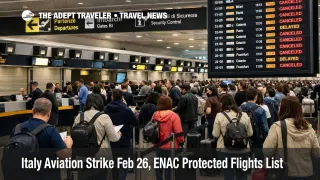
Italy's nationwide air transport strike is now in its day of travel phase on February 26, 2026, and the most decision useful update is that ENAC has published the guaranteed flights documentation for the strike day, alongside the protected operating windows from 700 to 1000 and 1800 to 2100 local time. Those windows do not promise smooth airport processing, but they materially change the odds that a flight operates, and they are the first filter travelers should use before deciding whether to leave the itinerary in place.
At the airline layer, ITA Airways says it has canceled about 55 percent of its scheduled operation for February 26, 2026, and it also cut some flights on February 25 and February 27. ITA is directing passengers to check flight status before heading to the airport, and it outlines rebooking and refund options tied to cancellation, large schedule shifts, and long delays, with an action deadline of March 8, 2026.
Italy Aviation Strike Feb 26, What Changed for Travelers
The practical change today is that you can stop guessing and start classifying. ENAC's strike notice makes clear that, beyond emergency and State type operations, all scheduled departures in the protected bands, 700 to 1000 and 1800 to 2100, must still be operated, and ENAC also lists specific additional flights that are treated as indispensable during the strike.
That classification matters because cancellations and long queues cluster outside those protected bands, while the protected bands tend to attract concentrated passenger volume, rebooked passengers, and stressed ground services. In other words, being "protected" helps the flight's likelihood of operating, but it can also mean heavier terminal congestion in the same time window.
If you are trying to connect through Italy the same day, treat this as a misconnect risk problem, not only a cancellation problem. Even a flight that operates can arrive late into a tight onward connection if baggage handling, turnaround staffing, or gate operations slow down across the day.
Which Itineraries Are Most Exposed Today
The highest risk itineraries are those that rely on domestic Italy feeder legs, short connections, or onward transport that cannot slip. Connections through Leonardo da Vinci Fiumicino International Airport (FCO), Milan Malpensa Airport (MXP), Milan Linate Airport (LIN), and Venice Marco Polo Airport (VCE) are especially exposed because they concentrate flight banks, rebooking demand, and ground handling dependencies in the same places.
If your departure is outside the protected windows, assume a higher probability of a same day cancellation or a forced retime, then ask a more blunt question: can your trip absorb an overnight? If the answer is no, the strike day logic shifts toward proactive rerouting rather than waiting for day of airport decisions.
If you are traveling on separate tickets, the exposure is worse. A delayed or canceled first leg can strand you without protected onward rebooking on the second ticket, even if the second flight itself is unaffected. The itinerary is only as resilient as its weakest, least protected segment.
What Travelers Should Do Now
Start with three checks, in this order. First, check whether your scheduled departure time sits inside ENAC's protected windows. Second, check whether your exact flight number appears in ENAC's guaranteed flights PDF for February 26, 2026. Third, compare that against your airline's own cancellation list or flight status tools, because airlines can still cancel flights that are not required to operate under the minimum service rules.
If you cannot absorb a same day slip, use a reroute threshold that forces action early. A good operational trigger is any itinerary where a delay would leave you with under three hours to make an international connection at Rome Fiumicino or Milan Malpensa, or any itinerary where missing the first leg causes you to miss a cruise embarkation, a timed entry booking, or a non refundable hotel night in another city. In those cases, rebooking earlier usually beats joining the rebooking wave after cancellations post and inventory collapses.
For reroutes, the traveler friendly goal is to reduce dependence on Italy domestic feeders and Italy based same day connections. One workable pattern is to rebook through a nearby hub outside Italy, then enter Italy later, or by a different mode, once the system is recovering. Switzerland, Austria, and France can be useful connection and ground substitution geographies for certain itineraries, but the right choice depends on where you are actually trying to end up, and whether you can complete the last segment by rail or car if flights are limited.
Finally, treat airport arrival time as part of the plan, not an afterthought. Even for flights that operate in protected windows, processing can slow at bag drop, check in, gates, and baggage services. If you must fly, aim to travel carry on only where possible, and build extra buffer for the steps that depend on staffing.
Why the Disruption Can Spill Into February 27
A 24 hour strike disrupts the travel system in layers. The first order effect is obvious, fewer staff or slower throughput across check in, baggage acceptance, ramp services, and gate operations, which can turn routine turnarounds into cascading delays. ENAC's protected windows and guaranteed flight list preserve a minimum level of operations, but they do not preserve normal throughput in terminals.
The second order effect is aircraft and crew positioning. When flights cancel or push late, aircraft end up in the wrong places for the next rotation, and crews can time out or miss legal rest windows. That is why ITA Airways explicitly notes not only strike day cancellations, but also cuts on February 25 and February 27. Even if your ticket is not dated February 26, you can still be impacted by the recovery sequence, particularly on early flights the next morning.
If you are choosing between waiting for day of waivers and moving early, the tradeoff is simple. Waiting can preserve your original fare and routing, but it often costs the itinerary when rebooking demand spikes and the remaining seats get hoarded by automated reaccommodation systems. Moving early can cost more, but it can save the trip if you have hard commitments and low tolerance for an overnight.