

Qatar Cuts Iran Flights, Limited Tehran Service to June 30
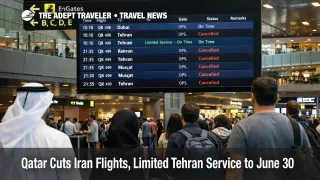
Qatar Airways has extended temporary cancellations for most flights to and from Iran through June 30, 2026, while keeping a single daily Doha to Tehran round trip in the schedule. This update matters because it converts a general disruption into a defined capacity ceiling with specific operating flight numbers and dates, which changes how travelers, and agencies, should manage inventory, connections, and rebooking risk. If an itinerary touches Iran, the practical takeaway is fewer seats, fewer same day alternatives, and a higher chance that a minor disruption turns into an overnight.
The airline's trade advisory shows the limited pattern as QR 498 from Doha to Tehran, and QR 499 from Tehran to Doha, with all other Qatar Airways flights to and from Iran canceled during the period.
Qatar Airways Iran Flight Cancellations, What Changed
The new operational detail is that Qatar Airways is not running its normal Iran schedule through June 30, 2026, it is running a constrained pattern that effectively functions like a single daily bridge between Doha and Tehran. The advisory states QR 498 operates from Doha to Tehran, and QR 499 returns from Tehran to Doha, and it frames everything else as canceled until the end of June.
For travelers, this is less about headlines and more about slack. When a market drops from multiple daily frequencies to one, missed connections and last seat problems show up faster, and they are harder to unwind on the same calendar day. That is especially true when you are relying on banked connections at Hamad International Airport (DOH), because a delayed inbound can push you past the one daily departure that still operates.
Which Itineraries Are Most Exposed
The highest exposure group is travelers holding Doha connections to Iran, or leaving Iran on a tight same day onward itinerary, because the reduced schedule narrows the number of protected reaccommodation options. If your trip is built on separate tickets, for example an Iran segment on one ticket and a long haul segment onward from Doha on another, the risk is not just the cancellation, it is that a disruption can break the whole chain with no automatic protection.
Travelers booking complex routings are also more exposed than nonstop buyers, because any small delay compounds into misconnect risk when there is only one daily flight to fall back on. If you are traveling for a fixed date commitment, such as a wedding, a medical appointment, or a non flexible work start, the tradeoff is clear. Waiting can preserve fare value, but rebooking early preserves itinerary integrity.
What Travelers Should Do Now
If you have ticketed Iran travel during the window that runs through June 30, 2026, verify whether you are on the operating flights, and treat anything else as likely to be canceled until you see it operating in your reservation, and in live status tools. If your plans are flexible, consider shifting travel days to reduce reliance on perfect same day connections, because with one daily option, your "miss by minutes" problem can become "miss by 24 hours."
Set a decision threshold for rebooking versus waiting, and make it operational, not emotional. Rebook now if an overnight misconnect would break the trip purpose, if you are on separate tickets, or if you see limited seat inventory in the cabins you can actually use. Wait only if you can absorb a forced overnight without cascading costs, and you have ticket rules, or waiver terms, that keep you from paying twice for the same trip.
For Doha connections, add buffer. The point is to avoid arriving into the Tehran departure with no recovery time. Build enough margin to survive routine delays, long terminal walks, and processing variability, then reassess again 72 hours before departure, and again at online check in, because the remaining flight can still be disruption sensitive when capacity is this tight.
Why Reduced Iran Service Can Break Gulf Connections
This kind of schedule cut propagates through the system because capacity and timing are coupled. First order, fewer flights means fewer seats, fewer rebooking paths, and higher load factors, so disruptions clear more slowly. Second order, connection banks at Hamad International become less forgiving for Iran bound travelers, because there is less frequency to "catch the next one" if the inbound arrives late, or if processing runs long.
The other mechanism is substitution pressure. When one major carrier reduces frequency, demand shifts to alternative routings, and those routings often involve different hubs, different ticket rules, and sometimes separate ticket structures that reduce passenger protection. If broader regional risk conditions are driving airlines to stay conservative, travelers should assume that schedules can remain fluid, and build plans that survive sudden changes. Related context on how regional airspace risk can force detours, and tighten options, is covered in Lebanon Remains Level 4, BEY Airspace Risk Persists, Use Detours and Beirut Embassy Drawdown Raises Lebanon Travel Risk.