

Middle East Airspace Closures Halt Dubai, Doha Flights
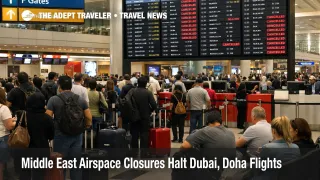
Middle East airspace closures widened on February 28, 2026, after U.S. and Israeli strikes on Iran, and subsequent escalation, pushing airlines to suspend flights and avoid large portions of regional airspace. The immediate traveler consequence is that two major connection hubs, Dubai International Airport (DXB) and Hamad International Airport (DOH), moved into full stop or near full stop conditions, triggering cancellations, diversions, and longer routings across Europe, Asia, and Africa. If your itinerary relies on Dubai or Doha for a same day connection, the risk is not only today's cancellation, it is the knock on disruption that follows aircraft and crew displacement for several days. Reuters reported airspace over multiple countries was largely vacated, with a large share of Israel bound flights canceled, and broader Middle East suspensions rising sharply.
Middle East Airspace Closures: What Changed
Qatar Airways said it temporarily suspended flights to and from Doha due to the closure of Qatari airspace, and warned that delays should be expected when operations resume. Separately, Dubai Airports published a passenger advisory stating that all flight operations at Dubai International (DXB) and Dubai World Central, Al Maktoum International (DWC) are suspended until further notice, and travelers should not go to the airport. Israel's Ben Gurion International Airport (TLV) also moved into a shutdown posture, with flights canceled until further notice and inbound aircraft diverted, according to reporting on the closures.
Airlines outside the region also began pausing service into affected airports, and rerouting around the closure zones. Reuters and other outlets listed major European carriers among those canceling or rerouting, reflecting a safety driven pullback rather than a routine schedule change. If you are tracking your trip in apps and seeing unusual routings, or returns to origin shortly after departure, that is consistent with operators encountering rolling airspace constraints and choosing conservative diversions.
Which Trips Are Most Exposed Right Now
The highest risk group is travelers using Dubai or Doha as an intermediate connection, especially on itineraries with tight onward banks to Europe, South Asia, Southeast Asia, or Africa. When a hub stops, the first order effect is obvious, departures cancel. The second order effect is the one that breaks trips, aircraft are stranded out of position, crews time out, and the rebook inventory collapses quickly, even after partial reopening.
Israel bound and Israel connecting itineraries remain especially disruption prone because airline suspensions tend to be broader, and because diversions can create forced overnights in alternates that were not part of the original plan. Travelers who booked on separate tickets are even more exposed, because a missed long haul connection may not be protected by the second airline, even if the first cancellation was outside your control.
This is also the moment when prior, smaller route suspensions become more relevant. If your trip planning already relied on reduced service into the region, such as KLM Suspends Amsterdam Tel Aviv Flights From March 2026, you now have fewer fallback options when disruptions cascade.
What Travelers Should Do Now
Start by treating same day connectivity as the core problem. If you have a Dubai or Doha connection within the next 72 hours, check whether your operating carrier has issued a waiver, and do not wait until check in to learn that your segment was canceled or rerouted. If your trip purpose cannot tolerate an overnight, a missed cruise embarkation, a wedding, a meeting start, or a non refundable tour, rebooking earlier is usually cheaper than trying to salvage the trip after airport wide stoppages stack passengers into limited seats.
Set a decision threshold before you get emotionally invested in the original itinerary. Rebook now if your routing depends on one connection, or if the new routing adds a second connection or an unplanned overnight. Wait only if you have flexibility to slide by one or more days, and you can absorb hotel and meal costs without turning a disruption into a budget blowout.
When you do accept a reroute, prioritize operational survivability over elegance. A nonstop is ideal, but if it is not available, choose itineraries with longer connection buffers, earlier departures, and fewer interline handoffs. For travelers transiting Israel after reopening, document readiness still matters, so it is worth reviewing Israel Entry Requirements For Tourists In 2026 before you accept a rebook that changes your entry timing, airport, or overnight plan.
Why This Disruption Spreads So Fast
This event is propagating through the aviation system because airspace is the constraint that everything else depends on. When multiple adjacent countries close or restrict airspace, the remaining corridors get congested, flight times increase, fuel plans change, and carriers often choose to cancel rather than operate a brittle schedule. That is why you can see long reroutes even on flights that never intended to land in the impacted countries, because their shortest safe path crossed the closure zone.
Regulators are also explicitly signaling elevated risk. EASA issued a Conflict Zone Information Bulletin for the Middle East and Persian Gulf, initially valid through March 2, 2026, which is a strong indicator that airlines will continue conservative routing and suspension decisions until the risk picture stabilizes. Even after airports reopen, recovery can be slow because fleets and crews will be scattered across alternates, and a day of cancellations can take several days to unwind across global rotations.
Sources
- Airlines suspend Middle East flights after US, Israel strikes on Iran
- Temporary Suspension of Qatar Airways Flights due to Qatari Airspace Closure
- Passenger Advisory
- EASA issues CZIB for Middle East and Persian Gulf
- Airspace of the Middle East and Persian Gulf, CZIB 2026-03
- Attack on Iran disrupts flights across the Middle East and beyond