

Delta JFK Tel Aviv Flights Suspended Through March 3
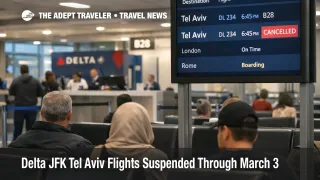
Delta has extended its pause of service between John F. Kennedy International Airport (JFK) and Ben Gurion International Airport (TLV) as the regional conflict escalates, pushing more airlines to suspend Middle East flying. The key update is timing, Delta's earlier "through March 1" pause has moved out, with JFK to Tel Aviv cancellations now through March 2, 2026, and TLV to JFK cancellations through March 3, 2026. If you are ticketed in this window, expect schedule changes to hit in stages as cancellations flow through reservations systems, and plan for limited same day reaccommodation because other carriers are also pulling capacity.
This is not an isolated route issue, it is part of a broader airspace and network reliability event that is breaking connecting itineraries and shrinking fallback options. If your trip relied on a tight connection into TLV, or a same day onward plan such as a tour start, a family event, or a cruise or package check in, the safe assumption is that recovery will be uneven for several days, even if some flights restart.
Delta JFK Tel Aviv Suspension: What Changed
Delta has canceled flights from JFK to Tel Aviv (TLV) through March 2, 2026, and from TLV back to JFK through March 3, 2026, citing the ongoing conflict in the region. Delta also posted a waiver covering travel to, from, or through Tel Aviv for trips booked for February 28 through March 5, 2026, with a reissue deadline of March 12, 2026. In practice, that waiver matters because it can let you move dates without absorbing the highest last seat pricing, but it does not create new seats, and it does not prevent long reaccommodation queues when multiple carriers are cutting schedules at the same time.
Delta says impacted travelers will receive notifications via the airline's app and the contact information in their reservation as cancellations are processed. That sequencing is important, because many travelers see the news first, but do not see their booking update for hours. If you are within 24 to 48 hours of departure, treat "pending" as risk, and actively check your flight status rather than waiting for the alert to land.
Which Travelers Are Most Exposed to Disruption
The highest exposure group is anyone scheduled on the nonstop JFK to TLV route in the cancellation window, plus travelers connecting onto Delta itineraries where TLV is the final leg. If your itinerary ends in TLV, the main failure mode is not just the canceled flight, it is the cascade into later departures that were supposed to carry a normal mix of local passengers and connections. Once the first wave of cancellations lands, the remaining flights become the scarce resource, and that is when reaccommodation shifts from "later today" to "tomorrow or later."
Travelers on separate tickets are the most financially exposed. If you booked JFK to Europe on one ticket, then Europe to TLV on another, your first carrier may still fly while your second carrier cancels, and those two systems will not automatically protect each other. In a fast moving security driven disruption, separate ticket plans tend to fail at the handoff, and the replacement can be expensive and slow.
Finally, travelers using Middle East hubs as a backup routing should assume those paths are fragile right now. The same conflict has driven wider operational disruptions and airspace constraints, which is why even "creative" reroutes can collapse unexpectedly. If you are considering a reroute via Gulf hubs, the context in Middle East Airspace Closures Halt Dubai, Doha Flights is the right baseline for how quickly hub reliability can degrade under airspace restrictions.
What Travelers Should Do Now
Start with a simple triage decision, do you need to be in Tel Aviv on a specific date, or is the trip flexible. If you have a hard arrival deadline, use the waiver, and push for a rebook that preserves slack, meaning earlier departures, longer connection buffers, and fewer connections, even if it looks less elegant than your original itinerary. A "legal" connection is not the same thing as a survivable connection during irregular operations.
If you are flexible, waiting can be rational, but set a decision threshold before you wait. For example, decide that if you do not have a confirmed rebook by a specific time on March 1, 2026, you will switch to a later travel date, reroute through a different gateway, or take a refund and rebuild the itinerary. The point is to avoid drifting into day of departure chaos where the remaining seats are both scarce and expensive.
If you are rerouted through a country you did not plan to transit, treat documents and screening as part of the itinerary, not an afterthought. Entry and transit rules can change your required buffer time materially, especially when you are rebooked onto new airports, new connection points, or an overnight. For travelers who still intend to travel once service resumes, Israel Entry Requirements For Tourists In 2026 is the right preflight checklist to revisit before you accept a new routing.
Why This Disruption Spreads Beyond One Route
Security driven flight suspensions rarely behave like routine maintenance cancellations. Airlines and regulators respond conservatively because the risk is not just at the destination airport, it is in the corridors aircraft must fly to get there. When multiple carriers pull back at once, the immediate effect is obvious, fewer flights. The second order effect is that the whole network becomes harder to stabilize, aircraft and crews end up out of position, passenger loads stack into fewer departures, and customer service channels get saturated.
This is also why "through March 1" messaging often turns into longer pauses. Airlines extend in short increments because conditions evolve quickly, and because they need to balance safety posture with the operational reality of restarting a long haul route that depends on aircraft availability, crew legality, and functioning alternates. In this cycle, what matters for travelers is not predicting the exact restart date, it is building a plan that still works if the pause extends again.
If you are tracking other Israel routes for alternatives, it is worth recognizing that capacity into TLV has already been tightening from multiple directions. KLM's separate suspension of Amsterdam service beginning March 1, 2026, removed another common one stop pathway for North America and Europe based travelers, which limits the number of clean reroutes available when disruptions stack. The broader point is that this is a market wide capacity squeeze, not just one airline's schedule choice, and that is why earlier rebooking decisions usually produce better outcomes than last minute triage.