

Italy General Strike March 9 Could Disrupt City Services
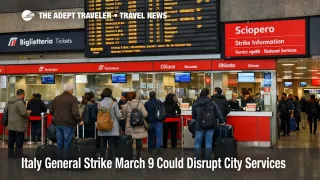
Italy has a nationwide general strike call for Monday, March 9, 2026, and it adds another operational uncertainty day after early March disruption risks already on the calendar. The traveler headline is not that every train and flight will stop, it is that city movement, staffing dependent services, and last mile timing can get less reliable, especially in big cities where even small staffing shortfalls create queues and cascading delays. This matters most if you have a same day move, a tight airport transfer, a cruise or ferry embarkation window, or timed entry plans that do not tolerate late arrivals.
This is new versus the last 48 hours set because it introduces a second, nationwide disruption date in the same week as other Italy movement risks, which raises the chance that travelers end up stacking buffers, paying for last minute substitutes, or adding an extra night to protect onward plans.
Which Trips Are Most Exposed on March 9
The biggest exposure is travelers who must move on March 9, 2026, and depend on predictable, staffed systems: local public transport, airport and rail station services, hotel front desks at peak check in times, and tour operations that need drivers and guides to show up on schedule. Even when core transport continues running, bottlenecks often shift to the edges, for example, longer taxi queues, fewer available private transfers, or slower baggage and customer service processes.
It is also important to separate the strike call from transport sector participation. Italy's Ministry of Infrastructure and Transport strike listing shows multiple general strike proclamations for March 9, 2026, and in that list USB, USI 1912, and CLAP explicitly exclude the entire transport sector, while Slai Cobas describes the strike as covering all sectors. That split is why March 9 can still be a real planning risk for travelers, but the transport impact can vary by city, operator, and staffing reality on the day.
How To Plan Around March 9 Without Overreacting
For travelers with any same day connection on March 9, the practical move is to de risk the last mile. Build buffer into transfers between hotels and stations, stations and airports, and airports and onward ground transport, because delays that start as "a bit slower" can become missed windows once queues form. If you have timed entry tickets, tours with fixed start times, or an embarkation cutoff, aim to arrive earlier than normal, and treat mid morning and late afternoon as higher risk for crowding and slowdowns.
If you are choosing between traveling on March 9 versus shifting by one day, the decision threshold is simple. Shift when the itinerary has a hard penalty for being late, for example, a flight on a separate ticket, a cruise departure, a pre booked non refundable tour, or a long distance rail segment where missing the departure breaks the day. If your plans are flexible and local, you can often ride it out by starting earlier and keeping alternative modes ready, taxi, private transfer, or walking routes in dense city centers.
Monitor for operator specific guidance in the 24 to 72 hours before March 9, because the day of experience is usually shaped by local participation and the real staffing picture, not the headline alone. If transport workers do participate in your city, Italy's essential services framework typically preserves minimum service windows in key commuter periods, but service outside those windows is where the unpredictability tends to concentrate.
Why This Strike Can Still Affect Travel Even If Some Transport Is Excluded
General strikes create travel friction through second order effects. The first order effect is staff not reporting in across a mix of public and private workplaces, which can reduce capacity at the exact points travelers touch, ticketing, information desks, station services, hotel operations, and local mobility. The second order effect is substitution pressure, travelers switching to taxis, rides, or private drivers at the same time, which increases prices, increases wait times, and slows road movement around stations and airports.
Reporting in Italy also frames March 9 as a broad, cross sector strike call that can go beyond transport and reach public services, logistics, and urban mobility, which is the part travelers should take seriously. Separately, the Ministry strike listing is the best reality check for whether the transport sector is formally in or out for specific proclamations, and for March 9 it shows a mixed picture across organizers. The result is a day where a traveler can be "technically moving" while still losing time in the seams of the journey.