

Naples March 6 EAV Strike Disrupts Pompeii Trains
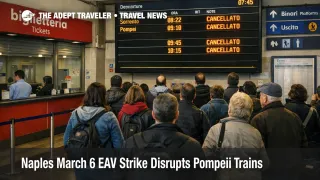
Naples, Italy, day trips to Pompeii, Herculaneum, and Sorrento face a high disruption risk on March 6, 2026, because Campania operator EAV has published a 24 hour strike notice covering Vesuviana rail services. The practical traveler problem is not just fewer trains, it is losing the specific departure that makes a timed entry slot, a ferry, or a cruise all line up. EAV says service during the strike is contingent on how many staff participate, with only two guaranteed windows posted.
The biggest exposure is the classic Naples base itinerary, sleep in the city, take Circumvesuviana style trains out to Pompeii and back, then continue to Sorrento or connect to the coast. If you are holding non refundable timed tickets, a tour start, or a port check in window on March 6, treat the rail leg as conditional and build a different way to reach the site, or move the visit to another day.
Naples March 6 EAV Strike, What Changed
EAV's published notice calls a 24 hour company strike on March 6, 2026, affecting only Vesuviana rail services. EAV also posts the two guaranteed service bands as 530 a.m. to 830 a.m. and 430 p.m. to 730 p.m., and it lists "last guaranteed" departures inside those windows, including morning departures from Naples toward Sorrento at 822 a.m., and afternoon departures from Naples toward Sorrento at 729 p.m.
That schedule detail matters more than the headline. It tells you the day will likely split into three operational phases: an early window where you may be able to get out to the ruins, a mid day gap where service can collapse unpredictably, and a late window where you may be able to get back. If your plan requires a mid day move, or requires a late morning return to make an afternoon flight or ferry, you are taking the highest risk slice of the day.
Which Travelers Are Most Likely To Get Stuck
Pompeii and Herculaneum visitors are the most exposed because the "simple" plan is to ride the Naples Sorrento commuter line and walk straight to the archaeological entrance from the dedicated stops. When that rail spine thins, crowds concentrate fast, platforms jam, and the day becomes a race between whatever departures actually run and your timed entry slot.
Sorrento and peninsula day trippers have a second layer of risk. Even if you reach Sorrento, the rest of the itinerary often depends on onward connections, ferry departures, private tours, or dinner reservations that assume you can return to Naples on schedule. When returns bunch into the late guaranteed window, seats and taxis become the choke point, not the track.
There is also some indication of additional, shorter strike action affecting EAV services during the same day, which increases uncertainty for travelers trying to "thread the needle" with perfect timing. The safest interpretation is that March 6 is a bad day to depend on EAV rail as the single point of failure for a paid schedule.
How To Plan Around the Disruption
If your trip can flex, the cleanest fix is to move Pompeii, Herculaneum, or Sorrento to March 5 or March 7, and keep March 6 for museums, neighborhoods, or anything you can do on foot in Naples. If you cannot move the day, then plan around the guaranteed windows, and make your "go or no go" decision based on what you must protect, not on optimism.
For Pompeii, an alternate is using Italy's national rail to the town station labeled Pompei, then finishing the last mile by taxi or local transport, rather than relying on the dedicated ruins stop on the commuter line. This is slower and less direct for the archaeological entrance, but it removes single point dependence on the Vesuviana line. Build extra time for the last mile and for queues because everyone else will be doing substitutions at once.
For Sorrento, consider switching to sea transport if conditions and schedules work for your day. For example, NLG publishes Naples Beverello to Sorrento sailings during the winter period through March 31, 2026, including a 7:20 a.m. daily departure, which can bypass road congestion and rail uncertainty. If you choose a ferry or hydrofoil backup, protect it with earlier arrival at the port and a plan for what you will do if the sea option sells out.
Over the next 24 to 72 hours, monitor EAV for any revisions to the strike notice, and for day of service updates. In practice, the decision point is the evening before. If your itinerary depends on a specific departure outside the guaranteed windows, treat that as the trigger to convert the day into a guided coach tour, a private driver, or a different destination, because that is when substitutions are still available.
Why Local Rail Strikes Break Timed Tickets
A local rail strike breaks tourist days through elasticity and concentration. First order effects are obvious, fewer departures, and departures that operate only if enough staff report. Second order effects are what actually costs travelers money: displaced riders concentrate onto the limited trains that do run, station circulation slows, taxi queues lengthen, and road corridors clog as people shift modes at the same time.
EAV's own notice highlights the mechanism by posting only two guaranteed bands and stating that service outside them depends on strike participation. That is why the correct planning posture is not "watch for delays," it is "assume the mid day spine is unreliable," and then design a day that still works if your chosen train never appears.