

Rome ATC Strike Risk March 7, Status Now Unclear
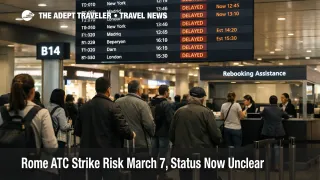
Rome ATC strike risk for Saturday, March 7, 2026 is being treated as a real delay threat in several Italian strike calendars, but the official Italian transport strike portal is not currently listing an ENAV ACC Rome action on that date. For travelers, that means the best move on March 1 is not blind panic rebooking, it is tightening decision thresholds and verifying status before you commit to tight same day connections through Leonardo da Vinci Rome Fiumicino Airport (FCO).
If a Rome area control center action does go forward, the most common risk pattern is not a dramatic shutdown, it is capacity loss. Airborne holding, departure flow constraints, and rolling delays can break minimum connection times even when flights still operate, and long haul banks are usually the most punishing place to be late because the next "good" option may not exist until the following day.
Rome ATC Strike Risk: What Changed for Travelers
The new development is the status conflict. Several outlets still describe a Saturday, March 7, 2026 action tied to ENAV's Rome area control function, often framed as a 1000 a.m. to 600 p.m. local time window. But Italy's official strike portal currently lists ENAV ACC Rome actions on April 10, 2026, and May 11, 2026, and does not show ENAV ACC Rome on March 7.
That difference matters because it changes the planning posture. When an action is fully reflected in the official portal and carrier advisories, travelers can treat it as a high confidence disruption day. When the official portal does not match secondary calendars, the correct traveler behavior is conditional planning, build buffers, avoid fragile connections, and wait for airline waiver signals before paying change fees.
Which Itineraries Are Most Exposed Through Rome
If March 7 disruption materializes, the most exposed itineraries are tight connections through Fiumicino, especially short haul feeds into long haul departures, and separate ticket trips where a missed first leg can strand you without protected onward rebooking. Even a moderate flow delay can break a planned connection because the delay is often front loaded into approach holds and departure metering, which means the schedule can look "mostly operating" while connection reliability collapses.
Travelers with hard downstream clocks should treat March 7 as higher risk even while status is uncertain. Cruise embarkations, timed tours, wedding check ins, and any paid commitment that cannot slide are the trips that lose the most value from a two hour delay. For those trips, the right question is not "will they cancel my flight," it is "does a delay break the itinerary."
What Travelers Should Do Now
Start with a simple risk classification. If your routing uses Rome as a hub on March 7, avoid minimum connections, and rebuild the itinerary so a single delay does not force an overnight. If the trip is important, the highest control move is converting the connection into a buffer by arriving in Rome on Friday, March 6, 2026, and treating March 7 as the operating day, not the positioning day.
Set a blunt decision threshold today. If your trip fails if you arrive more than two hours late, or if your connection time is tight enough that a delay breaks the onward leg, plan a reroute option now so you are not inventing one inside a rebooking line. If your trip is flexible, waiting can be rational, but only if you commit to checking again within 72 hours of departure for waiver eligibility and schedule changes.
Use ENAC's protected flight windows as a planning filter, not a promise. Italy's aviation regulator notes protected bands during strikes from 700 a.m. to 1000 a.m., and from 600 p.m. to 900 p.m., local time. Those windows can improve the odds that flights operate under some strike types, but they do not eliminate ATC flow constraints, and they do not guarantee on time connections.
Why Rome ATC Constraints Break Connections Even When Flights Operate
A Rome airspace constraint often expresses as throughput loss rather than total closure. When capacity drops in a control center environment, the system meters departures into the constrained airspace and holds arrivals, which creates a rolling queue that can persist beyond the nominal strike window. First order effects are late departures and airborne holding. Second order effects are missed connections, mispositioned aircraft, and crew duty and rest legality constraints that can ripple into the next day schedule.
The practical traveler takeaway is that the risk is nonlinear. A one hour delay is not just "late," it can be the difference between making the long haul bank or being forced into an overnight with limited inventory. That is why March 7 remains worth flagging for Rome connections even while confirmation is unsettled, because the downside is high for travelers who planned the day as a single tight chain.
Sources
- Scioperi (Ministero delle Infrastrutture e dei Trasporti)
- Voli garantiti in caso di sciopero (ENAC)
- Prestazioni minime garantite (ENAC)
- Tutti gli scioperi di marzo. Dall'Enav, all'agitazione generale del 7 (TravelQuotidiano)
- Scioperi nel traporto aereo, Salvini minaccia la precettazione (Corriere della Sera)
- Scioperi trasporti marzo 2026, calendario completo (Quality Travel)