

Malta Sicily Fast Ferry Cancellations in Force 8 Seas
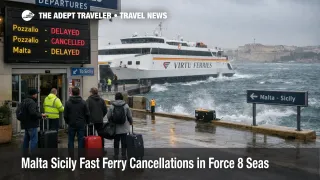
Malta Sicily fast ferry cancellations are an immediate planning risk when Force 8 seas hit the Central Mediterranean, because the Valletta, Malta to Pozzallo, Italy crossing can be amended or pulled with little notice once wind and sea state exceed safe operating limits. Early March sailings are scheduled across Monday, March 2, 2026, but travelers should treat the timetable as conditional and plan for same day changes or outright cancellations when gale conditions develop. This matters most for itineraries chaining the fast ferry to flights out of Malta International Airport (MLA) or to time sensitive rail and car plans in Sicily.
Malta Sicily Fast Ferry Cancellations: What Changed
Operator practice in recent gale windows has been to revise departure times, cancel late day sailings, and shift capacity into a smaller set of operating windows when seas allow safe docking and passenger handling. Virtu Ferries publishes date specific updates when sea conditions force changes, including outright cancellations and amended departure times, and those notices can appear close to departure as forecasts firm up. Recent examples include cancellations and amended sailings during late February gale conditions, which is the operational template travelers should assume again when Force 8 conditions return.
For Monday, March 2, 2026, Virtu's published schedule shows multiple Malta to Pozzallo and Pozzallo to Malta departures across the day, including early morning, mid afternoon, early evening, and late evening options. The problem is not whether a sailing exists on paper, it is whether sea state allows consistent berthing and safe turnaround at both ends. When gale warnings are active, the practical risk is that the sailing you built your entire day around is the one that disappears, and the remaining departures compress demand into fewer seats and vehicle slots.
Which Travelers Face the Most Disruption
Travelers tying the fast ferry to a same day flight are the highest risk group, especially anyone planning to arrive in Malta and then depart Malta International the same day, or anyone planning to land in Malta and immediately cross to Sicily without an overnight buffer. When the ferry slips by even a few hours, the airport transfer becomes fragile, and when a sailing is cancelled, the whole chain breaks.
On the Sicily side, the most exposed itineraries are the ones that assume a fixed arrival time in Pozzallo for onward rail, timed car pickup, or a long drive plan that depends on daylight. If a morning sailing is pushed later, you often lose the ability to recover the day by switching to a different departure, because the alternate is also filling with displaced passengers.
There is also a quiet capacity trap here. When multiple sailings cancel, the next operating departure can become a capacity problem rather than a timing inconvenience, and that can force an overnight in Valletta area hotels or in the Pozzallo corridor even for travelers who are willing to travel at odd hours. That second order ripple shows up fast in hotel availability, and in rental car and private transfer rebooking friction.
What Travelers Should Do Now
Start by breaking the habit of same day ferry to airport planning. If your trip involves Malta International Airport, treat the ferry as a separate travel day during Force 8 conditions, and shift to an overnight on Malta's main island before your flight, or an overnight in Sicily before any time sensitive onward plan. That single decision removes the most expensive failure mode, which is missing an international departure and paying last minute fares plus forced hotels.
Set a hard decision threshold for rebooking versus waiting. If you have a non flexible flight, a cruise embarkation, or a timed rail itinerary, do not wait at the terminal hoping the sea calms. Move early to a protected plan, either by shifting your flight date, switching your routing to a flight between Malta and Sicily, or booking the overnight that preserves your next day departure window. Waiting is only rational when you can absorb a one day slip without losing money on separate tickets and non refundable reservations.
Monitor the right signals for restart timing. Your best short cycle indicators are the operator's own "latest voyage updates" and the live schedule page, because they reflect the operational call on whether the vessel can safely dock and run the turnarounds. Broader weather headlines matter less than the specific wind strength and sea state that drive go or no go decisions. Malta's Met Office and local authorities have repeatedly issued gale warnings reaching Force 8 in recent events, and those are the conditions that typically degrade ferry reliability first.
If you need a practical baseline, reuse the playbook from prior Malta disruptions rather than improvising. The two safest rules are to protect fixed commitments with an overnight buffer, and to avoid building an itinerary that requires the ferry to run on time late in the day. For additional context on how fast ferry cancellations ripple into missed flights and forced overnights, see Malta Sicily Fast Ferry Cuts Virtu Schedule Jan 29 and Storm Harry Malta Ferries Disrupted January 19.
Why Force 8 Seas Break Fast Ferry Plans
Force 8 on the Beaufort scale is gale force wind, and in the Central Mediterranean that usually translates into rough to very rough seas, strong crosswinds at harbor approaches, and degraded docking margins. High speed catamarans can be fast, but they are not immune to the operational limits that matter most for travelers: safe boarding, safe docking, and predictable turnarounds. A vessel might be physically capable of moving, yet still unable to berth safely or keep passengers moving through terminal infrastructure without unacceptable risk.
That is why the disruption pattern often looks like this. First order, departures are cancelled or shifted, and late day sailings are the first to go because they remove the recovery margin. Second order, stranded travelers compress into the next operating window, which fills vehicle slots and pushes foot passengers into standby queues. Third order, the disruption spreads beyond the port, because hotels near Valletta and the Pozzallo corridor take the overflow, and airport and rail plans downstream become harder to protect once a one hour slip turns into an overnight.
In practical terms, a Force 8 day turns a fast ferry into a conditional service. Travelers who treat it like a commuter train, and chain it to flights and timed commitments, are the ones who get stranded. Travelers who separate the ferry day from the flight day, and who monitor voyage updates early enough to pivot, usually keep the itinerary intact.